There’s a Five Guys less than five minutes from our house. We have never once gone.
It isn’t because the burgers are bad. My husband is Argentine and a major beef eater, and in the five years since we moved from Argentina to the U.S., we’ve eaten a lot of hamburgers together. We’d be exactly the kind of regulars a burger place wants. But both of us eat gluten-free for health reasons, and Five Guys offers a lettuce wrap instead of a bun. For us, that’s just not the same experience. So when we’re deciding where to eat, Five Guys never even makes it into our consideration set.
Think about what that means for anyone writing Five Guys’ marketing. They could have the best burger messaging in the category, and it would never get the chance to work on us. We ruled them out before any of it was heard, based on one question: is there a real gluten-free bun?
And that’s worth being precise about, because there are two very different reasons a brand fails a question like that. Sometimes a brand already meets the customer’s requirement but never communicates it, so the customer assumes the answer is no. Better messaging can fix that. Other times, the brand doesn’t meet the requirement at all. That’s Five Guys for us. No headline can create a bun that isn’t on the menu. Getting into our consideration set would take a product or experience change, not a messaging change.
Marketers invest so much time developing and optimizing their messages, but some of their ideal customers rule the brand out before those messages have a chance to influence the decision. Sometimes the brand hasn’t answered a customer’s filter question. Other times, it can’t yet meet the requirement. Either way, the strongest selling point won’t matter if the brand never gets considered.
Listen on Apple Podcasts | Spotify | Read the full transcript
What Is a Consideration Set?
A consideration set is the shortlist of brands a customer seriously considers when making a purchase decision. Knowing a brand exists doesn’t automatically put it on that list.
Brands outside the set aren’t being actively compared or weighed at that point, no matter how good their product or pitch may be. But consideration sets can change: customers may add brands as they research, reconsider their requirements or discover a new reason to take another look.
The idea has been part of consumer research for decades. An early study of how people screen options before deciding is a 1977 Stanford working paper by Peter Wright and Fredrick Barbour. You’ll also hear it called the evoked set.
You’ll also see the related term brand consideration, which usually refers to the metric: the share of people in a category who say they’d consider your brand for their next purchase. The consideration set is the customer’s side of the same thing. It’s the list in their head, or in their search results, where your brand either shows up or doesn’t.
Why does it matter so much? In its research on the consumer decision journey, McKinsey found that brands in a customer’s initial consideration set “can be up to three times more likely to be purchased eventually than brands that aren’t in it.” The same research is clear that brands can still get added later, while customers are actively evaluating, so being left off the first list isn’t the end of the story. Customers can also come back to a brand they once ruled out, if something gives them a reason to look again. But it’s a much harder place to win from.
Getting Considered and Getting Chosen Are Two Different Jobs
Here’s what doesn’t change for my husband and me when we pick a burger place. Taste still matters. Ingredients still matter. Toppings still matter. But none of it gets evaluated, none of it even enters the conversation, until one question gets answered first: will this work for someone like me? Or in our case, people like us.
For us, “works for people like us” means two things. First, gluten-free buns, preferably ones that aren’t dry and don’t crumble when you bite into them. Second, gluten-free fries cooked in a separate fryer from things like chicken nuggets. French fries are part of the experience of eating a hamburger, and we don’t want to get sick from our burgers and fries.
So put yourself in the marketer’s seat. If you were creating the messaging for a new burger joint, what’s the message our family needs to hear if you want a shot at our business? Is it grass-fed beef? That’s a really good claim. Is it the size of the burger? The twelve different topping combinations?
For us, none of that matters until we hear the message that lets the restaurant into our consideration set: is this a place for gluten-free people? Grass-fed beef doesn’t stand a chance against a bun we can’t eat.
That’s the distinction I want every marketer to sit with. What gets you into the consideration set is a completely different job than what gets you chosen once you’re in it. Most messaging is built for the second job. That work matters, but it can only pay off with customers who are already considering you.
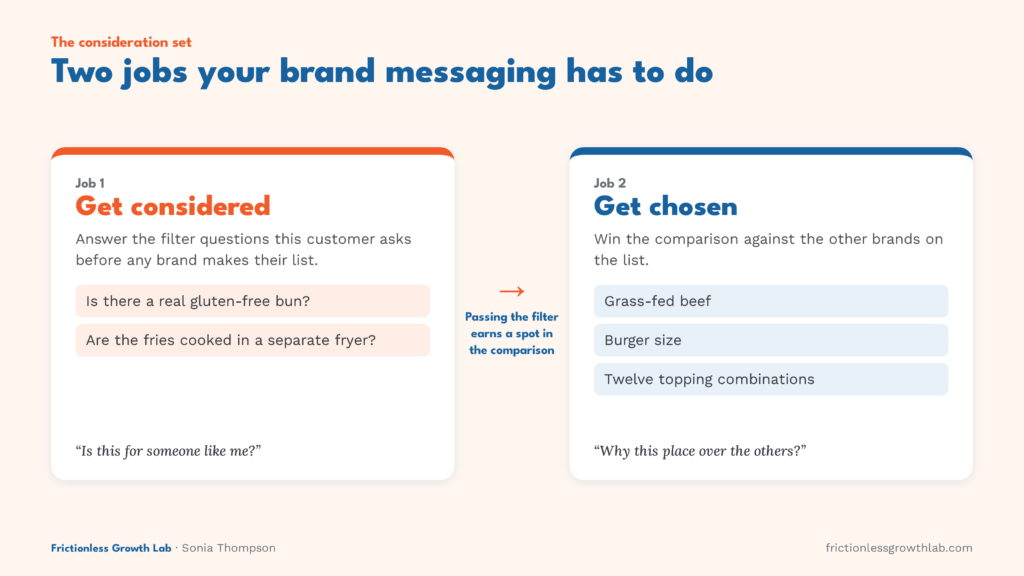
I call the questions behind that first job filter questions. They’re rarely about your category’s usual selling points. They come from who the customer is and what they’re deciding, which is why one brand can be an easy yes for one ideal customer and never even be considered by another.
How One Change Can Take You Out of the Consideration Set
Filter questions don’t just keep new customers out. They can also move existing customers out, sometimes without the brand ever knowing.
There’s another restaurant in the same shopping center as that Five Guys, closer to us than almost anywhere else we eat. We used to go there all the time. Then they changed their fry recipe and added flour to make the fries crispier. That one ingredient change, and it was no longer a place for people like us, so we stopped being customers. (I wrote about that moment, and what it says about policies that customers depend on, in my article on brand values.)
From the restaurant’s side, it was a small product improvement. From our side, it answered the question “Is this for someone like me?” with a no.
Compare that with Red Robin, which has become our go-to. They have gluten-free buns that don’t taste like they’re gluten-free. At the Red Robin we frequent, the fries are cooked in a separate fryer, which is one reason we feel comfortable choosing that location. And just in case you’re wondering, the burgers are really good too. But the burgers were never what got them on our list.
Notice where the answer to a filter question often lives: in operations. A bun, a fryer, a recipe or a policy can say “yes, this is for you” or “no, it isn’t” more loudly than any campaign. That’s why consideration is a customer experience delivery issue as much as a messaging issue.
When One Customer’s Non-Negotiable Decides Where the Whole Group Spends
There’s one more part of the Red Robin story that marketers can easily miss: one customer’s non-negotiable can determine where an entire group spends its money.
When we go out to eat with other family members, we often go to Red Robin, because it’s a restaurant our loved ones know works for us. Most of them aren’t gluten-free. But our gluten-free needs become the lead message for the entire group.
So Red Robin wins the whole table, not just the two of us. And every restaurant that can’t answer our filter question loses everyone we’re eating with, along with us, and never finds out. (I saw the same thing on a bigger scale when fifteen of us were deciding where to eat on a trip, and the gluten-free search decided where all fifteen went.)
A lot of purchase decisions work this way. The person whose needs are hardest to meet often decides for everyone else: a family choosing a vacation, a team choosing a venue, a household choosing a pediatrician or a grocery store. If your messaging only speaks to the majority of the group, you may be invisible to the one person who’s actually deciding.
Why Even Rigorous Messaging Processes Miss Filter Questions
You might be thinking, “Sure, that’s restaurants. Our messaging process is much more disciplined than that.” So let me tell you about the most disciplined messaging process I’ve ever been part of.
Years ago, when I worked in corporate, I led message development for one of our new product launches, an insulin pump for people with diabetes. That meant digging through every study behind the product. Every claim we wanted to make had to be backed by clinical evidence and reviewed by medical, legal and regulatory before a single word made it into the market.
It was tedious, and I loved every minute of it, because nothing went out the door without the proof behind it. We considered every angle of that product. I was incredibly proud of the messages we got approved, and seeing them in action in the markets where we launched was a shining moment for me.
But looking back now with a new lens, the only time identity ever entered the process, the only time we built messages differently based on who the patient was, was for pediatric patients. And that only happened because the FDA required a separate indication, separate studies and separate data to serve that audience.
Any other identity difference in our customer base never entered the conversation, because our process was never built to ask the question. That doesn’t mean those differences didn’t exist. Different patients still had points that were more relevant to their decision making. Our process just never went looking for them.
We had a very rigorous system for proving our claims. We didn’t have a system for asking who else needed a different claim in the first place.
That’s the pattern I see across industries, regulated or not. Plenty of brands have a process for proving their claims. Far fewer have one for finding out what has to be true for different customers before those claims get heard.
Why Your Buyer Personas Don’t Show You the Filter Questions
Marketing 101 says: right message, right customer, right place, right time. Most brands think they’ve nailed the “right customer” part, and they’ve got a whole persona deck to prove it.
My perspective is that most brands haven’t gone deep enough on the right customer, and that limits their ability to send the right message at the right place and the right time. A persona built at the surface tells you who someone is, but not how they decide. And if you don’t know how someone decides, you can’t know what actually moves them, or what has to be true before they’ll even consider you.
That’s why the consideration problem so often gets misdiagnosed as a copy problem. A team sees that a message isn’t landing with a group it wants to reach, so it rewrites the headline, tests new creative or adds a few more benefits. But that’s not a copywriting gap. Copy can only work with what it’s given. It’s a customer understanding gap, and it’s usually one level deeper than most brands have ever gone with their personas.
Here’s what going one level deeper means in practice. Think about what has to be true for this specific person, with this specific identity, making this specific kind of decision, before your brand is even allowed to compete. For my family, identity (eating gluten-free) and the kind of decision (a meal out, often with a group) produce two very specific filter questions. A parent choosing a pediatric clinic, a wheelchair user booking a hotel or a small business owner comparing software will have their own, and none of them will show up in a demographic profile or a job title.
Different customers have different consideration needs, and that’s true for more of your customers than you might expect. That’s the heart of what I call Mosaic Marketing: recognizing that your ideal customers aren’t one blended group, and that the differences between them change what they need to hear, know and see before they’ll choose you. There aren’t enough brands proactively working to remove that friction so the door to consideration opens for a broader base of their ideal customers. The ones that do give themselves a much bigger pool of people who might choose them.
If you suspect your personas stop at “who,” I did a four-part series on fixing that, starting with Episode 209 and running through Episode 212.
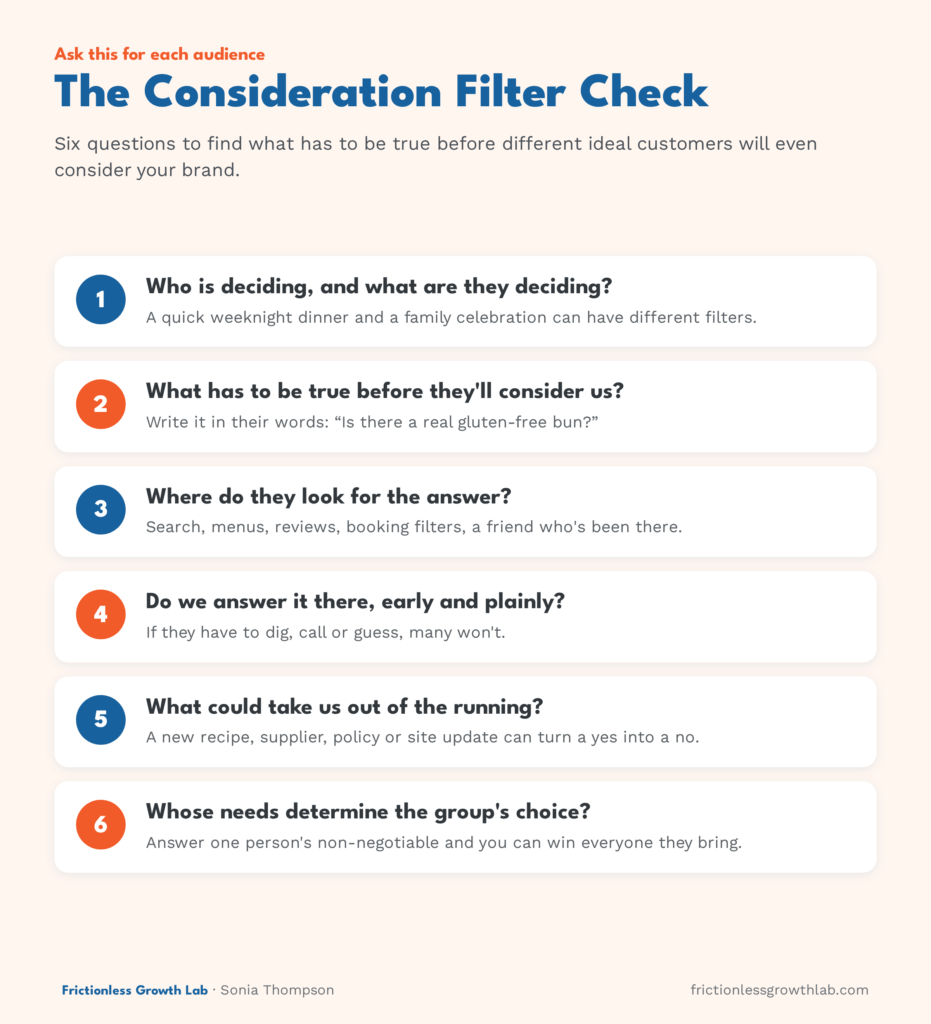
The Consideration Filter Check: 6 Questions to Ask for Each Audience
So if you’re thinking about your own messaging right now, here’s what I’d ask you to get honest about: do you actually know the filter questions for your different audiences? Not their demographics or their job titles, but the specific, sometimes invisible criteria that decide whether you’re even in the running before your best message gets heard.
Work through these questions for each group of ideal customers you want to win, ideally with real customer input rather than internal assumptions.
- Who is deciding, and what are they deciding? The same person can have different filters for a quick weeknight dinner and a family celebration.
- What has to be true before they’ll consider us? Write it the way they’d say it (“Is there a real gluten-free bun?”), not the way your product team would.
- Where do they look for the answer? A search phrase, a menu, reviews, a filter on a booking site, a friend who’s been there.
- Do we answer it there, early and plainly? If customers have to dig, call or guess, many won’t.
- What change on our side could take us out of the running? A new recipe, supplier, policy or website update can turn a yes into a no.
- Whose needs determine the group’s choice? When one person’s non-negotiable decides for a family, team or household, meeting their requirement and making it clear can help you win the whole group.
If the honest answer to most of these is “I’m not sure,” that’s useful information. It means your personas can tell you who someone is, but not yet how they decide. The fix is to make them more complete, so you can build better strategy and more effective execution in every other part of your marketing mix.
FAQ: Consideration Set Questions Marketers Ask
What’s the difference between a consideration set and an evoked set?
They describe the same idea and are often used interchangeably. Both refer to the short list of brands a customer actively evaluates when making a purchase decision, drawn from the larger group of brands they’re aware of. “Evoked set” is older consumer behavior language. “Consideration set” is the term most marketers use today, and “initial consideration set” refers specifically to the brands a customer has in mind at the moment they start shopping.
What is brand consideration?
Brand consideration usually refers to a measurement: the percentage of people in your category who say they would consider buying from your brand. It sits between awareness and purchase intent. It’s a useful number, but on its own it won’t tell you why some groups never consider you. For that, you need to know the filter questions each group is asking and whether your brand answers them where they look.
How do you get into a customer’s consideration set?
Start by learning what has to be true for each group of ideal customers before they’ll consider a brand like yours, in their own words. Then answer those questions early and plainly in the places they check, such as search results, menus, product pages, reviews and booking filters. Finally, protect those answers operationally, because a recipe, policy or product change can remove you from the set without any change to your marketing.
Can a brand still win if it isn’t in the initial consideration set?
Yes. McKinsey’s consumer decision journey research found that customers often add brands while they’re actively evaluating options, so being left off the first list isn’t final. Customers can also reconsider a brand they ruled out earlier, for example after a product change or a recommendation from someone they trust. But brands in the initial consideration set are much more likely to be bought, so answering filter questions early is the more reliable path.
Make Sure Your Best Messages Get the Chance to Work
The insulin-pump launch and the hamburger examples reveal the same blind spot: brands can develop persuasive messages without understanding the requirements that determine whether different customers will consider them. And when one person’s needs shape a group decision, the missed opportunity can extend well beyond one customer.
In the 7C Frictionless Growth Marketing Framework, this sits squarely in Customer Intimacy, knowing your customers well enough to understand how they decide, and it carries straight through to Customer Experience Delivery, where buns, fryers and policies keep answering the filter question long after the campaign is over. It’s also one of several ways good messaging gets blocked. Another is the gap between what you say and what your marketing communicates without you realizing it, which I cover in what really influences brand messaging effectiveness.
If you’re seeing strong messaging that tests well but doesn’t grow your business with certain customers, or you’re heading into a launch or a new market, it’s worth finding out where the friction actually sits before you rewrite another headline. That’s exactly what the Friction Finder Growth Audit is built for: identifying the friction preventing more of your ideal customers from moving forward, so you can prioritize the fixes that unlock growth.
Growth accelerates when you remove friction, for your customers and for your business.
Full Episode Transcript
Transcript of Frictionless Growth Lab Ep. 223, “Why Great Brand Messaging Gets Blocked Before Customers Ever Hear It.” Lightly edited for readability. Sponsor messages are marked.
Sonia Thompson: You know that old question, if a tree falls in the forest and no one's there to hear it, does it make a sound? That's exactly what happens with a lot of brand messages right now. Marketers invest so much time developing and optimizing them, but a lot of their ideal customers aren't even hearing those messages. And it's not because the message is wrong. It's for one very specific, very common reason, and that's what we're getting into today after this short break.
[Sponsor break]
When a buyer asks AI for a solution like yours, does your business come up? Most companies have no idea, and by the time they find out, they've already lost the deal to someone who did. HubSpot AEO helps you show up in those moments with the right answers buyers are looking for before the first click, before the first form fill. That's the moment HubSpot AEO is built for. Check out hubspot.com, the agentic customer platform for growing businesses.
[End of sponsor break]
Right message, right customer
Okay, so Marketing 101 says, "Right message, right customer, right place, right time." Most brands think they've nailed the right customer part, and they've got a whole persona deck to prove it. But my perspective is that most brands haven't gone deep enough with the right customer part, and that negatively impacts their ability to send the right message at both the right place and the right time. A persona built at the surface tells you who someone is, but it doesn't take into consideration how they decide. And if you don't know how someone decides, you can't know what actually moves them or what has to be true before they'll even consider you.
Now, I did a whole series on how to rectify that, episodes 209 through 212, so definitely go back and have a listen at those episodes if you think your personas may not be doing what they should be doing for you. All right, so for the rest of this episode, we're operating from the premise that your buyer personas are complete, that they've been optimized for the right customers your brand wants to serve, and that optimization includes identity. But most brands are optimizing their decision stage messaging, the arguments meant to win once they're already in the conversation. What they're under-investing in is the messaging that determines whether they ever make the consideration set to begin with. Persuasion only works on people who are already willing to listen, and whether someone's willing to listen isn't decided by your argument.
It's decided by whether your brand passed their first filter.
The insulin pump launch
Years ago, when I worked in corporate, I led message development for one of our new product launches, an insulin pump for people with diabetes. That meant digging through every study behind that product. Every claim you wanted to make had to be backed by clinical evidence, reviewed by medical, legal, and regulatory before a single word made it into the market. Now, it was tedious, and I loved every minute of it because nothing went out the door without the proof behind it. Now, we considered every angle of that product, and I was incredibly proud of the messages that we were able to get approved, and later seeing those messages in action in the markets we launched the product in was a shining moment for me.
However, looking back now with a new lens, the only time identity ever entered the process, the only time we built messages differently based upon who the patient was, was for pediatric patients, because the FDA required a separate indication, separate studies, separate data specifically to serve this audience. Now, so if we think about any other identity difference in our consumer base, it never even entered the conversation because our process was never built to ask that question. We had a very rigorous system for proving our claims. We didn't have a system for asking who else needed a different claim in the first place. Now, you might be listening to that thinking, "Well, that's pharma.
Heavily regulated, high stakes, tightly controlled. That's not my world." Fair. So let me take you to an example where there is significantly less regulation and significantly lower stakes, the world of hamburgers.
[Sponsor break]
Okay, I've got another podcast recommendation for you. It's This Old Marketing, hosted by Joe Pulizzi and Robert Rose, and it's brought to you by the HubSpot Podcast Network, the audio destination for business professionals. Joe Pulizzi and Robert Rose are two of the most well-known experts in the content marketing space, and in this show, they are talking about the latest content marketing trends, and they discuss how businesses can use content to attract and retain customers. One really great episode that you should tune into, and it's super timely, is The State of Content Marketing 2027: What Comes Next? And here's another one for you to consider: Is Blogging Dead or Mostly Dead? Listen to This Old Marketing wherever you get your podcasts.
[End of sponsor break]
The world of hamburgers
My husband is Argentine and a major beef eater. We moved from Argentina to the US about five years ago, and in that time we've eaten a lot of hamburgers together. Both of us eat gluten-free for health reasons, and that one detail changes everything about how we choose where to eat. So here's what doesn't change. Taste still matters.
Ingredients still matter. Toppings still matter. But none of it gets evaluated. None of it even enters the conversation until one question gets answered first. Will this work for someone like me?
Or in our case, people like us. And for us, working for people like us means gluten-free buns, preferably ones that aren't dry and crumble when you bite into them, and they have gluten-free fries cooked in a separate fryer than other things like chicken nuggets. Because for us, french fries are part of the experience of eating a hamburger, and we don't want to get sick as a result of eating our burgers and fries. Now, there was a Five Guys that opened less than five minutes from our house. We have never gone to that new Five Guys, and it isn't because the burgers are bad.
It's because they offer a lettuce wrap instead of a bun, and for us, that's just not the same experience. So they don't even make it into the consideration when we're thinking about eating outside of our home. So there's another restaurant in the same shopping center as that Five Guys, closer to us than almost anywhere else that we go, and we used to go there frequently, though we stopped because they changed their fryer recipe and added flour to it to make it crispier. That one ingredient change, and it was no longer for people like us, so we stopped being customers. Red Robin, on the other hand, has become our go-to.
Why? Because they have gluten-free buns that actually don't taste like they are gluten-free, and their fries are cooked in a separate fryer so there's no cross-contamination. And just in case you're wondering, the burgers are really good, too. So one other thing to note. When we go out to eat with other family members, we often go to Red Robin because it is a restaurant our loved ones know works for us.
So our gluten-free needs become the lead message for our group of largely non-gluten-free people. So from your perspective as a marketer, if you were creating messaging for a new burger joint, what's the message our family needs to hear if they want a shot at winning our business? Is it grass-fed beef? Although that's a really good claim. Is it burger size?
Is it the 12 different topping combinations? For us, none of that matters until we hear the most important message that allows that restaurant to enter into our consideration set. Is this a place for someone like me? Is this a place for gluten-free people? Grass-fed beef doesn't stand a chance against a bun we can't eat.
Getting considered vs. getting chosen
Now, in both of those stories, insulin pump and the hamburger, in both cases, the message being sent was aimed at winning. Winning new consumers. Best clinical outcomes, best tasting burger, strongest argument for why you should choose us over the competition. But winning only matters if you're already being considered, and what gets you in the consideration set is a completely different job than what gets you chosen once you're in it. You know the funnel: awareness, consideration, decision.
But different consumers have different consideration needs. There aren't enough brands who are proactively working to remove the friction so that the doors for consideration open for a broader base of their ideal consumers. More attention needs to be given to uncover what has to be true for this specific person with this specific identity making this specific kind of decision before your brand is even allowed to compete. And this process is needed for more consumers and identities than many brands think. That's not a copywriting gap.
Copy can only work with what it's given. It's a customer understanding gap, and it's usually one level deeper than most brands have ever gone with their personas.
Do you know your customers' filter questions?
So if you're sitting there thinking about your own messaging right now, here's what I'd ask you to get honest about. Do you actually know the filter questions for your different audiences? Not their demographics or their job titles, the specific, sometimes invisible criteria that decide whether you're even in the running before the best message ever gets heard. If the honest answer is "I'm not sure," that means your personas can tell you who someone is, but not yet how they decide. And the fix is to make your personas more complete so you can build better strategy and more effective execution in all other parts of your marketing mix.
If you haven't already, go back and listen to those buyer persona episodes, especially if you're not sure if they are as complete as they need to. And if you need additional help, this is exactly the kind of gap I help brands close. So if you wanna chat about that, send me an email, sonia@soniaethompson.com. I'll also drop it in the show notes for you so you can access it easily. Until next time, remember, growth accelerates when you remove friction for your customers and for your business.
Thanks so much for listening. Talk to you soon.
Found this post useful?
There’s more where that came from—get insights on the new rules of growth delivered to your inbox.