What happens when living your brand values starts threatening the survival of your business?
That’s the situation the Last Ditch Bar and Arts Venue, a lesbian bar in Greenfield, Massachusetts, found itself in. Last Ditch opened in 2025 with very clear values around queer belonging, mutual aid, anti-discrimination, community care and accessibility, and it backed those values with practice. Patrons were required to wear a KN95 mask or better inside. If someone couldn’t afford the cover charge, they weren’t supposed to be turned away. It was meant to be a space where people who are often excluded from nightlife, including disabled and immunocompromised people, could participate.
But the business was struggling. According to reporting by The Boston Globe, Last Ditch had fallen behind on its bills, owners and staff had gone unpaid, and two of the three founders had stepped away from daily operations. The remaining owner, Jackie Matellian, was responsible for repaying a $50,000 startup loan. She was working multiple jobs and had spent months living in her truck while trying to keep the bar open. So Last Ditch made Saturday nights mask-optional, while keeping the masking requirement on every other night it was open.
The response was intense. Some customers saw the change as Last Ditch walking away from the commitment that made the space accessible to them in the first place. (I dug into the full case in my Forbes column on the Last Ditch controversy.)
I’m not going to tell you whether Last Ditch should or shouldn’t have changed its policy. Financial pressure can explain why a business changes a policy without erasing the impact on the people who depended on it. Accessibility doesn’t automatically outrank the survival of the business here, and survival doesn’t automatically outrank accessibility. Both responsibilities matter, and that’s exactly what makes this such a hard values question. Last Ditch declared its values and lived them, at real cost. And it still ended up facing a question every values-led business eventually faces: what do you do when the things your business is responsible for start coming into conflict with each other? To answer that well, it helps to start with what brand values actually do, because they do a lot more than most companies give them credit for.
Listen on Apple Podcasts | Spotify | Read the full transcript
What Are Brand Values — and What Do They Actually Do?
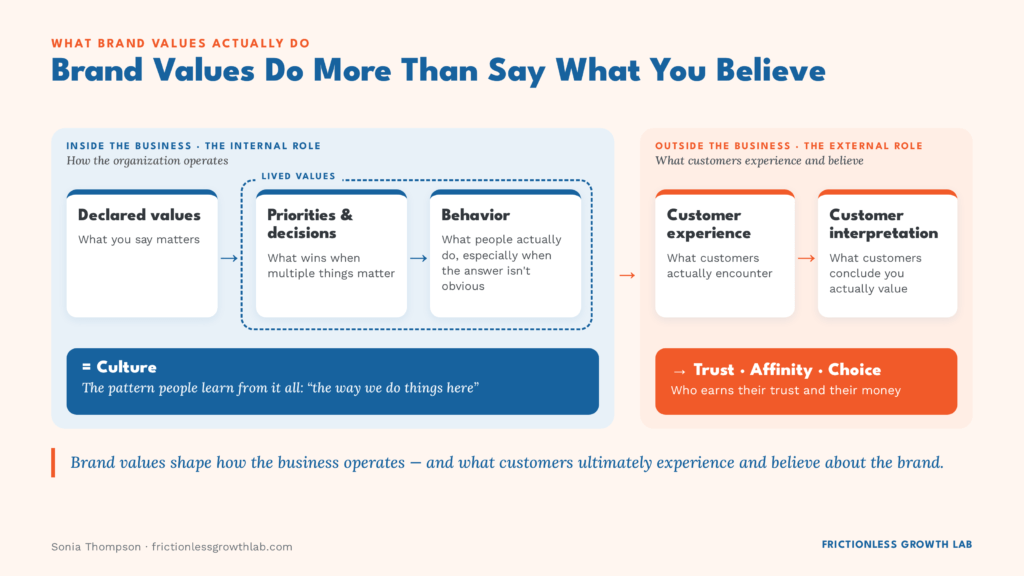
Brand values are the commitments that shape what a company prioritizes, how it shows up and how it engages with the people it serves, the people who work there and the communities around it. Most companies treat them as a statement of belief. But brand values do two jobs. Inside the business, they shape culture, priorities, behavior and decisions. Outside the business, they shape what customers experience and, ultimately, what customers conclude the brand actually values.
Start with the internal job of brand values, because that’s where culture comes in. I’ve long described culture as “the way we do things here,” and the relationship between values and culture looks something like this:
- Values are what we say matters.
- Prioritization is what wins when multiple things matter at the same time.
- Behavior is what people actually do, especially when no one is watching and the answer isn’t obvious.
- Culture is the pattern people learn from all of it, the shared sense of “the way we do things here.”
Notice what that means. Culture forms around what people watch the organization prioritize and do, again and again, until it becomes the expected way of operating. Values are the starting point. Culture is what your team concludes from the decisions that follow.
Then there’s the external job. Everything that happens inside the business eventually reaches the customer. Your priorities determine where you invest and where you cut corners. Your team’s behavior determines what a customer encounters when they call with a problem, walk into your store or read the fine print. And customers use all of it to draw their own conclusions about what you stand for, whether you can be trusted, how they answer the question “Is this for someone like me?” and, eventually, whether you deserve their money.
Why Brand Values Matter to Customers
Customers are paying attention to more than your product and your price. The 2026 Edelman Trust Barometer Special Report on brands found that 88% of consumers say trusting a brand is an important or critical purchase criterion, on par with quality (89%) and value (88%). And trust is shaped heavily by what a company’s values look like in practice. Edelman’s 2025 brand trust report put it plainly: “trust isn’t won with purpose statements – it’s earned through relevance, responsiveness, and relentless clarity of action.” (I’ve written more about why trust is a growth lever modern marketing can’t ignore.)
Values also show up directly in what people choose to stop buying. In Havas’s 2025 Meaningful Brands study, conducted with YouGov across 10 markets and nearly 1,900 brands, 45% of people said they’ve stopped buying from brands that don’t share their views and values.
But I want to be careful here, because the same study found that 69% of people say they’re quick to switch brands if they find a more cost-effective or convenient option. Customers don’t choose values over price, quality and convenience every time. They make tradeoffs, the same way your business does. Values are one of the inputs customers use when they decide which brands deserve their trust and their money. Sometimes values decide the purchase. Sometimes they’re the tiebreaker. And sometimes they’re what makes a customer walk away from a brand they otherwise liked, which is the risk Last Ditch ran into when some customers felt the bar had stepped back from a commitment they depended on.
Declared Values vs. Lived Values
Here’s where a lot of companies get stuck. They do the work of naming their values, they publish them, and they assume the job is done. But publishing a list of values is a declaration, and customers and employees look past what you declare to what you do.
Employees see it first. Years ago, I interviewed Sam Murray, who coaches and trains executives, often after they’ve behaved badly, about how leadership behavior shapes company culture. “Employees recognize inauthentic behavior,” she told me, “and so then pretty soon nobody’s behaving correctly, even though the policy is written.” When what’s written and what’s modeled don’t match, people follow what’s modeled.
Customers do the same math from the outside. They compare what you say you value with what they experience, and when the two don’t match, the experience wins. That’s why the brands that communicate their values well focus less on telling and more on showing how those values are lived. I wrote about how to do that, with examples from brands that demonstrate their values well, in my HubSpot article, Consumers Care About Brand Values: How to Communicate Them in a Way That Wins, and talked through it on Episode 138 of the podcast.
So living your values matters enormously. But it isn’t the end of the story, and Last Ditch is the proof. The bar was living its values in a very visible, very costly way. Even lived values can break down if they don’t help your team decide what to do when important priorities conflict. That’s the part most values work skips.
Why Even Lived Values Break Down Under Pressure
I’m a big believer in companies having brand values. Trust, inclusion, innovation, customer centricity, community, integrity: all of those are wonderful things to stand for. But values become an asset when they also work as a decision-making system. They should help a frontline employee handle a hard moment with a customer, help a product team weigh a tradeoff, and help a leadership team make a call they know some people won’t like.
That’s where the Last Ditch example gets complicated. The bar had clearly articulated values around community care, mutual aid and anti-discrimination. But as the business struggled, other responsibilities became more and more urgent. Employees needed to be paid. The owner needed to be paid. Bills needed to be paid. And the business needed enough revenue to keep its doors open. Those weren’t part of Last Ditch’s stated values, but leaving something off your list doesn’t make its importance disappear.
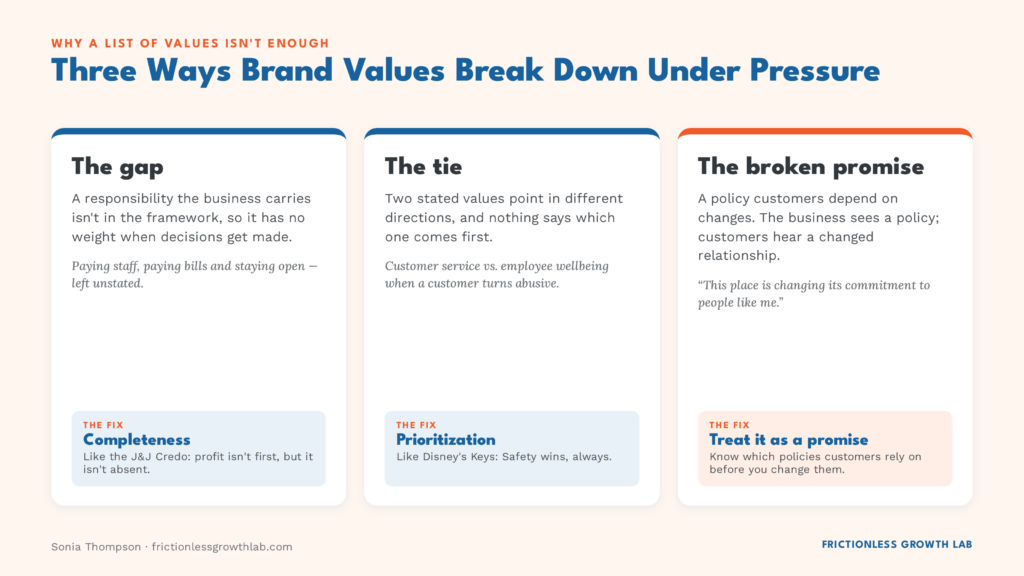
Which raises questions I think more leaders need to sit with. Does your values framework account for the things your business needs in order to keep delivering on those values? Even when everything important is accounted for, what happens when two of those values conflict? And do you know which of the ways you express your values have become promises your customers depend on? Those three questions point to three different ways brand values break down under pressure, and two companies I know well, one from my own career and one from a training room in Orlando, show what it looks like to solve for the first two.
Completeness: What the Johnson & Johnson Credo Gets Right
Fresh out of business school, I spent nine years at Johnson & Johnson, and one of the things ingrained in us from day one was the company’s Credo. The Credo lays out the company’s responsibilities to distinct groups, in order. It begins, “We believe our first responsibility is to the patients, doctors and nurses, to mothers and fathers and all others who use our products and services.” Then come employees. Then the communities where the company lives and works. And finally, stockholders, where the Credo states plainly: “Business must make a sound profit.”
I’ve always found that important. Profit isn’t first. But it isn’t absent, either, because financial health is what allows a business to keep fulfilling every other responsibility on the list. If you can’t pay employees, that’s an employee issue. If you can’t keep the lights on, eventually that’s a customer issue. If the organization disappears, that’s a community issue.
The Credo was so central to how we worked that my colleagues and I regularly debated, among ourselves, whether the company was actually living up to the order of responsibilities it had laid out. I think that’s a sign of a values framework doing its job, and of a culture that took it seriously. People cared enough to hold the company accountable to it.
That’s what completeness looks like. The framework acknowledges that the organization has responsibilities to customers, employees, communities and its own financial health. Not every company needs “profit” on its values page. But every framework needs to account for financial sustainability somewhere, so that when the bills come due, leaders aren’t weighing a critical business need against stated commitments with no principle to guide them.
Bring that back to Last Ditch, and you can see why the decision was so hard. The masking policy created access for people who may not have had many other nightlife options, if any. But if Last Ditch closes, those customers lose the space altogether, not just on Saturday nights but on every night of the week. That’s why the decision is so difficult, and why a framework that leaves the business’s survival unstated can’t help you make it.
Prioritization: What Disney’s Keys Teach About Conflicting Values
Years ago, I attended Disney’s Approach to Quality Service training in Orlando. One of the concepts we learned was Disney’s Four Keys to quality service: Safety, Courtesy, Show and Efficiency. Disney has since added a fifth Key, Inclusion, which now sits in the middle of the order. What I found so useful about the framework, so useful that I’ve brought it into several of my consulting engagements, is that the Keys came in a deliberate order.
Safety comes first, always. And that order matters. It doesn’t matter how efficient a department is, or how much was saved on materials, if the rides aren’t safe and people are getting hurt in the parks.
So imagine you’re a Disney cast member trying to create a more efficient experience for guests, but doing it would compromise safety. You don’t have to stand there wondering, “Efficiency is one of our Keys, too. Which one should I choose?” Safety wins. The organization already made that decision for you. There’s something incredibly powerful about removing that ambiguity for the people who work in your business, including you. It’s also how culture gets built: thousands of cast members making the same call, the same way, until it’s simply the way things are done there.
A lot of companies do the first part well. They identify five or six things they believe in and how they want to show up for customers. They define them, put them on the website and the wall, email them to every team member, maybe even build them into onboarding. But then two of those values point people in two different directions, and the list goes silent. A list tells you what matters. Prioritization tells you what to do when multiple things matter at the same time. That’s a very different level of usefulness.
And this isn’t only an issue for a company the size of Disney. Consider how often perfectly good company values collide in ordinary operating decisions:
- Exceptional customer service and employee wellbeing. A customer becomes verbally abusive to one of your employees, which unfortunately isn’t uncommon. Does “the customer comes first” mean that employee is expected to tolerate almost anything? Or does protecting the employee take priority once a customer’s behavior crosses a certain line?
- Sustainability and affordability. The more sustainable option significantly raises the price customers have to pay.
- Personalization and customer privacy. Improving personalization requires collecting more customer data.
- Speed and quality. Meeting the deadline means delivering work you know doesn’t meet your quality standard.
These are everyday operating decisions, and they’re being made in your company every week, whether or not your values help anyone make them. If your values are supposed to guide how the company operates, they need to be useful when the answer isn’t obvious.
When a Policy Becomes a Promise
There’s one more layer here that I think is especially important from a customer experience standpoint. A masking policy isn’t necessarily a value. Community care or accessibility might be the value. The policy is one way the business chose to express it.
In theory, that means a company can change a policy without changing the underlying value. But there’s a catch. Sometimes the way you express a value becomes part of the promise customers believe you’ve made to them. For some Last Ditch customers, masking was the thing that made the space accessible to them in the first place. So while the business may have seen the decision as “we’re changing our masking policy on one night,” some customers experienced it as “this place is changing its commitment to people like me.” Those are two very different interpretations.
I know a much lower-stakes version of that feeling. My husband and I both follow a gluten-free diet for health reasons, and there was a restaurant less than five minutes from our house that we went to often. We’d get hamburgers and, of course, fries, because fries are part of the hamburger experience. Their fries were gluten-free. Then one day, as I was placing our order, they told me they’d changed the recipe. They’d added flour to make the fries crunchier, so they weren’t gluten-free anymore.
When I tell you I was irate. We have so few options as gluten-free people, and this one was being taken away so the fries could be a little crunchier for people who could already eat almost anything on the menu. Without the fries, we didn’t even want the hamburger. So we basically stopped going. I know, I know. Super dramatic. But I’ve since heard they changed the recipe back, and the fries are gluten-free again. The damage was done. We’ve gotten takeout from there maybe once, at most twice, since.
From the restaurant’s side, I’m sure it felt like a recipe tweak. From our side, it answered the question every customer is asking, whether they say it out loud or not: “Is this for someone like me?” The answer was no, and it told us people like us were less valuable to them. That’s the external job of values at work. The restaurant never announced a change in what it valued, but we concluded one anyway from what we experienced. You may believe you’re changing a policy while your customers believe you’re changing the relationship. That’s a very different problem to solve, and it’s one of the most common ways brands create friction between what they promise and what customers experience.
None of this means policies can never change. Last Ditch was facing a real threat to its survival, and sometimes the most caring thing a business can do for its community is find a way to stay open. The brands that handle these moments well recognize which of their policies customers experience as promises, and they treat changes to those policies with the weight of a changed promise, starting with the people who depend on them most.
The Brand Values Pressure Test: 5 Questions to Ask Before Your Values Are Tested
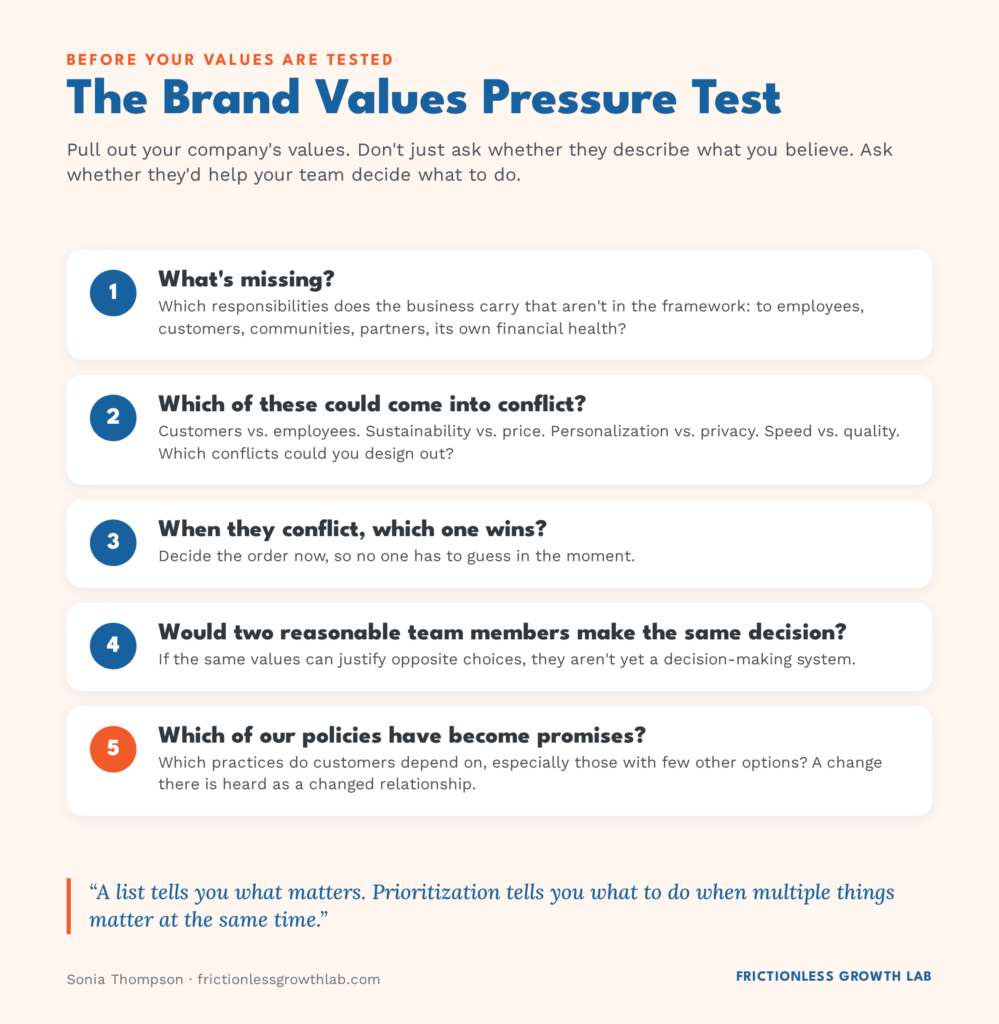
So here’s what I encourage you to do. Pull out your company’s values. Asking, “Do these accurately describe what we believe and how we want to show up in the world?” is a good start. Then pressure test them with these five questions.
1. What’s missing? What responsibilities does this business carry that aren’t represented anywhere in the framework? Look at employees, customers, communities, partners and the financial health of the business itself. If something essential is unstated, it will still show up in your decisions. It just won’t have any guidance attached.
2. Which of these could come into conflict? “We value our customers” and “we value our employees” sound perfectly compatible until a customer mistreats an employee. “We value sustainability” and “we value price accessibility” sound compatible until one makes your product significantly more expensive. Some conflicts you can design out entirely. When I started my business, I attended a panel featuring Tory Burch, and I asked her how she prioritized the Tory Burch Foundation against her fashion business. She told me the foundation was baked into the company’s business model from the very beginning, so she would never have to choose between the two. The business was designed to fuel the foundation. Not every conflict can be solved that way, but it’s worth asking which ones can.
3. When they conflict, which one wins? This is the Disney question. If you can’t answer it, your team will answer it for you, one situation at a time, and probably differently each time. Those scattered answers become your culture whether you chose them or not.
4. Would two reasonable team members make the same decision? Imagine two well-intentioned people on your team looking at your values during a real conflict. If they can use the same values to justify opposite decisions, those values may describe what your company believes, but they aren’t yet functioning as a decision-making system.
5. Which of our policies have become promises? List the policies, practices and experiences your customers have come to depend on, especially the ones that make your brand accessible to a group that has few other options. Those are the ones where a change will be heard as a change in the relationship, so they deserve the most care before you touch them.
A couple of practical notes on running it. Do it before you need it. The middle of a crisis is the hardest possible time to decide which value wins. And include the people who actually apply your values day to day, like the frontline team member facing an abusive customer or the product manager weighing personalization against privacy, because they’ll find the conflicts a leadership offsite won’t.
Where Values, Culture and Customer Experience Meet
In the 7C Frictionless Growth Marketing Framework, brand values are foundational to Culture, the first C. Culture is where your organization decides what it stands for, and where your people learn, through every decision they watch get made, what really wins. A values framework that’s complete and prioritized is what turns culture from a set of good intentions into “the way we do things here” on an ordinary Tuesday. (If you want to see where this thinking started, I first wrote about the role of culture and values back in Episode 8 of the podcast. This piece is where it’s evolved since.)
Values get tested in Customer Experience Delivery, the moments where your promises are kept or broken. That’s where a policy becomes a promise, where a team member decides how to handle a customer who has crossed a line, and where your customers find out whether your values were real. When the foundation is unclear, the friction shows up there, in front of the people you most want to keep.
Frequently Asked Questions
What are brand values?
Brand values are the commitments that shape what a company prioritizes, how it shows up and how it engages with customers, employees and communities. Common examples include trust, integrity, inclusion, innovation, community and customer centricity. Brand values do two jobs. Internally, they shape culture, priorities, behavior and decisions. Externally, they shape what customers experience and what customers conclude the brand actually values. The most useful brand values also work as a decision-making system, telling people what to do when two values point in different directions.
Why do brand values matter to customers?
Because customers use them, along with price, quality and convenience, to decide which brands deserve their trust and money. Edelman’s 2026 brand trust research found that 88% of consumers consider trusting a brand an important or critical purchase criterion, on par with quality and value. Havas’s 2025 Meaningful Brands study found 45% of people have stopped buying from brands that don’t share their values, even as 69% say they’ll switch quickly for a cheaper or more convenient option. Values rarely decide every purchase, but they’re a real input.
What’s the difference between declared values and lived values?
Declared values are what a company says matters, on its website, in onboarding and on the wall. Lived values are what its priorities, decisions and behavior show actually matters. Employees and customers both judge the second more than the first. When the two don’t match, people believe what they experience. Living your values is essential, but even lived values can break down if they don’t tell your team what to do when two important priorities conflict.
What should you do when brand values conflict?
Decide in advance which value wins. Disney’s Keys to quality service are a useful model: Safety comes first, so a cast member never has to choose between safety and efficiency in the moment. Johnson & Johnson’s Credo ranks its responsibilities, starting with the people who use its products and ending with stockholders. For your own values, identify the pairs most likely to collide, such as customer service and employee wellbeing, agree on an order or a clear line, then check whether two reasonable team members would make the same call.
Should profit be one of your brand values?
It doesn’t have to be on your values page, but your values framework needs to account for it. Financial health is what lets a business keep paying employees, serving customers and supporting its community. Johnson & Johnson’s Credo places stockholders last but still states that “business must make a sound profit.” Leave financial sustainability out of the framework, and decisions about it still get made, just without any guidance.
Can a company change a policy without abandoning its values?
Yes, because a policy is usually one expression of a value, not the value itself. But customers don’t always experience it that way. When a policy has become part of what makes your brand accessible or trustworthy to someone, changing it can feel like a changed relationship. Before changing a policy customers depend on, identify who relies on it most and treat the change with the care you’d give a broken promise.
Some challenges don’t fit neatly inside a predetermined package. If your organization is working out how its values, priorities and customer understanding should translate into the decisions your team makes and the experiences your customers actually have, that’s the kind of work I take on through my consulting and project engagements. Sometimes that’s a focused strategic project with a defined outcome. Sometimes it’s an ongoing advisory partnership where I work alongside your team as priorities evolve. Either way, we start with what you’re trying to accomplish and what’s getting in the way. Let’s talk about what you’re working on.
Last Ditch faced its hardest values question with the bills already overdue and every available option carrying a cost, and then had to answer for its decision in public. Most businesses meet that kind of question for the first time under similar pressure. The better time to work through it is before the bills are overdue, customers are angry and every option costs something. You can’t anticipate every difficult decision your company will face. But you can build a values framework strong enough to help you through one when it arrives. Because the real test of brand values is whether they help you decide what to do when things aren’t going well.
Until next time, remember: growth accelerates when you remove friction, for your customers and for your business.
Full Episode Transcript
Transcript of Frictionless Growth Lab Ep. 235, “Your Brand Values Are an Asset. Here’s How to Use Them Like One.” Lightly edited for readability. Sponsor messages are marked.
Sonia Thompson: What happens when living your brand values starts threatening the survival of your business? That's essentially the situation one Massachusetts bar recently found itself in. And whether or not you agree with the decision the owner ultimately made, there's a much bigger lesson here for brands, because establishing brand values is the easy part. The real test comes when two things that matter to your business start pulling you in different directions. And when that happens, a list of values probably isn't going to be enough.
We're gonna get into all the details and how to make sure your brand doesn't fall into the same mistake that this bar did after this short break.
[Sponsor break]
When a buyer asks AI for a solution like yours, does your business come up? Most companies have no idea, and by the time they find out, they've already lost the deal to someone who did. HubSpot AEO helps you show up in those moments with the right answers buyers are looking for before the first click, before the first form fill. That's the moment HubSpot AEO is built for. Check out hubspot.com, the agentic customer platform for growing businesses.
[End of sponsor break]
The Last Ditch Bar controversy
So let's start off with the Last Ditch Bar controversy. The Last Ditch Bar and Arts Venue is a lesbian bar located in Greenfield, Massachusetts. The business was founded with very clear values around queer belonging, mutual aid, anti-discrimination, community care, and accessibility. And those values weren't just words on a website. The bar has actively been working to live its values since it opened back in 2025.
One way living those values showed up was with a strict masking policy. Patrons of the bar were required to wear a KN95 mask or better inside. Another way the values were lived was through affordability. If someone could not afford the cover charge to enter the bar, the rule was they were not to be turned away. So you can see what it is that the founders were trying to build.
It wasn't just supposed to be a bar. It was supposed to be a space where people who are often excluded from traditional nightlife, including disabled and immunocompromised people, could participate. But there was a problem. The brand was struggling financially. According to reporting by The Boston Globe, Last Ditch had fallen behind on its bills.
Owners and staff had gone unpaid, and two of the three founders had stepped away from daily operations. The remaining owner, Jackie Matellian, was responsible for paying back a $50,000 startup loan. She was working multiple jobs and spent months at a time living in her car while trying to keep the business alive. So after consulting with the Massachusetts LGBT Chamber of Commerce, Last Ditch decided to try something different. Saturday nights would become mask optional, and the masking requirement would remain in place for all the other days that the bar was open.
And the response was intense, to say the least. Some customers saw this new policy as the business stepping away from its commitments. Some customers saw this change in policy for Saturday night as Last Ditch walking away from the commitments it had made to a community that made Last Ditch accessible to them in the first place. And that's one of the reasons why this becomes a really fascinating business case. My goal here isn't to try to tell you whether or not I feel like Last Ditch should or shouldn't have changed their policy.
I'm much more interested in a different question. What should a values-led business do when the things it is responsible for start coming into conflict with each other? Because this is where brand values actually get tested.
Brand values are a decision-making system
And to understand a little bit more about why I say that, we have to understand that brand values at their core are a decision-making system for brands. Now, a lot of companies have brand values, and I highly recommend that they do. You'll often see things like trust, inclusion, innovation, customer centricity, community, integrity. All of these are wonderful things. But your values aren't particularly useful if all they do is tell people what you say that you believe.
They should also help people within your company decide what to do, and that's where the Last Ditch example gets complicated. The bar had clearly articulated values around things like community care, mutual aid, and anti-discrimination. But there were other responsibilities that became increasingly more important as the business struggled. Employees needed to be paid, the owner needed to be paid, bills needed to be paid. And of those three things, all of those were lacking at Last Ditch.
And the business needed enough revenue to continue operating. Now, those weren't necessarily part of Last Ditch's stated values, but not putting them on the list of your values doesn't make their importance disappear. And that raises an important question that I think that more brands and more brand leaders need to consider. Does your values framework account for the things that your business needs in order to continue delivering on those values? And even when everything important is accounted for in your values, what happens when two of those values conflict?
Disney's Keys: prioritization
So let's talk a little bit about how Disney has solved for that potential type of conflict. Years ago, I attended Disney's Approach to Quality Service training in Orlando, and one of the concepts that we learned was about Disney's four keys. And at the time, those four keys to quality service were safety, courtesy, show, and efficiency. Disney has since added a fifth key, which is inclusion. But here's the thing that I found very useful about that framework, so much so that I've used it in several consulting engagements with clients.
The keys weren't just a list, they were prioritized. Safety came first, always, then courtesy, then show, then efficiency, and that prioritization matters. It doesn't matter how efficient a department is or how much you saved on sourcing different materials if the rides at a Disney park aren't safe, or if people are getting hurt right and left whenever they are inside of the parks. So imagine that you are a Disney cast member trying to create an efficient experience for guests, but doing so would compromise safety. You don't have to sit there wondering, "Well, efficiency is one of our quality standards, too.
It's one of our core keys. Which one should I choose?" Safety wins, always. The organization has already made that decision for you. There's something incredibly powerful about removing that ambiguity for the people who are working on your business and within your business, including you.
So a lot of companies do that first part. They identify five or six things that they believe in, ways in which they wanna show up, and how they wanna operate for consumers and in the marketplace. They define them. They put them on their website. They put them on the wall.
They email them to every employee, every team member. Maybe they even incorporate them into onboarding and team training. But what happens when two of those values point team members in two different directions? A list tells you what matters. Prioritization tells you what to do when multiple things matter at the same time.
That's a very different level of usefulness, and this isn't just an issue for a company like Disney. Imagine your company says it values exceptional customer service and employee wellbeing. Then a customer becomes verbally abusive to one of your employees. This isn't an uncommon scenario, unfortunately. So which value wins here?
Does "the customer comes first" mean that that employee is expected to tolerate almost anything, or does protecting the employee take priority once customer behavior crosses a certain line? What if your company values sustainability and affordability, but the more sustainable option significantly increases the price that customers have to pay? What if you value personalization and customer privacy, but improving personalization requires collecting more customer data? What if you value speed and quality, but meeting a deadline means delivering work that you know doesn't meet your quality standard? These aren't philosophical debates, they're operating decisions.
And if your values are supposed to guide how your company operates, they need to be useful when the answer isn't obvious. But prioritization isn't the only challenge that we're dealing with here.
When something essential is missing
So let's bring this back to Last Ditch because their situation exposes something slightly different. Because sometimes the answer isn't simply that two stated values are conflicting. Sometimes something essential to the business isn't represented in the framework whatsoever, and that brings to mind another example from the very beginning of my career.
The Johnson & Johnson Credo: completeness
So fresh out of business school, I spent nine years working at Johnson & Johnson, and one of the things that was ingrained in us from day one was the credo. Now, the credo lays out the company's responsibility to distinct groups. The credo specifically says, "Our first responsibility is to…" and then it starts to list the people who use its products and services. Then the second group is the employees. The third group are the communities with which the company lives, works, and operates.
And finally, the fourth responsibility is to the stockholders. And within that final responsibility, the credo specifically says that the business must make a sound profit. I've always found that important. Profit isn't first, and I gotta tell you, even during my time when I was working at J&J, because the credo was so ingrained in everything that we did, we often as employees had our own internal debates with each other about whether or not we felt the company was actually living into the, its own stated prioritization of responsibility and the ranking that the credo had laid out. It was something that we internally wanted to live, and we wanted to hold the company accountable to living its stated values and its own stated hierarchy of responsibilities.
So in the credo, profit isn't first, but it isn't absent either because financial health enables a business to continue fulfilling its responsibilities. If you can't pay employees, that's an employee issue. If you can't keep the lights on, eventually that's a customer issue. If the organization disappears, that's a community issue. So when I put the Disney example next to the Johnson & Johnson one, I think they illustrate two different weaknesses companies should look for in their own values.
Disney demonstrates the importance of prioritization. When important standards compete, people have guidance about which one comes first. Johnson & Johnson demonstrates the importance of completeness. The framework acknowledges that the organization has responsibilities to customers, employees, communities, and the financial health of the business, and that brings us right back to Last Ditch.
[Sponsor break]
Okay, I've got another podcast recommendation for you. It's This Old Marketing, hosted by Joe Pulizzi and Robert Rose, and it's brought to you by the HubSpot Podcast Network, the audio destination for business professionals. Joe Pulizzi and Robert Rose are two of the most well-known experts in the content marketing space. And in this show, they are talking about the latest content marketing trends, and they discuss how businesses can use content to attract and retain customers. One really great episode that you should tune into, and it's super timely, is The State of Content Marketing 2027: What Comes Next? And here's another one for you to consider. Is Blogging Dead or Mostly Dead? Listen to This Old Marketing wherever you get your podcasts.
[End of sponsor break]
The masking policy created access for people who may not have had very many other nightlife options available to them, if any at all. But if Last Ditch closes, those customers lose that place altogether. They don't have any options, not on Saturday night and not any other night of the week. Now, that doesn't automatically tell us what the right masking policy should be. It tells us why the decision is difficult, because sometimes a policy becomes a promise.
When a policy becomes a promise
There's one more layer here that I think is especially important to consider from a customer experience standpoint. A masking policy isn't necessarily a value. Community care or accessibility might be the value. The policy is one way the business expresses it. And in theory, that means a company can change their policy without changing the underlying value.
But there's a catch. Sometimes the way you express your value becomes part of the promise customers believe you've made to them. For some Last Ditch customers, masking wasn't simply yet another operating policy. It was part of what made the space accessible to them. So the business might see the decision as we're changing one night of our masking policy, while some customers experience it as this place is changing its commitment to people like me.
Those aren't the same interpretation. Now, I also want to bring in another example for you on, on this with something that is absolutely less stakes, but still I remember how I felt when it happened.
The gluten-free fries
You've heard me mention this before. Both me and my husband follow a gluten-free diet for health reasons, and there is a place that we used to go to very close to our house, less than five minutes away. And we went there, and we often got hamburgers and, of course, fries as a part of the hamburger experience. And their fries were gluten-free. And then one day, we went there and I was placing an order, and they said that they had changed the recipe for their french fries.
Now they had added flour to their fries to make them crunchier, so they were no longer gluten-free. When I tell you I was irate. I was irate. I was so upset. I was so bothered.
I was like, "Why? Why? Why do you have to change the french fries? We have– As gluten-free people, we have so few options, and just because you want to make the fries crunchier, you change the recipe. And now something that we enjoyed so much about your establishment, now we can't enjoy anymore.
And without fries, we don't even want the hamburger." And so we basically stopped going to that restaurant altogether. But I just remember how I felt whenever I heard the news about them changing the french fries. It was just like, gosh, we have so few options. Why are you taking this one option away from us and giving it to the people who already have everything, the people with no dietary restrictions?
I know, I know, I know. Super dramatic, but… Anyway, I've heard that they have since changed the recipe for their fries back. So now they're gluten-free again. But the damage was done, and we rarely, rarely, rarely go to that restaurant.
I think maybe once, at most twice, we've gotten takeout from there since they've gone back. And this leads to something that I want you to understand fully, especially whenever you're changing an experience, a policy, or a practice that customers have come to depend upon. You may believe that you are changing just a policy while your customers are believing that you are changing the relationship. That's a very different problem. You, in their mind, taking something away from them is basically communicating a message that says, "Uh, actually, this isn't a place for people like you.
People like you are a less valuable customer to us." Those are the messages that they are hearing.
Pressure test your brand values
So it's important for brands to pressure test their brand values. So here's what I encourage you to do. Pull out your company's values. But don't just ask, "Do these accurately describe what it is that we believe and how we want to show up in the world?" Pressure test them.
Ask what's missing. What responsibilities does this business have that aren't represented in the framework? Then ask which of these could come into conflict. Years ago, whenever I first started my business, I went to a panel discussion which featured Tory Burch. And in this discussion, she was talking specifically about the Tory Burch Foundation, and they were celebrating all the work that the Tory Burch Foundation had done.
They had partnered with a popular program that was helping women get the mentoring and the skills they needed to build and grow their businesses. And I remember asking her a question about how she prioritized her Tory Burch Foundation and all the good work that they were doing with her Tory Burch business. And she told me that the Tory Burch Foundation was baked into the business model of Tory Burch, the company. So it was never going to have to be able to choose between one or the other. The business model of her fashion business was designed to fuel the foundation.
It was baked into the business model from the very beginning. As you're looking at your values, ask yourself which of these could come into conflict. Because "we value our customers" and "we value our employees" sound perfectly compatible until there's a conflict between the two, until a customer mistreats an employee. "We value sustainability" and "we value price accessibility" sound compatible until one makes your product significantly more expensive. And then ask when they conflict, which one wins?
Also take the time to ask yourself, would two reasonable team members looking at this, would two reasonable team members looking at these values make the same decision about how they should proceed when the values are in conflict with each other? Because if two well-intentioned team members can look at your values and use them to justify two opposite decisions, those values may describe what your company believes, but they aren't yet functioning as a decision-making system. And that's ultimately what I think is at the core of what this Last Ditch Bar controversy can teach us. You can't anticipate every difficult decision that your company will face, but you can build a framework strong enough to help you navigate one whenever it does arrive. Because a real test of brand values isn't how good they sound when everything is going well.
It's whether they help you decide what to do when everything isn't. And ultimately, business should be kind to the people it serves and to the people who make the business possible.
Until next time
If you enjoyed this episode and you are looking for more marketing commentary on current events as well as frameworks and other guidance on how to grow your brand in today's marketing conditions and with today's consumers, definitely sign up for the Frictionless Growth Lab newsletter. I will drop a link for you to do so in the show notes for you below. Until next time, remember, growth accelerates when you remove friction for your customers and for your business. Thanks so much for listening. Talk to you soon.
Found this post useful?
There’s more where that came from—get insights on the new rules of growth delivered to your inbox.