A few years ago, I conducted an audit of a healthcare brand’s marketing. I was reviewing their promotional materials across channels, and across all of it, one thing kept catching my attention. With one exception, every doctor pictured was a man.
Nobody at that company had decided doctors should be men. There was never a strategy meeting where someone said, “Let’s have men represent medical expertise and authority.” When I laid the images side by side and walked the team through the pattern, they were mortified. When I later presented the findings to their agency, the agency was mortified too. But the pattern was still there, across channels, in work that had been reviewed and approved many times over.
Here’s what made it so easy to miss. Each image, on its own, looked like an ordinary marketing choice. A doctor in a white coat, a patient on the exam table, a reassuring headline. Every individual choice felt “normal.” But no image is neutral. Each one is an input about who doctors are, and this brand’s inputs, repeated across channels, said something nobody there meant to say: doctors are men.
One image is an input. A body of work creates a pattern. And that pattern doesn’t land on a blank slate.
That’s the gap I want to help you close. The message your brand intends to send isn’t necessarily the message your customers receive. The good news is that you can review for this, on purpose, before the work goes out the door. By the end of this article, you’ll have a way to do exactly that in your next creative review.
Listen on Apple Podcasts | Spotify | Read the full transcript
What Is Implicit Messaging in Marketing?
Every piece of marketing sends two messages at once. The explicit message is the one you decided to send: your features, benefits, differentiation and call to action. The implicit message is everything else the work communicates, through who is in it, who is centered, who holds authority, the language you use, the situations you show and the assumptions you make about the customer. Customers receive both, and they don’t separate the two.
When teams work on brand messaging effectiveness, they focus almost entirely on the first one. We spend weeks deciding what we want customers to think about our product. Then the copy, casting, imagery, examples and context all get layered on top, often by different people at different stages, and together they say things no one sat down and decided.
Your copy can say, “This product is for you,” while everything around it communicates, “We weren’t really thinking about people like you.” The customer receives and processes both messages. And we don’t get to decide that only the one we intended to send counts.
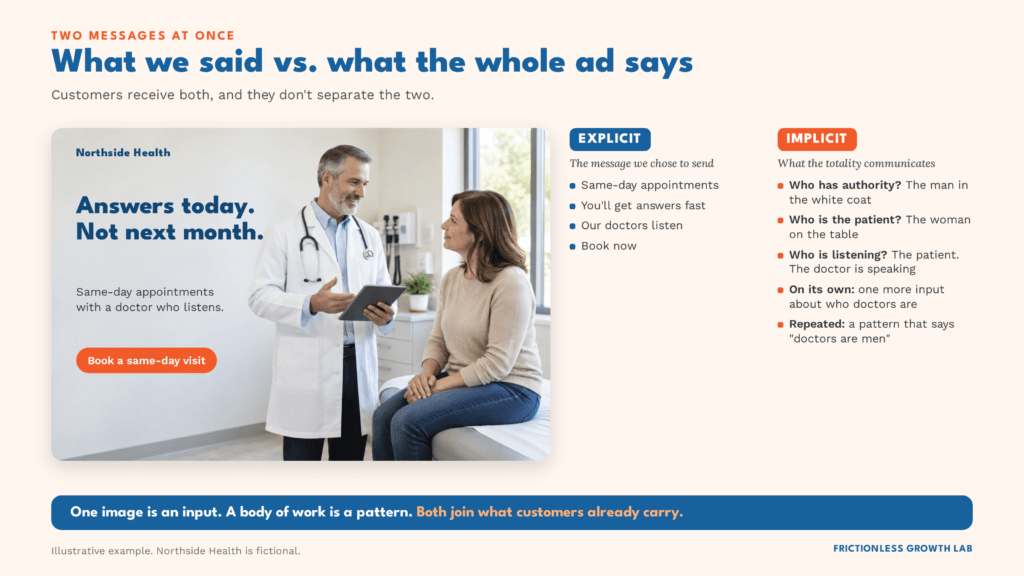
Look closely and there’s a second implicit message that has nothing to do with who was cast. The copy promises “a doctor who listens.” But in the image, the doctor is the one talking, and the patient is the one listening. The composition quietly contradicts the explicit promise. Implicit messaging isn’t only about who is in the picture. It’s also about what they’re doing in it.
Your Marketing Is Never the First Message Your Customer Receives
Every message you put into the world enters a conversation that started long before your brand showed up. Your customers have spent years, sometimes decades, absorbing messages from media, family, communities, previous experiences and other brands about who belongs, who’s beautiful, who has authority, what’s normal and what’s possible for someone like them. I call this societal programming, and it shapes how your message is received.
I see how early it starts with my six-year-old daughter. I asked her recently if she wanted to play basketball on a team, and she told me sports are for boys. My husband and I never taught her that. She loves sports. She and I play basketball together all the time. But she’s watched us watch the World Cup, where the players she saw were men. She’s seen countless videos and images of men playing sports. She knows Ronaldo (her favorite, which makes us laugh, because our household is a Messi household), and I learned the names Haaland and Mbappé from her before I’d ever seen either of them play.
Nobody explicitly told her sports are for boys. She deduced it from the pattern. And it wasn’t the first time I’d watched her absorb this particular message. Not long before, she’d told me during math homework that girls don’t do pushups, a moment I shared in Mosaic Marketing. That’s how programming tends to work. It happens through accumulation. We see something, then we see it again and again, and eventually a pattern starts to feel like the way the world works.
So we’re intentionally giving her different inputs. She plays sports. We play with her. We make sure she sees women playing sports, and when the 2027 Women’s World Cup comes on, we’ll be watching. Every one of those is an input that says, sports are for you, too. And that’s what matters for marketers. Programming accumulates, but new inputs can expand what someone believes is possible for them.
She’s six. Now imagine the accumulated effect of 20, 30, 40 or 60 years of those inputs on the customers encountering your marketing. Those inputs don’t only shape what people believe about the world. They shape what people believe about themselves, including whether a product, a category or an experience is for someone like them.
Which brings us back to that healthcare brand. Its inputs didn’t land in isolation. Each image joined a bank of thousands of inputs its customers had already accumulated about who doctors, experts and leaders are. That’s the mechanism underneath all of this. Your brand adds an input, the customer interprets it in relation to everything already in the bank, and that input, especially repeated campaign after campaign, reinforces, expands or challenges the pattern they already carry. That’s what I mean by societal programming. It isn’t just another way of saying people have different perspectives. It’s the accumulated pattern your message lands in.
Your Team Has Been Programmed, Too
Marketers don’t stand outside of society observing everyone else’s programming. We’ve spent our whole lives absorbing the same messages, and they find their way into the work. That’s the other half of what happened at the healthcare brand.
The tricky thing about programming is that it rarely shows up as a conscious belief. It shows up as something that simply feels normal. The stock photo feels “normal.” The casting choice feels normal. The example in the copy feels normal. The customer we picture while we’re writing the brief feels normal. We aren’t thinking, “This is what I believe.” We’re just making choices. But those choices can collectively communicate something we never intended to say.
And it isn’t only about who appears in the work. Language carries programming too. In 2021, Unilever announced it would remove the word “normal” from the packaging and advertising of all its beauty and personal care brands. In a survey of 10,000 people across nine countries, seven in ten said the word “normal” on beauty packaging has a negative effect on people. Think about what that one word was doing. A shampoo labeled for “normal hair” was explicitly describing a product. Implicitly, it was telling everyone who needed the other bottle that their hair wasn’t normal. Unilever decided it didn’t want to keep feeding that programming. (I talked through that decision in Ep. 114: What Is Normal Anyway?)
The same thing happens through situations and assumptions. In a financial services ad, who is shown making the investment decision, and who is shown nodding along? Does the tutorial assume the customer already knows the jargon? Does the onboarding copy assume a two-parent household, a desk job or a certain budget? None of these choices are about your product. All of them are part of your message. And customers don’t experience your campaigns one asset at a time in a conference room, the way teams review them. They experience the pattern.
Sometimes that pattern is bigger than any one brand. When I reviewed 50 brand websites across industries like automotive, travel, beauty, food, tech, finance and healthcare, from brands on six continents, I saw fewer than five people who were visibly 50 or older. Not fewer than five per site. Fewer than five across all 50 sites combined. One website leaving out older customers might not seem remarkable. But when the overwhelming majority do it, invisibility becomes part of the environment customers are navigating. If you’re 55, you get the same message nearly every time you shop, read or plan a trip online: we didn’t think of you. The SeeMe Index sees the same gap in its advertising data. Co-founder Asha Shivaji told me that Boomers made up only 4 percent of the talent in over-the-counter advertising, while spending 20 percent of the money in that category. No single brand created that pattern. Every brand that went along with it added to it.
When the Casting Became Part of the Message
The explicit message of this ad is about Alexa: a voice assistant that can dim the lights, run the sprinklers and handle the little things around the house. The joke is that a woman imagines Alexa in a new “vessel,” and the vessel is Michael B. Jordan.
Now notice who the ad is built around. The main character is a dark-skinned Black woman with natural hair. It’s her imagination that drives the story, her desire the whole spot is built on, and her point of view the camera follows. She isn’t the friend in the background or the customer in the final shot. She’s the protagonist.
When I saw this during the Super Bowl, I noticed it immediately. I sent it to several other Black women, and one of them wrote back, “Oh my gosh, this ad is everything.” Why? Because it was so rare for us to see a woman who looked like us at the center of a national campaign like that. The ad never said, “Dark-skinned Black women with natural hair belong at the center of national advertising.” It didn’t need to. The explicit product message didn’t change because of who was cast. But the total message did. The casting became part of the message.
Here’s the strategic significance. I had spent years watching national advertising where women who looked like me rarely got to be the protagonist. This ad didn’t argue with that pattern. It expanded it, adding a possibility I’d rarely seen about who gets to be centered, and who this product could be for. For me, that implicit message worked with the explicit one, and more than five years later, I still remember the ad. I couldn’t tell you what else aired during that game. You don’t always have to tell people, “Someone like you belongs here.” Sometimes it’s more powerful to show them.
Your Customer’s Worldview: What They Absorbed and What They Chose
It would be easy to stop here and conclude that customers are simply the sum of their programming. They’re not. People question programming. They reject it, reshape it, and decide, “No, that’s not what I believe.” So your customer’s worldview includes both what they’ve absorbed and what they’ve intentionally chosen to believe, including beliefs that push back against what society taught them.
I saw a clear example of this recently. After the Novig campaign featuring Sydney Sweeney drew criticism from women athletes, a woman on TikTok shared that she had spent years learning to appreciate her athletic body. After seeing the campaign, she found herself second-guessing her outfit. She had done real work to arrive at a different place, and this input collided with the worldview she had built. It took other women hyping her up in the comments for her to wear what she’d planned. (I wrote about the campaign itself in my Inc. column.)
That’s why the question can’t only be, “What are we trying to communicate?” We also have to ask what worldview our message is entering, both the programming and the work someone has done to move past it.
When your message meets that worldview, it plays a role whether you name it or not. Every message is an input. Every input can reinforce, expand or challenge the pattern customers already carry:
- Reinforce: confirms an existing pattern. Another male physician, presented once again as the authority.
- Expand: adds another possibility to the existing pattern, without confronting it. A woman physician shown simply as the expert. The Alexa ad belongs here too. It didn’t argue with anyone. It centered a kind of woman national advertising rarely centered, and let the story do the rest.
- Challenge: actively pushes against an existing pattern or norm. Tess Holliday on the cover of Cosmopolitan, which I’ll come back to in a moment.
These aren’t rigid categories, and they overlap in practice. They describe the role your work is playing in relation to a pattern that already exists. The point is to know which role that is, and to choose it.
Conflict Isn’t Always the Problem
I want to be careful here, because this is where the idea is easy to misread. Understanding your customers’ worldview doesn’t mean creating marketing that never makes anyone uncomfortable. Sometimes challenging societal programming is exactly the point.
When Cosmopolitan UK put plus-size model Tess Holliday on its cover in 2018, it was a highly debated decision. For someone who had absorbed years of messages that only certain bodies belong on the cover of a major fashion magazine, that cover may have been in conflict with their worldview. But I’ll never forget one woman’s response on social media. She wrote that if she had seen women who looked like her on magazine covers growing up, it might not have taken her more than 25 years to love her body. For her, the same cover was exactly the input she’d been missing, one that challenged the programming she’d been handed.
So the question isn’t, “How do we make sure our marketing never conflicts with anybody’s worldview?” It’s whether we know what we’re reinforcing, expanding or challenging, and whether we’re doing it on purpose. There’s a major difference between intentionally challenging a pattern and accidentally reinforcing one you didn’t realize was embedded in your work.
Why Implicit Signals Decide Brand Messaging Effectiveness
This is where it becomes very practical. Your customers are constantly collecting signals that help them answer one question: Is this for someone like me? Sometimes they ask it consciously. Often they don’t. Does this company understand people like me? Did they consider people like me? Will this work for someone like me? Will I be successful here? Will I be treated well? (I’ve written about why that question sits underneath conversion in Ep. 148: Answer This Question to Convert More Customers.)
Two people can encounter the exact same ad and receive something very different, because they aren’t bringing the same bank of inputs or the same worldview. And if the implicit signals tell me, “This isn’t for someone like you,” your product message may never get the chance to do its job. You can tell me about the features, the benefits and the guarantee, and give me the perfect call to action. Maybe I keep scrolling. Maybe I don’t click. Maybe you never make it into my consideration set, or I take you out of it. I’m not going to send you an email explaining why. I might not even be able to articulate it myself. I just know this isn’t for me.
That’s friction, and it’s why this belongs in any conversation about brand messaging effectiveness. It’s also one reason relevant social proof outperforms generic testimonials: it answers the question with evidence instead of leaving customers to guess.
If your realization reading this is, “We need to rethink how we develop messages for the different customers we want to reach,” that’s the work of Mosaic Messaging: getting specific about what each group of ideal customers needs to hear, see, know or have resolved before they move forward, and making sure the explicit and implicit messages point the same direction.
The Implicit Message Review: A Checklist for Your Next Creative Review
Here’s what I recommend you take into your next meeting. Run this review on a campaign, a landing page, an email sequence, a product page or any customer-facing work before you approve it. It works best when you lay out the body of work side by side, the way I did in that healthcare audit, instead of judging one asset at a time.
1. Name the explicit message.
What are we explicitly communicating? What do we intend customers to understand, and which ideal customers is this for?
2. Read the implicit signals.
Go through the work and note what it communicates beyond the stated message:
- Who is present, and who is absent?
- Who is centered? Whose story is it, whose point of view, whose desire drives the scene?
- Who has authority? Who is the expert, the executive, the physician, the one with the answer?
- What do success, desirability and expertise look like? Who wins, who is admired, who is presented as beautiful, professional, normal or aspirational?
- What does the language assume? Words like “normal,” default pronouns, jargon, which languages you show up in.
- What situations are we showing, and who is shown as capable in them?
- What are we assuming about the customer’s life? Household, income, body, age, abilities, schedule, prior knowledge.
- What does the surrounding context add? Placement, partners, and how this piece fits into everything customers have already seen from you.
3. Consider the programming customers bring.
What messages have our ideal customers already received about this category, identity, need, experience or situation? What might they have spent years trying to unlearn? What worldview, absorbed and chosen, might they bring to what we’re showing them? And what larger pattern will this work join?
4. Decide the role you’re playing.
In relation to the programming our customers already bring, are we reinforcing it, expanding it or challenging it? Look across the body of work, not just this one piece. Is that what we intend?
5. Ask the customer’s question: “Is this for someone like me?”
Taken as a whole, what does this work help our different ideal customers conclude: Do we understand them? Did we consider them? Can we help them succeed?
6. Ask: How do we know?
This is the question that keeps the review honest. We can’t solve this by sitting around a conference table projecting our own programming onto our customers. Talk to them. Listen to them. Test the work. Bring different lived experiences into the process. Pay attention when customers tell you something means something different to them than it does to you. And sometimes the honest answer will be, “We don’t know.” That’s useful. It means you’ve found an assumption, and now you can go learn instead of letting that assumption become another unintended input in your marketing.
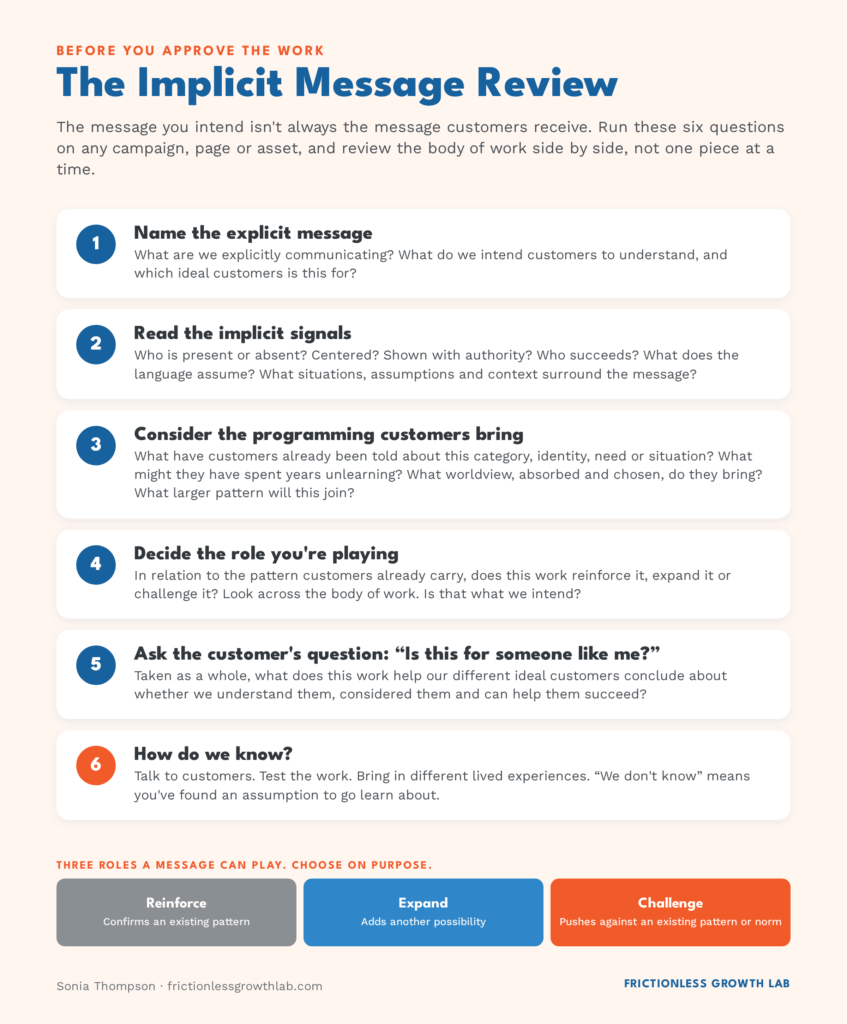
A few practical notes on using it. Give one person in the review the job of reading only for implicit signals, so it doesn’t get lost in debates about headline wording. Run it before approval, while changes are cheap, rather than after launch. And treat “We don’t know” as an action item, not a failure. The objective isn’t perfect marketing. It’s intentional marketing.
How This Connects to Mosaic Marketing and the 7C Framework
In Mosaic Marketing, societal programming is one of the four meaningful ways your ideal customers differ. This article goes one level deeper into how that difference works in practice: how programming shapes the way your message is received, and how your own team’s programming shapes the message before anyone sees it.
Inside the 7C Frictionless Growth Framework, it starts with Customer Intimacy, understanding the worldview, absorbed and chosen, that your ideal customers bring to your marketing. It shows up in Customer Experience Design, where those insights become the casting, language, situations and signals built into the work, so the implicit message supports the explicit one instead of competing with it.
Frequently Asked Questions
What is the difference between explicit and implicit messaging?
Explicit messaging is what your marketing deliberately says: features, benefits, differentiation and the call to action. Implicit messaging is what the work communicates through everything around those words, including who appears, who is centered, who holds authority, the language, situations and assumptions about the customer. Customers receive both at the same time and interpret them together. When the implicit message suggests “this isn’t for someone like you,” it can override even a strong explicit message.
What is societal programming in marketing?
Societal programming is the accumulated set of messages people absorb over their lives, from media, family, communities, experiences and brands, about who belongs, what’s normal, who has authority and what’s possible for people like them. Every new message, including your marketing, is an input interpreted in relation to that accumulated pattern, and it can reinforce, expand or challenge it. Customers bring that programming to how they receive your marketing, and marketers bring their own to how they create it. Programming isn’t permanent. People question and reject it.
Should brand messaging avoid challenging customers’ beliefs?
No. Sometimes challenging societal programming is exactly what a brand should do, and a message that conflicts with one person’s worldview can be a welcome challenge for another. The goal is intentionality. Know what programming your ideal customers bring, decide whether your work reinforces, expands or challenges that pattern (the roles often overlap), and make that choice on purpose rather than by accident.
How do you review marketing creative for unintended messages?
Lay out the body of work side by side rather than judging one asset. Name the explicit message, then read the implicit signals: who is present, centered and shown with authority, plus the language, situations and assumptions. Consider the programming your customers bring, decide the role you’re playing, and ask the customer’s question: “Is this for someone like me?” Finally, ask, “How do we know?” and go test any assumption you find.
Is implicit messaging the same as representation in advertising?
Representation is one important part of it, but implicit messaging is broader. It also comes through language (like the word “normal” on packaging), the situations you portray, assumptions about the customer’s life, what success and expertise look like, and the context surrounding your message. Any choice that communicates something beyond your stated message is part of it, which makes it a question of overall brand messaging effectiveness.
If you suspect your messaging is one symptom of broader friction, in how well you understand your customers, in your marketing, or across the customer experience, the Friction Finder Growth Audit is designed to pinpoint where friction is suppressing your growth and where to focus first. If the issue is more specifically about developing messages that land with each of the customer groups you want to reach, Mosaic Messaging is built for that.
We spend an enormous amount of time deciding what we want customers to think about our brands. That’s our job. But I think we should spend more time considering what our marketing helps customers think about themselves. Your brand is going to become another input into how your customers understand themselves and the world, whether you think about it or not. So think about it. As you look at the next piece of work headed into the world, ask: What pattern are we reinforcing, expanding or challenging? And ultimately, what are we helping our customers believe about themselves?
Until next time, remember: growth accelerates when you remove friction, for your customers and for your business.
Full Episode Transcript
Transcript of Frictionless Growth Lab Ep. 233, “What Really Influences the Effectiveness of Your Brand Messaging—and Conversions.” Lightly edited for readability. Sponsor messages are marked.
Sonia Thompson: Your customers have been programmed, and so have you. Whether you know it or not, years of messages from society have shaped what we believe about who belongs, who's beautiful, who has authority, what's possible, and who certain products, experiences, and spaces are for. And that programming doesn't disappear when someone encounters your marketing. Your customers bring theirs to how they receive your message, and you bring yours to the marketing you create. If you aren't aware of either, we can send messages we never intended and make it harder for the messages we did intend to get through.
Now, we can also interrupt society's program. We don't have to just accept it as an absolute, but it has to happen intentionally. And when you understand how societal programming influences your ideal customers and become intentional about the signals your brand sends, your marketing can become much more effective and impactful. We're gonna get into all of it after this short break.
[Sponsor break]
When a buyer asks AI for a solution like yours, does your business come up? Most companies have no idea, and by the time they find out, they've already lost the deal to someone who did. HubSpot AEO helps you show up in those moments with the right answers buyers are looking for before the first click, before the first form fill. That's the moment HubSpot AEO is built for. Check out hubspot.com, the agentic customer platform for growing businesses.
[End of sponsor break]
A campaign meets a worldview
Sydney Sweeney is facing backlash at the time of this recording once again for an ad campaign she is featured in. This time it's for sports betting company Novig, where Sweeney is a strategic partner and equity holder. The campaign features Sweeney in a series of sports themed images. In many, she is nude with sporting equipment strategically covering her body, footballs in one, a tennis ball and a racket in another. Now, the campaign has drawn criticism from women and athletes, including Olympians, who say the imagery sexualizes women in sports at a time when female athletes have worked for years to be recognized for their athleticism rather than their bodies.
Now, I first learned about this campaign because I saw a video on TikTok of a woman. She had spent years learning to appreciate her athletic body and the types of clothes that she should wear. But after seeing the campaign, she found herself second guessing some of her clothing choices. It wasn't until after some of the women in her comment section started hyping her up that she, like, didn't let the imagery in that video changed her point of view about what it is that she should and shouldn't wear and the positive ways in which she felt about her body. But her initial reaction is what I want to zero in on because she didn't encounter that campaign with a blank slate.
She brought years of messages about women, athleticism, bodies, beauty, and sexuality with her. But she also brought a worldview she had spent years shaping. She had spent years learning to appreciate her athletic body. Whatever messages she had received along the way about what a woman's body should look like or how it should be valued, she had done work to arrive at a different place. And then she encountered this campaign, another input.
Except this input was in conflict with the worldview she had worked to build and preserve. And for a moment, according to her, it caused her to question something about herself again. It took other women hyping her up in the comments for her to decide to wear the outfit she had been planning to wear and not let the ad change the way she felt about herself. That's what I want us to understand as marketers. Your marketing is never the first message your customer receives.
Your message is entering into years, sometimes decades of other messages from society, media, family, communities, previous experiences, other brands. And sometimes it's entering into years of work someone has already done to question, reject, or reprogram some of those messages. So when we create marketing, the question can't only be what are we trying to communicate? We also have to understand what programming is our message entering, and how might that programming influence the way our message is received. As brands, we spend a lot of time thinking about what we want to communicate, features, benefits, differentiation, calls to action, why our product is better, why someone should choose us.
But customers experience those messages through everything they have already seen, heard, experienced, and internalized.
Programming starts early
Culture has been messaging to your customers long before your brand ever gets the opportunity to. I see this already with my six-year-old daughter. I asked her recently if she wanted to play basketball on a team, and she responded that sports are for boys. This isn't something that my husband or I have taught her. In fact, she loves sports.
She and I play basketball together often. But she's watched us watch the World Cup, where the players she saw are men, and she's encountered various videos and other images of men playing sports. Her favorite soccer player, football player is Ronaldo, which is … Which makes us laugh because our household is a Messi fan. But I learned about all the most famous soccer players' names from her.
She knew them all from things that she was seeing. I learned about Haaland and Mbappé before I had ever seen either of them play because these are the some of the images that she's been seeing. She's encountered countless other images of men playing sports, and somewhere along the way, she took those inputs and constructed a message, "Sports are for boys." Nobody explicitly told her that. She deduced that from the pattern she was seeing. That's important because societal programming often happens through accumulation.
We see something, then we see it again and again, and eventually a pattern can start to feel like the way the world works. So we as parents are intentionally introducing different inputs for our daughter. She plays sports. We play sports with her. We make sure she sees women playing sports.
Next year when the Women's World Cup comes on, we'll tune into it. We're giving her additional inputs that say sports are for you, too. She's six years old-Imagine the accumulated impact of 20, 30, 40, 50 or 60 years of societal inputs on the customers encountering your marketing. And those inputs don't just shape what we believe about the world, they can shape what we believe about ourselves. In 2018, Cosmopolitan UK put plus-size model Tess Holliday on its cover.
One woman's response on social media is burned into my memory. She wrote that if she had seen women who looked like her on magazine covers growing up, and her, she's referring to Tess Holliday, it might not have taken her more than 25 years to love her body. 25 years, that's a long time. I once complimented a woman on her beautiful curly hair when I saw her coming out of a restaurant, and her response was, "Thank you. It took me 20 years to love it." When I shared that story later on social media, another woman commented that it took her 20 years for her to love her curls, too. Let's pause and think about that for a few moments. 20 years to love something that naturally grows out of your head.
But these aren't unique stories because we're constantly receiving messages about what's beautiful, what's desirable, what's professional, what's normal, what should be celebrated, and what should be changed. Eventually, those accumulated inputs can become beliefs about the world and about ourselves. But here's something else that is critical to point out. Programming doesn't have to be permanent. We can question it, reject it, introduce new inputs.
That's what we're doing with my daughter and sports. It's what that woman's comment about the Cosmopolitan cover illustrates. Seeing someone who looked like her being celebrated could have been a different input, one that challenged the programming she'd already received, and that's where marketers have more power than I think we realize sometimes. Every time we put something into the world, we're adding another input. We can reinforce the pattern someone has been seeing their entire life, or we can introduce something different.
This reminded me of Unilever a couple of years back decided that they were going to remove the word normal from all their packaging, all their marketing, all their creative for all of their personal care products all around the world, and they did that after doing some research of more than 10,000 people globally. They found that people who needed to buy products that didn't have the word normal written on them, in seeing tho- the products that they needed in comparison to ones that were labeled as normal, it negatively influenced the way those people felt about themselves. And Unilever, as a brand, decided that they didn't want to be feeding into that social programming. They didn't want to continue to feed into those stereotypes, so they decided to change the narrative by removing this word that was causing harm for people from all of their packaging and promotional campaigns, et cetera. But before we can be intentional as some brands have, there's another piece of this conversation that we have to confront because our customers aren't the only ones who've been programmed.
We have as marketers, too, and we're gonna get into that after this short break.
[Sponsor break]
Okay, I've got another podcast recommendation for you. It's I Digress, hosted by Troy Sandidge, and it's brought to you by the HubSpot Podcast Network, the audio destination for business professionals. I Digress helps eliminate complexity, complications, and confusion in your business with frameworks and strategies to achieve scalable and sustainable success. Here's one episode for you to tune into to get you started: Which Growth System Is Quietly Costing You Revenue in Your Business? Listen to I Digress wherever you get your podcasts.
[End of sponsor break]
Marketers have been programmed, too
So marketers aren't standing outside of society observing everyone else's cultural programming. We spent our entire lives absorbing messages, too, and those messages can find their way into the work without us realizing it. I once conducted an audit for a client. It was a healthcare brand. So I did an audit of their marketing materials, and there were several things that I observed during this audit, but one of those things was really fascinating to me.
With one exception, every doctor that was showcased across their promotional materials across channels, every doctor pictured was a man, except for that one image where the doctor was a woman. The brand hadn't intentionally decided that doctors should be men. There wasn't a strategy meeting where somebody said, "Men should represent medical expertise and authority." In fact, when I brought the pattern to their attention with images and showed them as I was looking a- across their body of work, they were mortified. Later on, whenever we had a meeting with the agency and I was presenting my findings to the agency, the agency was mortified, but the pattern was still there. Societal programming about who we associate with expertise and authority had found its way into the brand's marketing.
That's the tricky thing about programming. Sometimes it doesn't show up as a conscious belief. Sometimes it shows up as something that simply feels normal. Whenever you're looking at the visuals for one campaign, it doesn't really stand out to you, but whenever you're looking at it, as I was, as a body of work across all the different touchpoints that the brand was putting out there, the pattern became very clear. And that's the way your customers experience it, but not just from your brand, from the things that they're seeing throughout society.
Sometimes this programming doesn't show up as a conscious belief. Sometimes it shows up as something that simply feels normal. The stock photo feels normal. The casting choice feels, quote, unquote, normal. The customer we imagine when we're creating that campaign where it feels like it should be fine to use.
We're just making choices, but those choices can collectively communicate something we never intended to say. Your customers bring their programming to how they receive your marketing, and you bring your programming to how you create it. And every brand is participating in the programming, whether or not they're doing so intentionally or not, which means that brands don't really get to opt out of this.
The casting becomes part of the message
Who appears in your marketing is part of your message. Who's the protagonist, the expert, the executive, the athlete, the parent, the successful customer? I see this quite a bit whenever I'm looking at new podcasts. I don't think creators or marketers and brands realize just how many of the guests that they might feature on their shows are all of the same race and gender. And as someone who is not of that same race and gender, those are things that stand out to me because I'm looking for them.
A few years ago, I saw an ad for Amazon Alexa at the Super Bowl, and this ad featured a dark-skinned Black woman with natural hair as the main character. And I remember noticing it, like so much so, I have sent this ad to multiple women, other Black women. I remember I sent it to one woman. She's like, "Oh my gosh, this ad is everything." Why? Because it was such a rare thing for us to see that.
And the ad didn't say explicitly, "Dark-skinned Black women with natural hair belong at the center of national advertising campaigns." It didn't need to. The product message didn't change because of who was cast, but the casting became part of the message. Five years later, four or five years later, I still remember this ad from the Super Bowl years ago, and I can't remember anything else from it. For anyone who had spent years consuming advertising where women who looked like her rarely got to be the protagonist, this was a different input. It was remarkable.
It was another signal about who gets to be centered and who this product and this world could be for. You don't always have to explicitly tell someone, "People like you belong here." A lot of times it's more impactful when you show them. That's why your marketing can communicate more than one message at the same time. There's the explicit message about your products, and there are implicit messages about who belongs, who matters, who has authority, and who gets centered. Your copy can say, "This product is for you," while everything else communicates, "We weren't really thinking about people like you." The customer receives and processes both of those messages, and we don't get to decide that only the one that we intended to send counts.
Worldview: absorbed and chosen
Now, all of these inputs help shape the way customers understand themselves and the world around them. But worldview isn't simply everything society taught you. People can question that programming. They can reject it, reshape it. They can decide, "No, that's not what I believe." So your customer's worldview can include both what they've absorbed and what they've intentionally decided to believe instead.
Then your marketing enters the picture. Sometimes your message aligns with that worldview, sometimes it expands it, sometimes it challenges it, and sometimes it conflicts with it. That's what happened in the reaction we started this episode with. This woman had spent years learning to appreciate her athletic body, and then she encountered an input she interpreted as being in conflict with her worldview. That Sydney Sweeney campaign rocked her because it was something that was in clear conflict with what this woman believed about herself.
And she had curated her worldview and the imagery that she was, had seen over the years to reflect what she believed about herself. So marketers need to understand more than what do we want to say, what are the most persuasive messages. We need to understand what worldview is our message entering. That doesn't mean creating marketing that never challenges anyone's worldview. Sometimes challenging societal programming is exactly the point.
Think about Cosmopolitan putting Tess Holliday on its cover. That was a highly controversial move at the time, and there was so much discourse and discussion about differing points of view on it all over, across the board. For someone who had absorbed years of messaging that only certain bodies belong on the cover of a major fashion and beauty magazine, that cover may have conflicted with her existing worldview. But for the woman who said seeing someone like herself might have helped her love her body sooner, it offered a different input. So the question isn't how do we make sure our marketing never conflicts with anybody's worldview, it's what programming are our customers bringing with them?
What are we reinforcing? What are we challenging? And are we doing it intentionally? There's a major difference between intentionally introducing a different input and accidentally reinforcing a narrative you didn't realize was embedded in your work.
Is this for someone like me?
And this is where it becomes very practical for brands. Your customers are constantly collecting information that helps them answer, "Is this for someone like me? Does this company understand people like me? Did they consider people like me? Does this product work for someone like me?
Will I be successful here? Have people like me found success here? Do I belong here?" Societal programming influences how customers interpret those signals. That's why two people can encounter this exact same marketing and receive something very different. They aren't bringing the same history, inputs, or worldview.
And if the signals I'm receiving tell me, "This isn't for someone like me," your product message may never get the opportunity to do its job. Maybe I keep scrolling, maybe I don't click, maybe I never explore the product. Maybe you never enter my consideration set and maybe never send you an email explaining why. I may not even be able to articulate it myself. I just know this isn't for me.
That's friction, and that's why understanding societal programming isn't separate from effective marketing. It could influence whether your message gets through at all.
Questions for your next creative review
So the next time you're reviewing a campaign, a piece of creative, customer experience, website ad, or any other customer-facing work, don't stop with what are we trying to communicate. Also ask, what are we explicitly communicating? What do we intend customers to understand? And also, what are we implicitly communicating? Who was present?
Who was absent? Who gets centered? Who has authority? Who succeeds? What are we presenting as beautiful, desirable, normal, or aspirational?
Also think about what programming might our ideal customers bring to this. What messages have they already received about this category, identity, need, or experience? What might they have spent years trying to unlearn? Also ask yourself, are we reinforcing that programming, challenging it, or introducing a different input? Ask yourself, is what you're communicating what you intended to?
Being intentional about understanding more about what it is that your marketing is communicating beyond just your brand's message is a critical component to making sure that your messages are received, that they will convert, and that you will have the impact you intend with the people that you want to serve. As I mentioned in the beginning, we've all been programmed, but just as we've been programmed, we have the ability as individuals and as marketers to reprogram what society has inputted into us, but it has to happen intentionally. If you are listening to this and you're not sure if your brand, your marketing, is reinforcing messages that you don't intend to, is feeding into society's programming, or if it is actively working to reprogram and change the narrative that currently exists in a way that better serves more of your ideal customers, that is definitely something that I can help you with as part of Mosaic Messaging. I will drop some details into the show notes for you below so we can talk about how I can support you with this. Until next time, remember, growth accelerates when you remove friction for your customers and for your business.
Thanks so much for listening. Talk to you soon.
Found this post useful?
There’s more where that came from—get insights on the new rules of growth delivered to your inbox.