Your marketing can be working exactly as intended and still only be working for a fraction of your ideal customers.
For some groups of customers, it’s doing its job. It builds trust, drives conversions and grows revenue. But for other groups of the very same ideal customers, the exact same marketing can produce the opposite of what you intended: confusion, frustration, hesitation, and ultimately a step back from your brand rather than a step closer.
The tricky part is that you usually can’t see this in your dashboards. Aggregate performance blends everyone together. A campaign can hit its targets while the people it was never really speaking to drift away, and the numbers look fine because the customers it was built for are carrying the average. So the more useful question to ask about your marketing is who it’s working for, and who it’s leaving behind without anyone noticing.
That’s the problem Mosaic Marketing is designed to solve.
What Is Mosaic Marketing?
Mosaic Marketing acknowledges the meaningful ways your customers are different. You intentionally choose which mosaics your brand will serve, go deeper in understanding what those customers need from you to move forward, and infuse those insights throughout your marketing mix.
At its core, Mosaic Marketing is really about being customer-centric. It’s acknowledging that your ideal customers are different and meeting them where they are. Instead of expecting customers to conform to you and your way of doing things, you adapt your way of doing things to what they need from you.
The name comes from a distinction I use a lot: the melting pot versus the mosaic. Most brands market as though their audience is a melting pot, one big group where everyone blends together, wants the same things and responds to the same message. But people don’t experience brands that way. They operate more like a mosaic. Distinct identities stay visible, and people look for themselves within the larger whole. (I first introduced that idea in my conversation with Myles Worthington, which you can read about in General Market Marketing: Why It Limits Brand Growth.)
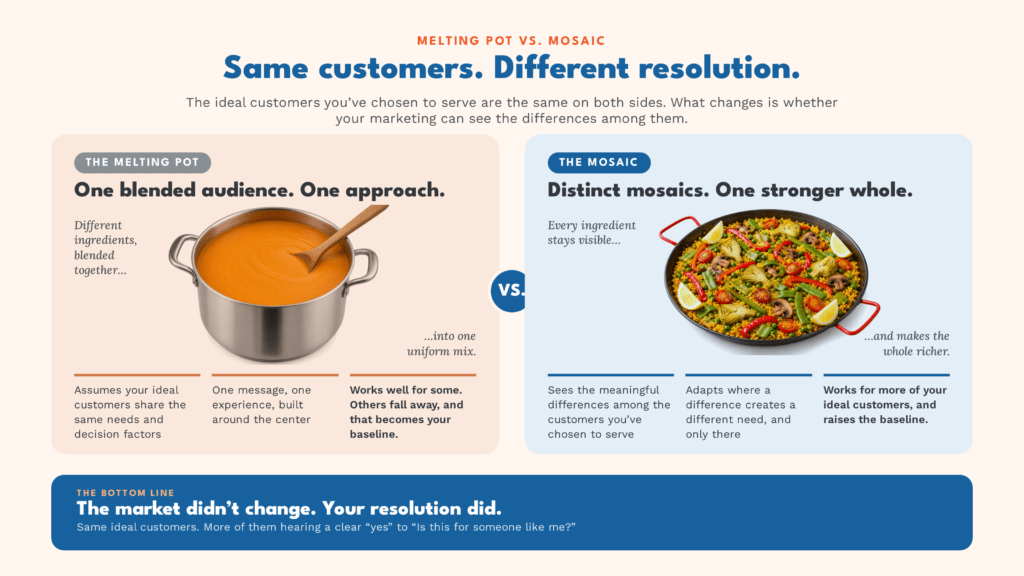
A “mosaic,” then, is a group of your ideal customers who share something meaningful that shapes how they make decisions about the problem you solve. Your total market is made up of many of them.
And one clarification belongs right up front, because it’s the first thing people worry about: Mosaic Marketing doesn’t mean being everything to everyone. It means being intentional about who you choose to serve, and becoming exceptionally good at serving them.
Listen on Apple Podcasts | Spotify | Read the full episode transcript ↓
Why One-Size-Fits-All Marketing Works for Some Customers and Not Others
I’ve often heard parents of more than one child talk about how different their kids are. They come from the same two parents, they grow up in the same house, and they’re still very, very different people. So those parents learn they can’t parent each child exactly the same way. A one-size-fits-all parenting approach isn’t as effective with each child. If they want to give each kid what they need, they have to switch up their approach when it’s warranted.
Just like kids aren’t one-size-fits-all, consumers aren’t either, even though a lot of brands act like they are.
That analogy matters because it gets at something marketers sometimes miss. People can belong to the same broad group, your “ideal customer,” your core segment, your target demographic, and still have meaningfully different needs. Those differences are often identity-based, and they shape how people receive your message, how they view the world, and whether they decide to move forward with you.
To be fair to general market marketing (a single, broad approach built to reach as many people as possible), it can absolutely work. Bennie F. Johnson, CEO of the American Marketing Association, put it this way in our conversation: “The reality is general marketing can still work. It’s a question of good, better, best. It’s a question of meeting the goals versus exceeding. It’s a question of surviving versus thriving.”
That’s the right frame. One-size-fits-all marketing can work extremely well for some of your ideal customers while creating friction for others. The opportunity is the level of customer centricity available to you once you understand the meaningful differences among the customers you want to serve, and the growth that’s currently being left on the table because those differences go unaddressed.
The Four Meaningful Ways Your Ideal Customers Differ
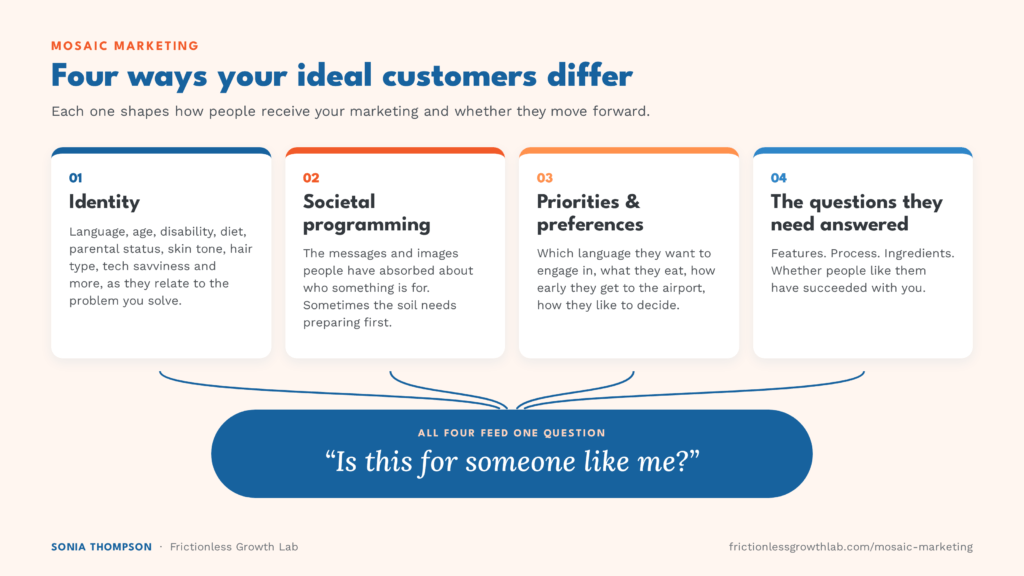
There are four ways your ideal customers tend to differ that shape how they respond to your marketing.
1. Identity
Your ideal customers hold a number of identities that are relevant to the problem you’re helping them solve, including: their language preferences, geographic location, disability, dietary restrictions, age, parental status, marital status, sexual orientation, degree of tech savviness, skin tone, hair type, even whether they embrace gentle parenting or are more old school.
Those identities influence how they make decisions, how they’ll receive your message and how they see the world. Your marketing needs to acknowledge and reflect that. The question to ask is which identities actually change how someone evaluates what you sell. Not every identity will. The ones that do are where your mosaics begin.
2. Societal programming
Every one of us, consumers and marketers alike, has been programmed in some way by society and the world around us: the images we see, the messages we receive, the way we interpret what we’re seeing and hearing, and what we’re not seeing and hearing too.
Someone with a larger body size receives different programming from society than someone with a smaller frame, through images, comments, what they see on the big screen and what they don’t see in mainstream media and marketing. Someone who is 50 receives different programming than someone who is 25. Someone who grew up with economic privilege receives different programming than someone who grew up economically disadvantaged. Women often receive different programming than men.
I saw how early this starts while doing math homework with my six-year-old daughter. The app she was using gave her a word problem: Steve did 57 pushups in one minute, and Jane did more than him. She looked at me, surprised, and asked, “Jane did more pushups than Steve?” A little later she said, “Girls don’t do pushups.”
My first thought was, where is she getting this from? (Then I had her do some pushups, just to show her that yes, girls can do pushups.) But that comment at six years old is the result of programming she’s already absorbed about who plays sports and who doesn’t, who is shown being active and who isn’t, who is strong and who isn’t. As her parents, we’re working on reprogramming that.
Now compound that with the decades of programming many of your ideal customers have received. For some of them, their mindset is fertile ground for your message. For others, you have some prepare-the-soil work to do before they’re in a position to receive it. That’s why societal programming belongs in your strategy. As marketers, we need to be aware of it so we can counteract it when needed, rather than assuming everyone hears the same message the same way.
3. Priorities and preferences
A few years ago, I was doing an audit and consumer testing for a client that wanted to reach Hispanic consumers. The brand had chosen to speak to those customers in Spanish. But through the user testing, we learned that many of the Hispanic consumers in the study were bilingual, and some didn’t speak Spanish at all. Their preference was to engage with the brand in English. For other ideal customers, Spanish, or another language, is their first language, depending on their geographic location, heritage and culture.
That’s a preference difference inside a group that, on a targeting sheet, looks like one segment.
Preferences show up everywhere. Some consumers prioritize a healthier lifestyle, whether that’s avoiding seed oils, abstaining from fried foods or following an anti-inflammatory diet. Some travelers get to the airport three hours early, and others arrive right before the plane door closes. Different customers have different preferences about how they make decisions and how they want to engage with brands.
4. The questions they need answered
Different customers also carry different questions that influence whether they can decide to move forward with you. Some want specifics about your features. Others want to know whether people like them have had success with your brand. Others want to understand your process from start to finish. Still others want to know what’s inside your product, how it was made and what the ingredients are.
When a customer’s question goes unanswered, it creates friction, and for many customers the answer to one of those questions is the difference between buying and walking away. (This is also why the kind of social proof you show matters; I’ve written about that in Relevant Social Proof: The Missing Link Between Customer Acquisition and Conversion.)
The Question Every Customer Is Asking: “Is This for Someone Like Me?”
Identity, societal programming, priorities and preferences, and core questions all point to the same conclusion: your ideal customers, on the whole, need more than a one-size-fits-all marketing approach.
Underneath all four sits one fundamental question every ideal customer is asking, consciously or subconsciously, whenever they’re considering a brand: Is this for someone like me?
General market marketing, by design, doesn’t answer that question well for a large share of customers whose identities, programming, preferences and questions are different from the people the marketing is speaking to most directly. The customers it was built around get a clear yes. Everyone else has to work harder to find their answer, and many won’t bother. Silence reads as no.
That’s the gap Mosaic Marketing closes. When you meet your chosen mosaics where they are across your marketing, then no matter where they enter your brand’s ecosystem, they get a clear, quick answer to that question, and the answer is yes. (For more on this question and why it drives conversion, see Ep. 148: Answer This Question to Convert More Customers.)
What Other Marketing Leaders Say About General Market Marketing
I’m not the only one who sees this. In the episode, I brought in three marketing leaders I’ve interviewed, each with a slightly different angle on it.
Myles Worthington, founder and CEO of the cultural connections agency WORTHI, is blunt about the traditional model. He describes a lot of general marketing as coming “from like a point of fear and safety for leaders, where they just do one thing that they try to hit the masses with.” His point is that even when culture feels shared, people enter it at different points: “The idea of like, ‘Hey, we’re gonna do this one thing that’s gonna hit everybody and move the needle,’ is just archaic.” What works instead, he says, is asking “what are we trying to say and who are we trying to talk to? What do they need to hear and see and feel from us to actually move?” (Read more from our conversation in General Market Marketing: Why It Limits Brand Growth.)
Amani Duncan, CEO of My Code, frames it as a budgeting mistake. “It is a business imperative,” she told me. “If you’re still carving out a piece of your budget, it’s wrong, friends… because it’s no longer a piece of the pie. The stats are clearly pointing to the fact that growth audiences are the pie.”
And Bennie F. Johnson, whose “good, better, best” framing I shared above, adds the nuance that keeps this honest. You can have a level of success with a generic approach. “What we know is if you want to be able to separate your brand, distinguish your brand, thrive in markets… it’s going to be best to evolve to these more relevant approaches to marketing.” (Read our full conversation in Why Trust Is the Growth Lever Modern Marketing Can’t Ignore.)
Each of them emphasizes something different. Myles sees the old default fading, Amani sees growth audiences as the market itself, and Bennie sees relevance as what separates brands that thrive from brands that simply get by.
Where Mosaic Marketing Shows Up Across Your Marketing Mix
This is where Mosaic Marketing goes further than an ad campaign or a multicultural initiative. Once you’ve chosen the mosaics you want to serve, those customers should be part of your thinking across your entire marketing mix: product development, brand messaging, customer experience, packaging, which influencers you work with, the campaigns you produce, the talent you cast, the imagery you put forward, your copy, and your ads and targeting.
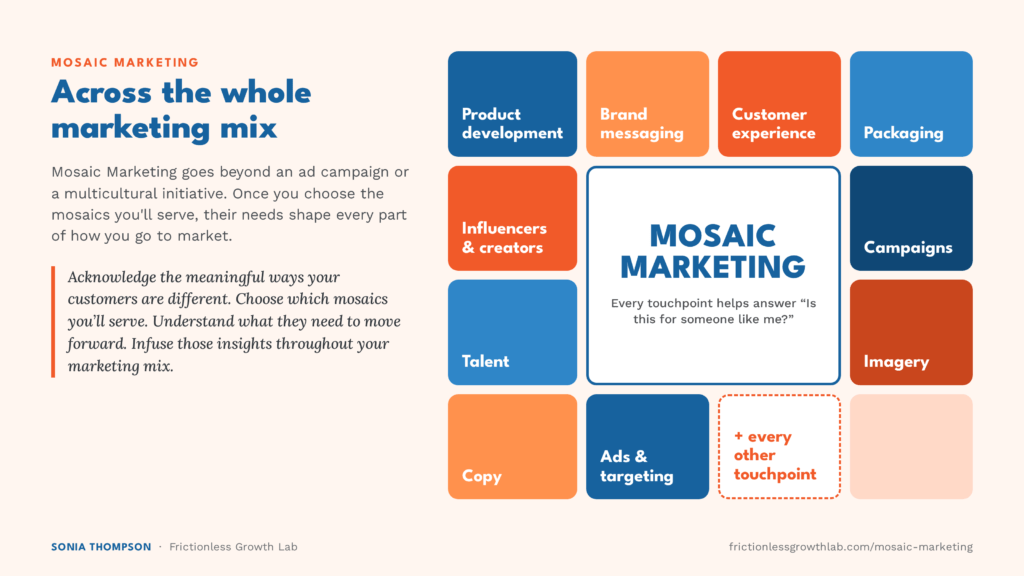
A useful way to pressure-test each area is to ask the same question for every mosaic you’ve chosen:
| Area of the mix | The question to ask for each mosaic |
|---|---|
| Product development | Does what we make meet this mosaic’s needs, or are we asking them to work around it? |
| Brand messaging | Does our messaging answer the questions this mosaic needs answered to move forward? |
| Customer experience | Where does the experience create friction for this mosaic that other customers never feel? |
| Packaging | Can this mosaic quickly tell the product is for someone like them? |
| Influencers and creators | Are the voices this mosaic trusts represented in who speaks for us? |
| Campaigns | Is this mosaic built into campaign planning from the start, or added at the end? |
| Talent and imagery | Can this mosaic see themselves in the people and scenes we show? |
| Copy | Does the language reflect how this mosaic talks and what they care about? |
| Ads and targeting | Are we reaching this mosaic where they actually discover brands like ours? |
You won’t change all of these at once, and you shouldn’t try to. But the list is a reminder that a customer’s answer to “is this for someone like me?” is shaped by every touchpoint, and that the friction holding a mosaic back may be sitting somewhere other than the ad.
Mosaic Marketing Examples: Brands Already Doing This
Smart brands are already practicing Mosaic Marketing, even if that’s not what they call it. What makes these examples useful is that each one answers a different kind of customer difference, in a different part of the mix.
Lysol: a product built around a preference. Lysol learned that its Hispanic consumers responded to different types of scents. Instead of expecting those customers to adjust to the scents the brand already had, Lysol created a new scent specifically for this community, based on their preferences. That’s Mosaic Marketing in product development. I talked about Lysol’s approach with Gary Osifchin, CMO and general manager at Reckitt U.S. Hygiene, the makers of Lysol, in Ep. 113.
HubSpot: translation isn’t the same as relevance. When HubSpot expanded into French-speaking markets in Europe, the team initially took what they had already built and translated it into French. But the market wasn’t responding to translated versions of existing content. They needed their own strategy, their own approach and their own local examples. Once HubSpot’s growth team started doing that, they began to see significant growth in those markets. I heard this story from Selim Dahmani, then a senior growth manager at HubSpot focused on the French market, in Ep. 127. (For more on doing this well, see What It Really Takes to Execute a Multilingual Content Strategy.)
Walmart: redesigning the experience for different sensory needs. Walmart heard that its in-store experience didn’t work for every type of customer it served, particularly shoppers with sensory sensitivities. After testing sensory-friendly hours on Saturday mornings during the 2023 back-to-school season, the company made them daily: since November 2023, every Walmart store in the U.S. and Puerto Rico has offered sensory-friendly hours from 8 to 10 a.m. local time, with a calmer environment that includes turning off overhead music, and no planned end date (Walmart). Walmart Canada followed in 2024 with sensory-friendly hours three mornings a week (Walmart Canada). That’s Mosaic Marketing in customer experience: people who need a calmer shopping environment get one, at predictable times.
Sephora: answering a question in the navigation. Sephora recognized that many Black shoppers are specifically looking to buy from Black-owned brands. So Sephora.com gives those shoppers a direct path to a dedicated Black-owned brands destination, meaning customers looking for that can find it straight away. That’s Mosaic Marketing in the digital experience: it answers a customer’s core question before they have to go looking.
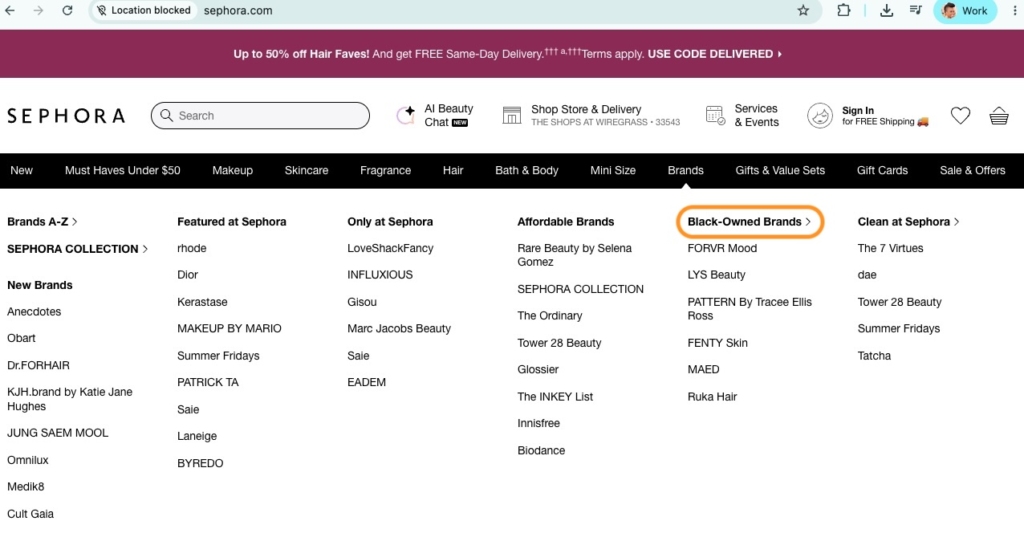
Notice what these four have in common. None of these brands tried to serve everyone at once. Each chose a mosaic, understood what that group needed to move forward, and changed something concrete.
Mosaic Marketing Doesn’t Mean Serving Everyone
Here’s where I want to take some pressure off. The expectation isn’t that your brand serves every possible customer group. That’s a super tall order that most brands can’t do effectively. If you can, that’s amazing, and I encourage you to keep going. If you’re not there yet, that’s totally okay.
The goal right now is to intentionally choose which mosaics your brand will serve, go deeper in understanding what those customers need from you to move forward, and infuse those insights throughout your marketing mix. Start with the mosaics that matter most to your growth, get genuinely good at serving them, and expand from there.
How to Start Applying Mosaic Marketing
The definition doubles as a sequence. Each part of it points to a deeper body of work.
1. Choose your mosaics. Look at your ideal customers and identify the meaningful differences, across identity, programming, preferences and questions, that change how they evaluate what you sell. Then decide which mosaics you’re going to serve first. Your buyer personas are where this lives. If your personas describe one “average” customer, they’re likely hiding the mosaics inside your market.
2. Understand what each mosaic needs to move forward. For every mosaic you’ve chosen, get specific about what they need to hear, know, see or have resolved before they’ll take the next step. This is the work of Mosaic Messaging, and Mosaic Message Mapping is how you check whether those messages are actually showing up across the touchpoints where each mosaic meets your brand.
3. Infuse those insights throughout your marketing mix. Use the table above to decide where each insight needs to show up, from product and packaging to copy, imagery and targeting. This is where understanding turns into content, evidence and experiences your mosaics can see for themselves.
If you’re not sure where your marketing is creating friction for the customers you most want to reach, that’s often the right first question to answer. The Friction Finder Growth Audit is designed to pinpoint where friction is suppressing your growth and where to focus first, which makes it a natural starting point before you decide which mosaics to prioritize.
How Mosaic Marketing Connects to the 7C Framework
Mosaic Marketing lives inside the 7C Frictionless Growth Framework, and it touches several phases. It starts with Customer Intimacy, knowing your customers well enough to see the meaningful differences among them. It shapes Customer Experience Design, where those insights become products, messages and experiences. And it depends on your Circle of Influence, the people and voices each mosaic trusts, which is why influencers, creators and talent belong in the conversation.
Frequently Asked Questions About Mosaic Marketing
Is Mosaic Marketing the same as multicultural marketing?
No. Multicultural marketing is one place Mosaic Marketing can show up, but Mosaic Marketing is broader. It accounts for any meaningful difference among your ideal customers that changes how they make decisions, including language, age, disability, diet, body size, parental status, tech savviness and more. It also goes beyond campaigns. Mosaic Marketing applies across your whole marketing mix: product development, messaging, customer experience, packaging, influencers, talent, imagery, copy, and ads and targeting.
Does general market marketing still work?
It can. As Bennie F. Johnson of the American Marketing Association put it, it’s a question of “good, better, best.” A one-size-fits-all approach can perform well for some of your ideal customers, and aggregate results can look healthy. The risk is that those averages hide the customers it isn’t working for. Mosaic Marketing helps you see who your marketing is working for and adapt so more of your ideal customers get a clear answer to “is this for someone like me?”
Do I need to market to every customer group?
No. Mosaic Marketing doesn’t mean being everything to everyone. It means being intentional about which mosaics you choose to serve and becoming exceptionally good at serving them. Most brands can’t serve every group effectively, and they don’t need to. Start with the mosaics most important to your growth, understand what they need from you to move forward, and build those insights into your marketing mix before expanding to others.
How is Mosaic Marketing different from customer segmentation?
Segmentation groups customers so you can target them, and Mosaic Marketing uses it. Mosaic Marketing asks what each group needs from you to move forward, including the identity, programming, preferences and questions behind their decisions, and then builds those insights into everything from product to customer experience, so each mosaic can quickly see that your brand is for someone like them.
Mosaic Marketing is aligned with who customers are today and how they make decisions. The brands that win will be the ones that stop asking their customers to conform, and start meeting each mosaic they’ve chosen to serve where they are.
Full Episode Transcript
Transcript of Frictionless Growth Lab Ep. 234, “Is Your Marketing Only Working for a Fraction of Your Ideal Customers? | Mosaic Marketing.” Lightly edited for readability. Sponsor messages are marked, and a sentence interrupted by a sponsor break has been rejoined.
Sonia Thompson: Is the way your brand approaches marketing bringing your ideal customers closer to you or is it pushing them away? Is it giving them clarity or is it introducing friction? For some groups of customers, your marketing may produce exactly the impact that you intended, building trust, driving conversions, and increasing revenue. But for other groups of your ideal customers, the exact same marketing can produce the opposite of what you intend, confusion, frustration, and ultimately taking a step back away from your brand rather than taking a step closer to your brand.
Today, we're talking about how to make your marketing more effective with a higher percentage of your ideal customers so you can get better results with more of the people you want to reach rather than just a fraction of them. We're gonna get into all of it after this short break.
[Sponsor break]
When a buyer asks AI for a solution like yours, does your business come up? Most companies have no idea, and by the time they find out, they've already lost the deal to someone who did. HubSpot AEO helps you show up in those moments with the right answers buyers are looking for before the first click, before the first form fill. That's the moment HubSpot AEO is built for. Check out hubspot.com, the agentic customer platform for growing businesses.
[End of sponsor break]
Now, I've often heard parents who have more than one child talking about how even though your kids come from the same two parents and grow up in the same house, that they are very, very different.
And as a result, that means that you can't necessarily parent each child exactly the same way. So in essence, what many of these parents are saying is a one-size-fits-all parenting approach isn't quite as effective with each of their children. If they wanna give each kid what they need, they need to switch up their approach a little bit when warranted. Just like kids aren't one size fits all, people aren't one size fits all, and consumers are not one size fits all even though a lot of brands do try to act like they are.
In essence, this notion of one size fits all is a bit of a lie. Most things just don't work that way, and that's because different consumers have different needs, and often those needs of consumers are identity based. Sometimes a consumer's language preferences, geographic location, their disability, their dietary restriction, their age, their parental status, their marital status, their sexual orientation, their degree of tech savviness, their skin tone, their hair type, whether they embrace gentle parenting or whether they're old school. There are a number of different identities that your ideal customers hold as it relates to the problem that you are working to try to help them solve, and those identities influence their decision-making, of course how they're gonna receive your message, how they view the world, and your marketing needs to acknowledge and reflect that.
Another way your ideal customers are different comes through their societal programming. Everybody, consumers, us as marketers, we have all been programmed in some way, shape, or form by society and the world around us, whether it's the images we see, whether it's the communication or the messages that society is sending us, the ways in which we're interpreting the things that we're seeing and hearing and not seeing and hearing as well. Someone who has a larger body size or type has different programming that they are receiving from society at large, whether through images, through messages, through comments, through what they see on the big screen in media, what they don't see in mainstream media and marketing. All those things are sending messages.
And so what someone with a larger body size or type is receiving different messages and different programming than someone who might have a smaller frame. Someone who is 50 receives different types of societal programming than someone who is 25. Someone who has grown up with a lot of economic privilege has received a lot of different societal programming than someone who wasn't, from someone who was disadvantaged economically growing up. Women often receive different societal programming than men do.
I was sitting with my six-year-old daughter yesterday as we were doing her math homework, and she was in an application that she's working to do these problems. And the application, it said Jane and Steve were doing pushups, and Steve did 57 pushups in one minute, and Jane did more than him. And she sit there and she looked at me and she's like, "Jane did more pushups than Steve?" And then later on she said, "Girls don't do pushups." And first I was just like, "Oh my goodness, where is she getting this from?" And then I had her go and do some pushups just to show her that, yes, girls can do pushups. But what she said, that comment from her at six years old is a result of programming that she's seen in terms of who is playing sports and who doesn't play sports, who is being shown as doing things that are very active and who isn't, who is strong versus who isn't.
So as her parents, we're gonna be working on reprogramming her to make sure that she knows that pushups aren't just for boys, but that just gives you an idea of all the different type of programming that's coming in from all different places. And then we have to compound that with the decades long of programming that many of your ideal customers have received, then how that makes their mindset fertile ground or needing some additional prepare the soil work to be able to be in a position to effectively receive your messages. Societal programming exists in a lot of different ways, shapes, or forms, and as marketers, we need to be aware of it so we can counteract it whenever needed. Another way consumers are different is through their priorities and their preferences.
I saw this whenever I was working with a client doing an audit for them and some consumer testing a few years ago. The brand specifically was trying to reach Hispanic consumers, and the brand had opted to speak to their Hispanic consumers via Spanish language. But through the course of the user testing, we found out that a lot of Hispanic consumers were bilingual.
They spoke English, and some of them didn't speak Spanish, so these ideal customers' preference was to engage and interact with the brand in English rather than Spanish. For some ideal customers, Spanish is their first language or some other language, depending upon where they are, their geographic location, their heritage, their culture. When it comes to diet, for instance, some consumers prefer to eat a healthier lifestyle, whether it's preferring not to eat seed oils or abstaining from fried foods and, or following an anti-inflammatory diet. When you're traveling, some people prefer to get to the airport three hours in advance.
Other people prefer to get to the airport right before the plane door closes. Different consumers have different preferences about how they're making decisions and how they are engaging with brands. In addition, different consumers have different questions that influence their ability to make a decision about whether to move forward with you or not. Some people wanna know more specifically about different features that you have.
Others will have questions about people who are like them, who have had success with your brand in the past. Others wanna know all about your process from start to finish. Other consumers wanna know what's inside your product, how was it made, what are the specific ingredients that are involved with it. Different types of consumers have different questions.
And all of these things, identity, societal programming, priorities and preferences, and core questions, those things just demonstrate very clearly that your ideal customers on the whole need more than just a one-size-fits-all marketing approach to meet their needs. So whenever we think about it from that perspective, it makes it easy to understand that one-size-fits-all marketing or general market marketing doesn't quite hit the mark the way it could or isn't quite as effective as it could be in helping you attract, convert, and retain more of your ideal customers. Even though many brands do practice general market marketing, that just means a lot of them are leaving a lot of growth on the table.
[Sponsor break]
Okay, I've got another podcast recommendation for you. It's I Digress, hosted by Troy Sandidge, and it's brought to you by the HubSpot Podcast Network, the audio destination for business professionals. I Digress helps eliminate complexity, complications, and confusion in your business with frameworks and strategies to achieve scalable and sustainable success. Here's one episode for you to tune into to get you started: Which Growth System Is Quietly Costing You Revenue in Your Business? Listen to I Digress wherever you get your podcasts.
[End of sponsor break]
General market marketing isn't always effective as it could be because it doesn't answer the fundamental question that all of your ideal customers are having, whether it's consciously or subconsciously, whenever they're considering a brand to work with. That fundamental question is: Is this for someone like me? And general market marketing just doesn't do a very good job by design of answering that question for a large percentage of customers if their identity, decision-making drivers, programming, preferences, and questions that they have are very different from other people that general market marketing is speaking to more directly. But don't just take my word for it.
You're about to hear from three marketing leaders I spoke with who all have a perspective on this. The first one is Myles Worthington, the founder and CEO of WORTHI, a cultural connections agency that has worked with major brands including Google, Apple, Disney, Amazon, Hulu, and Paramount. Next is Amani Duncan. She's the CEO of My Code, a media and marketing agency focused on reaching diverse consumers.
Over the course of her career, she's worked with major brands including Google, Netflix, Heineken, Mattel, LinkedIn, and Lionsgate. And lastly, you'll hear from Bennie F. Johnson, the CEO of the American Marketing Association, the world's largest community of marketers with more than 20,000, with more than 29,000 members worldwide. Here's what they had to say.
Myles Worthington: Always talk about just the idea of the general market being dead, and she's been dead for a while. When we think about general marketing, lots of times it happens from like a point of fear and safety for leaders, where they just do one thing that they try to hit the masses with, but that just never works, right? There is sometimes a sense of monoculture, like we'll all gravitate around something happening in culture, but we enter at different entry points. So the idea of like, "Hey, we're gonna do this one thing that's gonna hit everybody and move the needle," is just archaic.
It doesn't work anymore. So we really pride ourselves in thinking about what are we trying to say and who are we trying to talk to? What do they need to hear and see and feel from us to actually move? And that requires just some audience segmentation, some research, et cetera, but nothing that's like a one-stop shop, nothing that's just gonna do one thing and hit the masses.
That just doesn't exist anymore.
Amani Duncan: It is a business imperative. If you're still carving out a piece of your budget, it's wrong, friends. It, it, it is, because it's, it's no longer a piece of the pie.
The stats are clearly pointing to the fact that growth audiences are the pie. If you are not authentically, incredibly reaching out and engaging with growth audiences of today, you are so late, and it will impact your bottom line.
Bennie F. Johnson: The reality is general marketing can still work. It's a question of good, better, best.
It's a question of meeting the goals versus exceeding. It's a question of surviving versus thriving. So I won't say that if you do a generic approach to marketing, no matter what your product is, its scale or its scope in there, that you won't have success. You can have a level of success.
What we know is if you want to be able to separate your brand, distinguish your brand- thrive in markets and space in there, it's going to be best to evolve to these more relevant, uh, approaches to marketing.
Sonia Thompson: So if general market, one-size-fits-all marketing isn't as effective for today's consumers, given all the differences that they have, what should brands be doing? How should brands be addressing these consumers of today? That's where Mosaic Marketing comes in.
Mosaic marketing helps brands better serve their ideal customers and convert them at higher rates. It fully supports growth with today's consumer. So to make sure that we are all on the same page with what exactly is Mosaic Marketing, let me give you the definition of it. Mosaic marketing acknowledges the meaningful ways that your customers are different.
You're intentionally choosing which mosaics your brand will serve because the expectation isn't that you are serving everybody. That is a super tall order that most brands can't do effectively. If you can, that is amazing, and I applaud you, and I encourage you to keep going. If you're not there yet, it's totally okay.
The goal at this point in time is to intentionally choose which mosaics your brand will serve, go deeper in understanding what it is that those customers need from you to move forward, and infuse those insights throughout all areas of your brand's marketing mix. So that means that the different mosaics that you've chosen to serve, you should be thinking about them whenever it comes to your product development, when it comes to creating your brand's messaging, your customer experience, your packaging, which influencers you work with, the various campaigns that you're producing, the talent that you are choosing, the imagery that you are putting forth from your brand, your copy, of course, your ads and targeting, anything else that I may have missed. Smart brands are already engaging in Mosaic Marketing, even if that's not what they're calling it. Because at its core, Mosaic Marketing is really just being customer-centric.
It's acknowledging that your ideal customers are different and meeting them where they are. Instead of expecting them to conform to you and your way of doing things, it's you adapting your way of doing things to what it is that they need from you. A few examples of some brands who have done this. Lysol started creating new scents for different customer groups.
They learned that their Hispanic consumers responded better to different types of scents. So instead of expecting them to adjust to the scents they already had, they went out and created a new scent that was specifically for this community based upon their preferences. When HubSpot wanted to expand into the French-speaking markets in Europe, initially, they tried to take what they had already done and translate it into the French language, but then they started to realize the market wasn't responding to just translated versions of what was already done. They needed their own strategy, their own approach, their own local examples.
And once the HubSpot growth team started doing that, they started to see significant growth in those markets. When Walmart started getting feedback that their in-store experience didn't work for all the different types of customers they had, specifically those who had sensory processing disorder, they decided to implement sensory-friendly hours across all their stores in North America from eight to 10:00 AM every morning so that people who had different sensory needs and needed a much more peaceful shopping environment, they could come into the store at those hours to have a shopping experience that better aligned with what it is that they needed. Sephora recognized that there are a number of Black shoppers who specifically are looking to buy Black-owned brands. So in their main navigation on their brand's website, you will find a category for Black-owned brands so consumers who are looking for that can find it straight away.
I've got so many other examples for you. I will drop them in the show notes for you in case you wanna check it out and explore further. One size fits all marketing is not the way to go to convert more of your ideal customers. To increase the effectiveness of the marketing that you are producing, let's move away from one size fits all marketing.
Let's lean much more heavily into Mosaic Marketing, where we are acknowledging the different ways that our ideal customers are different and meeting them where they are throughout our marketing mix, throughout your brand's ecosystem, so no matter where your ideal customers are entering, no matter what it is, their identity, they are able to get an answer to the fundamental question clearly and quickly, "Is this for someone like me?" And the answer they're getting is an affirmative. If your brand has historically engaged in one size fits all general market marketing and needs to start making this transition into Mosaic Marketing, and you're not sure where to start or how to pull it off, and you could use some help in doing that, definitely, I've got you. I will drop some links into the show notes for you on how I can support you in doing that. Until next time, remember, growth accelerates when you remove friction for your customers and for your business.
Thanks so much for listening. Talk to you soon.
Found this post useful?
There’s more where that came from—get insights on the new rules of growth delivered to your inbox.