When I went to Nike House of Go in Buenos Aires, I showed up in a tank top and a skirt. I was spending a Saturday afternoon with friends. One of them worked at Nike and had invited us to the pop-up event she and her team had been working on.
I didn’t think of myself as a runner. I was there to spend time with my friends.
We laughed among colorful cushions and watched an art installation mirror our movements on a screen. Trying on the shoes was another thing we could do together.

My friend encouraged me to go for a run, and the Nike team made it easy. So the two of us and two women from the team put on the shoes and headed around the block.

That experience helped me start picturing myself as a runner. A couple of weeks later, when I decided to buy running shoes, Nike was the brand I went to.
Looking back, that afternoon was upper funnel marketing at work. Upper funnel marketing helps people discover a brand and see why it might matter to them before they’re actively shopping.
From the Mosaic Studio series, Part 4. In Episode 240 of Frictionless Growth Marketing, I explore how content, campaigns, and experiences can enter conversations customers are already having and give them a reason to consider your brand.
Listen on Apple Podcasts | Spotify | Read the full transcript
How upper funnel marketing helps customers see what’s possible
Before customers have a shortlist, something has to make the possibility feel relevant enough to explore.
Your ideal customer doesn’t need to be actively shopping for your product or service to be interested in something relevant to their life. They already have goals, challenges, interests, and aspirations. They’re already paying attention to things that matter to them.
Upper funnel marketing can meet them there. A story, campaign, or experience can introduce a possibility they hadn’t considered, or show them a different way to address something they’ve been living with.
Lower funnel marketing has a different job: helping people who are already interested evaluate their options and choose. If that’s the challenge you’re working on, Part 3 of this series explores how content can help convert more prospects into customers.
The funnel is useful shorthand for different marketing jobs, and customers can move between them in any order. Someone might watch a story, look up a product, leave it alone for months, and come back when their circumstances change.
What interests me here is the moment when a person sees something and starts thinking about a new possibility for their own life. With Nike, I could begin to answer “Is this for someone like me?” differently. I could picture myself running.
Once I saw myself as a runner, I did what runners do. I bought running shoes. Trying the shoes and running around the block with friends gave me a reason to believe I could do it again.
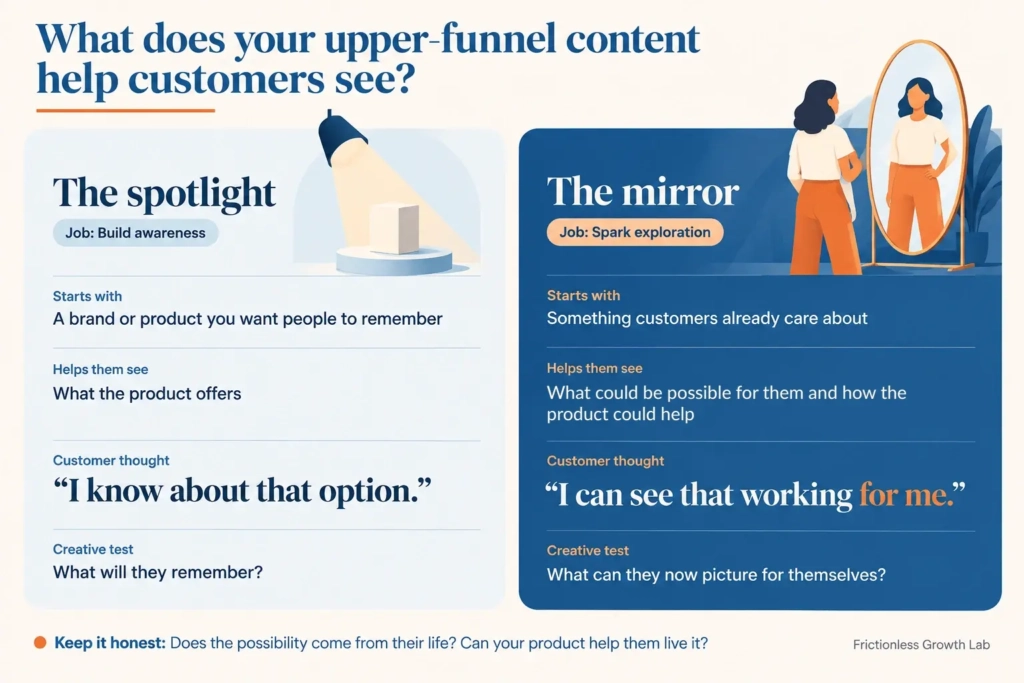
That’s what makes this kind of upper-funnel marketing work. Start with something that already matters to the customer. Give them a way to picture what could be possible for them and see how your product could help. A fun experience earns its place when it helps them see something they’d actually want in their life.
That’s one way to use Mosaic Content: content created with a particular group of ideal customers and their needs, experiences, or motivations in mind. In Mosaic Marketing, different customer mosaics may need different stories and experiences alongside your universal marketing.
Within the six Mosaic campaign types, this is an application of Prepare the Soil. You’re giving a customer a reason to recognize why what you offer might matter to them.
Some people may begin exploring right away. Others may remember you when they’re ready to look.
Help Lois and Jack recognize a possibility for their home
Imagine a couple, Lois and Jack. They’ve had their sofa for about 15 years. It’s still in reasonably good condition, and they like the way it looks in their living room.
But lately, getting up from that low seat has become harder.
Replacing it hasn’t made their list yet. They’ve noticed the problem, but they’re still living with it.
They care about style, comfort, and quality. They want their living room to reflect their taste. They’d also like seating that makes sitting down and getting up easier, without having to turn their living room into something that doesn’t feel like them.
Now imagine a furniture brand creating a home-tour series.
The series features interesting people in beautiful homes, talking about how they’ve created spaces that reflect their lives. They show the objects they’ve collected, the design choices they’ve made, and how their homes have evolved over time.
Lois and Jack would watch because they enjoy the people and the homes. They don’t have to be shopping for a sofa to find that interesting.
In one episode, a homeowner talks about rethinking the living room. They loved their previous sofa, but getting up from it had become difficult. The homeowner sits on the new sofa and stands back up to show what changed. The seat is higher, and the sofa still looks like something they’d choose for their living room.
Lois and Jack had gotten used to pushing themselves up from a low seat. Seeing someone get up easily from a sofa they’d actually want in their living room gave them a reason to rethink what they’d been putting up with.
Maybe Lois and Jack want to find the sofa immediately. Maybe they share the episode with each other and leave it there for a while. When they do decide to replace their furniture, the series could give them a place to begin.
Here’s the question I’d put to the furniture brand’s creative team. Would Lois and Jack watch this home tour on a Saturday when a new sofa is nowhere on their list? What could they picture for themselves afterward?
When you talk to your customers, listen for what they’ve learned to live with. That’s often where you’ll find a story they’d watch before they ever think to shop.
Give interest a useful next step
Now imagine Lois and Jack want to know more. They click through from the home tour, but land on a general furniture page. They can’t find the sofa they just saw, and the products they do find leave them wondering which ones might work for them.
The content has created interest. The next experience is asking them to start figuring things out again.
This is where you roll out the red carpet. Make it easy for them to find the sofa, see how it works, and try it for themselves.
Each home-tour episode’s page could identify the exact sofa in the home tour, link directly to it, and explain the features discussed in the story. It could also say where customers can try it in person.
The product information still needs to cover the things Lois and Jack care about: style, comfort, materials, quality, and how the furniture fits their home. Alongside that, it needs to help them evaluate the practical requirement that brought them there.
A beautiful sofa that’s too low is still the wrong sofa.
When I took a quick look at furniture ads and product pages and tried an AI-assisted search, I found dimensions. I still had to work out what they meant for Lois and Jack. A seat-height measurement gives you a number to compare. A short demonstration shows you what to look for when you sit down and stand up in the showroom.
If your team needs to connect the interest a story creates to useful answers across touchpoints, Mosaic Message Mapping can help identify what customers need to know and where they need to find it.
And the product has to deliver. A story can help someone recognize a relevant option; it can’t make unsuitable furniture meet their needs.
Put it in your next campaign brief
Think about one customer mosaic your brand wants to reach. What conversation is already happening in their life that connects to what you offer?
Start there, before deciding what to produce.
1. Name the customer and the conversation
Be specific about the group and what matters to them. For Lois and Jack, the conversation is about how to make their home work better without giving up the style they love.
Customer research can help you understand how people describe that tension, what they’ve already tried, and what they might want to change. Give the creative team something more useful than a demographic label.
2. Identify a possibility you can help them see
What could become imaginable through your content or experience?
For Lois and Jack, it’s a beautiful living room with seating that better meets their needs. At Nike House of Go, I got to experience running in a way that made it feel like something I could do.
Keep the possibility grounded in what your brand can genuinely offer. Does it come from their life? Can your product help them live it?
3. Create something they’d choose to spend time with
Think about the value of the story or experience before the product search begins. The home tour offers people, design, and inspiration. The Nike event gave me a fun afternoon with friends and an easy invitation to participate.
Your format might be a series, a single story, an event, or another experience. Choose it based on what would interest that customer mosaic and make the possibility tangible.
4. Make the next step useful
If someone becomes curious, what should they be able to do? Find the featured product? See how it works? Try it? Get an answer to a question?
Plan that continuation as part of the campaign. Check that the destination helps the customer explore what caught their attention and that your team can deliver the experience you’re inviting them into.
Here’s a prompt to bring into your next brief:
Our customer is already thinking about ____. We can help them picture ____ through a story or experience they’d want to spend time with. Our product or service can help make that possible by ____. If they’re curious, the next useful thing they can do is ____.
For the furniture example, that could read:
Our customer is already thinking about how to make their home more comfortable without losing the style they love. We can help them picture a living room that works better for them through a home tour they’d enjoy watching. Our sofa can help make that possible with a higher seat they can try for themselves. If they’re curious, the next useful thing they can do is find the featured sofa, learn about its design, and see where they can try it.
This work connects several parts of the 7C Frictionless Growth Marketing Framework: Customer Intimacy helps you understand the conversation; Circle of Influence brings the lived experiences of the customers you want to reach into the decisions shaping the work; Customer Experience Design and Delivery help make the continuation useful.
Upper funnel marketing gives you a way to reach customers before a product search brings them to you. Start with something that matters in their life, help them recognize a possibility, and roll out the red carpet if they want to explore it.
Growth accelerates when you remove friction. For your customers and for your business.
Develop your next Mosaic Content campaign
Want to reach a specific group of customers before they start shopping? Mosaic Studio can help you develop a story, campaign, or experience that gives them a reason to start exploring.
Full Episode Transcript
Episode 240 of Frictionless Growth Marketing, “How to Get Customers to Buy Sooner (Before They’re Even Shopping).” Transcribed from the podcast audio and lightly edited for readability. Sponsor messages are marked.
What if you can create a campaign that enters a conversation that your ideal customer is already having in their head. Something that captures your attention and then rolls out the red carpet from where they are today all the way to your brand’s doorstep. There is specific content and campaign type that does exactly that and it can be especially powerful for specific types of customer groups within your total addressable market who may not be choosing or considering your brand at the same rates as others even though they absolutely could.
And it’s not because they’re less of an ideal customer than maybe some of your others are, it’s just that they haven’t yet received the type of content or campaign that they need to get them from where they are over to that finish line. Today we’re gonna look at what those content and campaigns look like, why they work, and how you can create them for your own brand to accelerate growth. And we’re gonna get into all of it after this short break.
[Sponsor message] So growing a business means you wear a lot of hats, but way too often you spend hours sifting through your own notes and trying to remember every detail. It’s hard to balance on top of all your other tasks. HubSpot’s built-in note taker organizes every call for you. It summarizes each conversation, keeps customer details up to date, shows you the next steps to take, and even drafts a follow-up email for you to review. You can pause and pick up where you left off without needing to keep track of everything. The best part? Note taker helps customers close 45% more deals, and it lets you take off at least one hat, even if you’re still wearing a dozen others. Right now you can get HubSpot’s starter plan for $10 a month. Learn more at HubSpot.com. [End of sponsor message]
Before customers start shopping
In the last episode we talked about how Mosaic Content can help people who are already considering your brand move closer to actually choosing your brand. Today we’re going to talk about how to get more of your ideal customers to even start considering your brand in the first place. To be clear, your ideal customer doesn’t need to be actively shopping for the product or the service that you offer to be interested in content and campaigns that are relevant to their lives.
They already have goals, challenges, interests, and aspirations. They’re already paying attention to things that matter to them. The opportunity is to create content, campaigns, and experiences that meets them there.
Nike House of Go
When I was living in Buenos Aires, I was hanging out with some girlfriends, and one of them worked at Nike, and she invited us to this event that she and her team had been working on called the Nike House of Go. This is a very cool pop-up event that they had created in this house in the neighborhood that I was living in. You would go into the house. There are all kinds of different activations. It was super fun.
One of the things that they did was allow you to be able to try on shoes and go for a run. Now, I showed up. I’m at this event. I’m in a tank top. I’m in a skirt, but my friend said, hey, come on, let’s go. And the people at this House of Go were super kind and cool, and they encouraged me to go on a run in a pair of Nike shoes that they were promoting at this event.
So I put the shoes on and me and my friend and these two women who were part of the Nike team, we went and we ran around the block. I’m going to find the picture and I’m going to show you the picture of us running around, but the interesting thing that popped up, never had I really considered myself a runner, but by going to this event and then making it so easy and just a part of participating in the event for us to put on a pair of Nike shoes and run around the block and making it this really fun experience.
Now, I was starting to think of myself as a runner and a couple of weeks later, what did I do? I ended up buying myself a pair of Nike running shoes and I started running. None of that would have happened if I hadn’t gone to this House of Go event where it encouraged me to do something that I normally would not have done. As a result of that, whenever it came time for me to get the gear that I needed to take on this new identity that I was seeing myself as, that this event seeded, I went directly to the brand that kind of ignited this fire within me.
Because Nike had planted the seed for me, they became the number one and quite frankly the only brand that I was considering whenever it came time to make a purchase. So that was an example for me from way back when about how a specific type of content campaign or activation caused me to move forward and to actually become a customer and to buy something that I wasn’t previously thinking about doing. It integrated into my life because it was something that I did with some friends on a Saturday afternoon.
Lois and Jack: a furniture-shopping example
Now, for the rest of the episode, I want to show you how this might play out with a different example, this time with a couple who is shopping for furniture. So imagine a couple, Lois and Jack, they are in their late 50s and they’ve had this beautiful furniture in their home. Specifically, they’ve got this sofa set that they’ve had in their home for the last 15 years or so. It’s still in reasonably good condition. They love it.
They find that it fits with their style. It’s comfortable, but more and more they’re noticing that it’s not as easy to get up out of the couch as it used to be. Sometimes they find that they’re having to make a few little extra noises and their little extra creaks that are happening whenever they’re sitting down. And they’ve also noticed that whenever their mother comes over to visit, she doesn’t even sit in the couches anymore because for her, it’s just a mobility challenge to sit down and get in because it just seems like these couches have gotten lower over the years, even though we know that’s not the case.
So the couple starts to see that this couch that has been a staple in their home for all these years isn’t quite meeting the needs of their family the way it used to and their extended guests the way it used to. And it’s probably time to start thinking about a change. They love their living room. They want some beautiful pieces of furniture that complement their current style, their aesthetic that they’ve got. They want something that’s good quality, nothing that they’ll feel like they’re going to have to replace in just a few short years.
They want comfort, right? They want to sit there and just be able to chill and enjoy their time using it. They want furniture that reflects their tastes and all their specific preferences. But now there’s also another important requirement. They need something that they can sit down and stand up in with ease and something that works really well for their mother whenever she comes and visits. And that makes her feel comfortable. They’re not really looking for like a lift recliner that kind of pushes you up or kind of helps you ease you into sitting down and they’re not looking for medical type of furniture.
They want attractive comfortable stylish furniture that fits with their everyday lives. So in essence for where they are now, what their requirements are now, a beautiful sofa that is still too low is the wrong sofa for them. And that presents a little bit of a challenge when it comes time for them to start looking for this new sofa. Because furniture brands are in the habit of communicating about style, comfort, quality, durability, even. So remember, every consumer is asking a fundamental question as they’re going through the buying process and that is, is this for someone like me?
And in the case of this couple, the key aspect of the someone like me question is really going to be people who need a couch that isn’t too low, that’s a little bit higher and that meets their needs from a mobility standpoint, as well as all the other style and comfort and durability features. Now this isn’t to say that every consumer within this age bracket is going to have the same need, but I’ll venture to say that as the brand starts to think about their total addressable market, there are going to be a number of people who, for whatever reason, and it might not be just related to their age, wants a couch that is just a little bit higher up.
So it’s important to think about messaging for this type of group or mosaic so that they can get the answers that they need without having to actively hunt and search to find the answer that they need that communicates, yes, this is for people like you. So what happens when this couple actively starts to look for a couch that will meet their needs, the couch that is for people like them?
[Sponsor message] Okay, I’ve got another podcast episode for you. It’s Demand Decoded and it’s brought to you by the HubSpot Podcast Network, the audio destination for business professionals. From the team at Blend, a B2B website and demand generation agency, comes the podcast that breaks the mold of traditional B2B marketing tactics. Hosts Dan and Phil deliver actionable insights that transform your marketing into a revenue generating machine. So if you’re ready to stop wasting budget on tactics that don’t work and start building a marketing strategy that actually drives pipeline, this show is perfect for you. One episode that I recommend that you tune into is the predictable pipeline playbook from lucky quarters to repeatable growth. Listen to Demand Decoded wherever you get your podcasts. [End of sponsor message]
What the furniture search revealed
I explored this on behalf of this couple through search engines, furniture advertisements, product pages on brand websites, and even an AI assisted shopping conversation. And so this was a snapshot of one shopping investigation, not a comprehensive audit of any specific furniture brand. And so here’s what I saw from brands. All the ads emphasize attractive rooms, comfort, style, and promotions for sales that they were having. A number of them talked about durability, especially as it relates to people who have kids and they need something that’s going to stand kids jumping on and off the couches.
And these are all relevant benefits, but they didn’t necessarily answer the question that our couple was asking or what they needed to know that yeah, this couch is for someone like me. None of the advertisements addressed someone who finds low seating difficult. Because I wasn’t finding anything on just the overall different furniture brand advertisements, I turned to Google. Then I started searching for sofas that would be easier for people to sit on and stand up from.
Now, some results provided guidance about seat height and other design characteristics. Other results pointed towards specialized furniture or general product listings. A few results even pointed just directly to a brand’s ADA guidelines for their overall website. And the more I started to refine my search, I started to get results for accessible furniture from different brands. Now, a lot of those did kind of lean into lift recliners, which wasn’t at all what this couple was looking for.
So whenever I got to different brand websites and looked at their product pages specifically, almost all of them did include dimensions for the sofas. There would be things like seat height, seat depth, cushion construction, all useful information. But for the average person, they don’t really know what that means, right? That means they’re going to have to go and measure their own couch to kind of see if it works for them, if it doesn’t. It just feels very technical.
And that’s not traditionally how this couple particularly looks for a couch. Whenever I turn to AI as a part of this exercise, I went to ChatGPT specifically. I asked it for recommendations. I kind of laid out the case of what was happening based upon what I told you earlier. They’re starting to have more and more trouble sitting down and getting up and their mother just doesn’t even bother sitting in the couches at all because it’s too much of a hassle.
And so AI in this instance returned some considerations that they should be thinking about when it comes time to choosing the couch. And then it made a recommendation of about 10 different brands that could be beneficial and that they can turn their attention to. That would have couches that met their primary need from a heightened accessibility standpoint, but also their other needs with regards to design, style, durability, aesthetic, etc. But the interesting thing that I found here is that none of the useful information that the couple found came from the furniture brands themselves.
In fact, the furniture brands were almost the least useful overall in this process because they just offered up some technical specifications and really what a customer was going to have to do was just go into a store and just kind of start sitting on couches and figuring it out or maybe relying on a salesperson to help them, which of course is going to be useful. They would need to do that. They’re probably going to end up doing that anyway before choosing an offering, but it just was requiring a lot of work on their part and there was enough friction involved for them to just not be excited about going through it overall.
So here we have a number of furniture brands who probably already have a product that is exactly what this couple is looking for, but the couple is having a lot of trouble finding information that lets them know that this brand has exactly what it is that this couple needs, that they’ve got exactly products designed for people like them in mind. The product exists, but the couple never discovers that exists. So the brand never really makes it into the consideration set and ultimately the couple doesn’t buy anything.
They’re not converting. So ultimately what might happen is this couple will probably just stick with their current setup, their current couch that they have for a little while longer until eventually the problem may become so prevalent that they have to make a decision and they have to go through and start actively looking for options that will work for them. So that is probably what’s happening in a lot of instances now, but what would happen if a furniture brand decided to enter the conversation earlier and to have a better conversation so that it makes it easier for a couple like this to find exactly what they need so that whenever it comes time for them to make a decision or something that the brand creates prompts them to make that decision even earlier.
Going back to my Nike House of Go story, I wasn’t thinking about starting to run, but because of what they created I was like, oh maybe I should do this and I ultimately made a purchase. What if a furniture brand could do the same thing for people like this couple? Here’s an example of how that could work.
Entering the conversation earlier
What if a brand created a really cool YouTube series of retirees welcoming people into their homes to show how they’ve built a life, built their home, they’ve gotten the design just the way they wanted it over the years and in it they’re explaining about all the different types of decor and things that they’ve collected during their travels. They are talking about their style, how they came to evolve to the style that they have now, they’re showcasing the different decisions that they’ve made, they’re showcasing their different furniture pieces and in the course of that they probably mentioned something about how over time they recognized that they needed different types of furniture that fit more for their lifestyle and one of those things was they needed a couch that was higher up.
So they bought something that really worked with their style and it worked for them functionally as well. Light bulbs will start going off for this couple if they’re the type of people who watch this content. They might start to have more and more conversations with their friends and then they’re going to remember, ah who sponsored this show? What were the specific brands that the people in in these videos mentioned that I can just go ahead and stop searching and go check out and see what they have because I like the style of this couple here and I want to see if they have something that can work for us too.
So in this case the brand created some type of Mosaic Content that addressed a specific problem that this type of couple is having but in a way that matched the conversation they were already having in their head and then of course the brand could follow up this particular type of content with other types of content sprinkled throughout the brand’s ecosystem that reinforces the messages that were communicated in this particular type of content so that if this couple does go to search online on their social media they find information that reinforces what they’ve already heard.
The beautiful thing about these types of content campaigns events is that they really do take customers like this couple through a journey. First they have a recognition moment, hey this actually works for someone like me or someone like me has this particular type of problem and then after that moment of recognition the customer can then move to a next step because that particular content or campaign is activating that customer’s journey and in a lot of ways it can shorten that journey because they’re just going to be going with you because you’re the one who kind of planted that seed for them in the first place.
This particular type of content activated both consideration and ultimately conversion. Now this doesn’t always have to happen whenever you’re trying to bring someone in who may not be considering your product and you’re reeling them in. This type of content and campaigns can also happen for people who are already in the buying process. Remember for this couple they were kind of poking around searching and through the different channels that I was exploring as part of this case study there wasn’t much information that they were finding but what if the brand already had content in place that someone who was actively searching for answers were able to find.
This is where Mosaic Messaging often comes into play. I talk about this a lot as a gluten-free person a lot of times whenever I am considering going to a new restaurant I need to go and find out first are they going to have things that I’m going to be able to eat. I am actively in the consideration process but very often brands do not have the information that I need. Possibly that means that the brand doesn’t have gluten-free options which more often not that’s what’s assumed but in some instances they actually do but I don’t find that out from the brand.
I’m finding it out from a third party such as Find Me Gluten Free what would happen if the brand had already thought about the different types of consumers that were going to be searching and they provided resources that people who were already in the consideration process could find because it was content or messaging that was designed specifically for people like them.
Applying this to your brand
So how do you apply all this for your brand? Of course it starts with understanding the different mosaics or the different types of customers you have within your total addressable market of your ideal customers and then identifying what are the different types of needs that they may have and then figuring out what is it that you need to do to be able to move them from where they are to where you want them to be to be able to convert and buy from you.
That means of course mapping out their whole customer journey understanding the questions that they have where they might go look for it the barriers that may exist and then evaluating what it is that you might need to be doing where might specific gaps and holes exist that prevent different customers that you want to serve from finding the information that they need to let them know that your brand is for people like them. The goal is to roll out that red carpet that eliminates friction and makes it super easy for people to move from where they are whether considering just kind of wondering or having conversations about a specific problem that your brand solves to knowing exactly that you can solve it and kind of leading the way for them to get there without having to flounder around figuring it out on their own.
The goal is to remove barriers for your customers to being your customer and specific types of Mosaic Content and of course Mosaic Messaging can help you do that. Now these aren’t replacements to your overall brand messaging but it’s more so a complement to it because specific customers are going to have different questions and different needs that need to be addressed that don’t neatly fit into your mainstream general market type marketing general universal messaging. So let’s close the gap for these consumers and roll out the red carpet for them so that they know that your brand is for them and you give them easily all the resources that they need to make the decision to be your customer and if you’re needing help with that I’ve got resources to support you with Mosaic Studio and as well with Mosaic Message Mapping.
I will provide resources in the show notes for you so you can access that easily. Until next time remember growth accelerates when you remove friction for your customers and for your business. Thanks so much for listening. Talk to you soon.
Found this post useful?
There’s more where that came from—get insights on the new rules of growth delivered to your inbox.