Your brand has more than one front door. Your ideal customers might meet you through a creator they trust, a Google search or an AI answer, a review, a conversation on Reddit, a product on a store shelf or your website. They won’t all arrive at the same moment, and they won’t all arrive with the same questions. Wherever they come in, though, many of them are trying to answer one fundamental question: ”Is this for someone like me?”
You may already have exactly the message, proof or experience a customer needs to answer that question. If it only lives somewhere they never encounter your brand, it can’t help them. As I said on the podcast, the right message in the wrong place is still a missed opportunity. A messaging matrix helps you plan for that. It maps what each of your ideal customers needs to find, where they might meet your brand when they need it, and which team is responsible for making sure it’s there.
In this article, you’ll learn what a messaging matrix is, the four questions behind an effective one and how to build your own, following one customer, Selena, through a fitness brand’s ecosystem. You’ll also get five audit questions for finding gaps and guidance for putting the matrix to work across your teams.
Listen on Apple Podcasts | Spotify | Read the full transcript
Related listening: This article also draws on Episode 227, The Customer Journey: The Missing Link to More Effective Brand Messaging. Its transcript is at the end of this article, too.
What Is a Messaging Matrix?
A messaging matrix is a planning tool that organizes what your brand needs to communicate, to whom and where. Many of the versions you’ll find online line up audiences or personas against stages of the buying process and fill each cell with key messages and proof points. That’s a useful start, because it connects your messaging to the people who need to hear it.
The messaging matrix I use with clients builds on that structure. It starts with customer Mosaics: groups within your market whose identities, needs, experiences or barriers shape how they decide. Gluten-free diners are a Mosaic. So are women in their fifties who want to get stronger. It plans for the touchpoints where a customer might first meet your brand, in whatever order they arrive, and for the experiences that follow. It treats a message as any signal of relevance, so an image, a creator, a search result or an experience can do the work alongside a line of copy. And it gives every row an owner, because the work almost always crosses several teams.
If you’ve read my guide to brand messaging strategy, you know Mosaic Messaging™ works alongside your universal messaging to help specific Mosaics recognize that your brand is relevant to them. The fourth step of Mosaic Message Mapping™, the Mosaic Message Map, connects each customer to their question or need, the message that answers it, the moment it matters and the touchpoint where it needs to appear. A messaging matrix helps operationalize Mosaic Message Mapping by turning those connections into a plan your teams can execute.
It’s easy to confuse a messaging matrix with a content calendar, since both organize what goes where. A content calendar tells you when to publish. A messaging matrix is a decision map: it shows where each customer needs an answer, and who delivers it.
Why Your Brand Needs More Than One Customer Journey
A brand ecosystem is every way someone can discover you, experience you, receive value from you and develop a relationship with you. When I spoke with Vicky Lozano, who was Crayola’s chief marketing officer at the time, she described Crayola’s ecosystem through three pillars: products, content and experiences. “If you think about the brand through the lens of products, experiences, and content, it creates a much more robust ecosystem,” she told me. Someone might have a relationship with Crayola through one, two or all three, which gives the brand more ways to be, in her words, “genuinely relevant and helpful.” A teacher might first meet Crayola through Creativity Week, a family through a Crayola Experience location and a child through a box of crayons. (I wrote more about that ecosystem in my article on what Crayola’s Creativity Week reveals about building brand ecosystems.)
Your customers move through your brand the same way. One sees a social post, another asks an AI tool for a recommendation, and a third goes straight to your website after a friend mentions you. Many won’t search for long. When my husband asked me to check whether a burger place had gluten-free buns, I gave it about five minutes across the restaurant’s website, reviews, social media and AI before I gave up. (I tell the full story in my brand messaging strategy guide.)
In the video version of this episode, I walk through what this looks like for different customers entering a brand’s ecosystem:
Meet Selena
Let’s make this concrete with a customer we’ll follow through the rest of this article. Selena is 51, and she wants to lose weight and get stronger. (Selena and the other customers you’ll meet here are illustrative composites.) She comes across a fitness expert’s program on Instagram. The advice is useful, and the expert seems credible. Every workout demonstration, though, features people in their twenties or early thirties. So does every transformation story and every testimonial.
The program may be suitable for Selena, but its marketing gives her little evidence that it was designed with someone like her in mind. So she starts to wonder, “Does this actually work for someone like me?” If the answer stays unclear, she may move on, even if the program could have helped her. The absence of relevance creates friction, even when a brand hasn’t excluded anyone.
What Selena needs is enough relevant evidence to conclude, “They understand someone like me. This could work for me.” That evidence can come from the people in the brand’s images, the creators it works with, the publications where it appears, its search results, its testimonials, its onboarding and the experience of the program itself. “Is this for someone like me?” is often answered without words, through what customers see, who they see you with, where you show up and what they experience.
Alongside “Is this for someone like me?”, Selena may also be asking, “Can this brand genuinely help me?” She may weigh relevance and believability together. I cover the evidence that answers the second question in my article on why your marketing messages aren’t converting customers. A messaging matrix gives you a place to plan for both.
The Four Questions Behind an Effective Messaging Matrix
This messaging matrix is built around four questions: Who, What, Where and How. Work through them for each customer Mosaic you’ve chosen to serve.
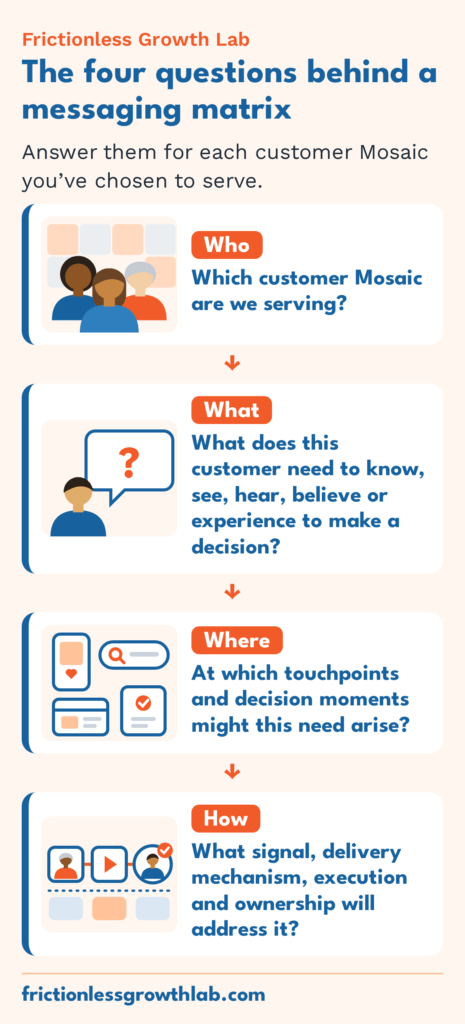
1. Who: Which customer Mosaic are we serving? Start with an identity-rich buyer persona. In Selena’s case, we know her age and gender matter to how she evaluates the program: she wants evidence that it understands women at her life stage and can help her reach her goals. Research with the customers you want to serve fills out that picture: their goals and desired progress, the life context shaping their choices, their constraints and anxieties, their past experiences, the proof they need before they’ll trust a brand, and the identity factors that shape their sense of relevance.
2. What: What does this customer need to know, see, hear, believe or experience to make a decision? Some of what Selena needs will be your universal messages about the program and what makes it effective. Some will be specific to her Mosaic, such as evidence that women at her stage of life use the program and make progress with it. That specific evidence is often what gets her to consider the program in the first place. (I go deeper on that in my article on how to get into a customer’s consideration set.)
3. Where: At which touchpoints and decision moments might this need arise? Three ideas help here, and it’s worth keeping them separate:
- A touchpoint is where an interaction happens, like Instagram, a search result, your website or onboarding. When the customer is discovering you, it’s also an entry point, one of the doors they might come through.
- A journey moment is what they’re trying to decide or accomplish at that point, like deciding whether a program is worth a closer look.
- A customer question is what they need answered to move forward, like “Has this worked for people like me?”
Map the touchpoints that matter for this Mosaic and this decision. You don’t need every channel you can imagine. For Selena, the meaningful places might be Instagram, YouTube, search and AI answers, and the brand’s website. Once she signs up, onboarding becomes another important touchpoint, though it serves a different purpose: she’s already a customer, and now she’s deciding whether to stay.
4. How: What signal, delivery mechanism, execution and ownership will address it? This is where the plan becomes specific, and three of its parts are easy to blur together:
- The signal needed is what would communicate relevance, credibility or capability to this customer at this moment.
- The delivery mechanism is the format or experience that carries the signal, such as a label, an image, a dedicated page or a specialized experience. My article on brand messaging examples walks through six tactics you can choose from, with a real example of each.
- The execution is what a team will specifically produce, publish, change or deliver.
Then name who’s accountable for it and who contributes. The aim is the right signal at the right moment, in the right execution, in the places this customer is likely to look.
Messaging Matrix Example: Selena Across Five Touchpoints
Here’s what a simplified messaging matrix could look like for Selena and the fitness brand. Each row represents one customer decision need at one relevant touchpoint. The five touchpoints are possible encounters, not a required sequence. Selena could first meet the brand at any of the first four, skip some entirely or come back through a different one later. Onboarding sits at the end because it only happens after she signs up.
| Touchpoint | Customer question | Signal needed | Execution | Next step |
|---|---|---|---|---|
| “Could this be for someone like me?” | Women at her life stage belong here | Relevant imagery, a trusted midlife creator and short-form proof | Save, follow or visit the profile | |
| YouTube | “Do they understand what I need?” | Useful, credible expertise | Educational videos on strength training in midlife | Subscribe, watch another video or access a resource |
| Search or AI answer | “Does this expert understand fitness for women my age?” | Relevant expertise | Useful content on midlife strength, accurate program information and credible supporting evidence | Read, watch or visit a relevant page |
| Website | “Has this worked for people like me?” | Contextual proof | A customer story from a member over 50, her outcomes and clear program details | Explore the offer or begin enrollment |
| Onboarding (after she signs up) | “Will this work for my circumstances?” | Personal relevance in the experience | Intake questions, adaptable guidance and an early win | Continue and make progress |
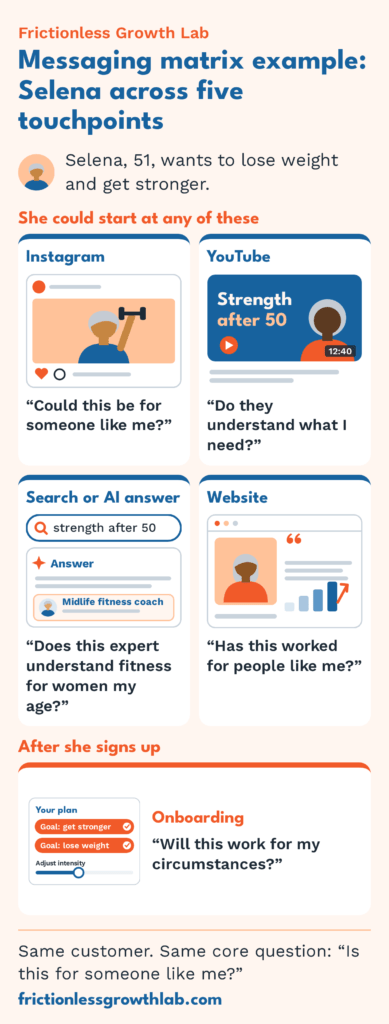
Selena, the brand and the core question stay the same. What changes at each touchpoint is her specific question, the signal she needs and the execution that delivers it. Together, the post, the video, the search result, the web page and the program experience form a connected set of answers, wherever she starts.
For search results, AI answers, reviews and partner channels, the matrix identifies what customers need and what the brand can influence. It doesn’t mean the brand controls the final presentation. The execution in that row stays focused on work the brand controls: useful content, accurate program information and credible supporting evidence.
The simplified table highlights five parts of the full matrix. Here’s what one complete row could look like, using the website:
| Field | Selena at the website |
|---|---|
| 1. Mosaic/persona | Women in their fifties who want to build strength (Selena, 51) |
| 2. Customer need or job | Lose weight and get stronger with a program that fits her stage of life |
| 3. Touchpoint / entry point | The brand’s website. She might arrive from search, an AI answer, a creator’s link or directly. |
| 4. Journey moment | Deciding whether the program is worth enrolling in |
| 5. Customer question | “Has this worked for people like me?” |
| 6. Friction | Stories and testimonials that only feature younger customers leave her guessing |
| 7. Signal needed | Proof that women her age have made progress with the program |
| 8. Delivery mechanism | A customer story, representative imagery and dedicated program information |
| 9. Execution | A story from a member over 50, linked from the program page, with clear program details |
| 10. Next step | Explore the offer or begin enrollment |
| 11. Owner | Accountable owner: website lead. Contributor: content team, gathering and preparing customer stories. |
| 12. Success measure | Story engagement, enrollment starts from the page, and new members’ feedback on whether the story helped them decide. |
Story engagement shows interaction; enrollment starts show a downstream action. Customer feedback helps you understand whether the story answered a relevant question. Read the measures together rather than treating any one of them as proof that the story drove enrollment.
Extending the Matrix to Shanté and Sam
The same brand may also want to reach Shanté, a 25-year-old Black woman, and Sam, a 33-year-old Black man. All three are ideal customers for the brand, and each belongs to a different Mosaic.
Together, these three customers illustrate how understanding a meaningful dimension of identity can reveal needs that a broad ideal-customer profile might overlook. A single dimension of identity can significantly shape someone’s experiences, expectations and decisions. At the same time, people who share a demographic characteristic don’t necessarily have identical needs. Selena and Shanté are both women, and the signals that tell each of them “This is for someone like me” may be quite different. Demographics can reveal meaningful patterns, especially when you combine them with research and an understanding of customers’ lived experiences.
That gives a messaging matrix two dimensions to plan for. Across customers, different ideal customer Mosaics may need different messages and signals, which may call for different rows or views in the matrix. Research with customers like Shanté may point to touchpoints Selena never uses, or to a different question at the same website. Create separate matrices or views where research reveals meaningful differences; reuse rows where the needs and required signals overlap. Across touchpoints, the same customer may need different messages and signals depending on where she encounters the brand and what she’s trying to decide, as Selena’s rows show.
A brand that can genuinely serve all three can design its ecosystem so each of them finds a clear yes, whichever door they use. That takes planning, Mosaic by Mosaic.
How to Build Your Messaging Matrix
Step 1: Choose one priority Mosaic. Start with a Mosaic you’ve decided to serve and have the research to understand. (My brand messaging strategy guide covers how to choose.) One complete matrix teaches your team more than three half-finished ones.
Step 2: List the touchpoints and moments that matter. Use customer interviews, search data, reviews, sales and support conversations, and your analytics to find where this Mosaic actually meets you and what they’re deciding there. Keep the entry points where someone first discovers you separate from the experiences that come after they buy.
Step 3: Write one row for each decision need at each touchpoint, using the 12 fields. The framework is organized around four questions: Who, What, Where and How. It helps to fill in the customer and the moment before the response, so the fields are grouped this way:
The customer (Fields 1–2)
- Mosaic/persona: Which Mosaic does this row serve? Link to the persona so anyone can read the fuller picture.
- Customer need or job: What progress is this customer trying to make?
The moment (Fields 3–4)
- Touchpoint / entry point: Where does this interaction happen? If it’s a discovery encounter, how might the customer arrive?
- Journey moment: What are they trying to decide or accomplish there?
The need (Fields 5–6)
- Customer question: What do they need answered to move forward? Write it in their words.
- Friction: What doubt, confusion or barrier could stop them? Common identity-based friction includes missing information, a lack of representation, missing accessibility details, uncertainty about whether they’ll be welcome, difficulty finding what’s relevant and marketing that doesn’t feel relevant to them.
The response (Fields 7–12)
- Signal needed: What would communicate relevance, credibility or capability?
- Delivery mechanism: What format or experience carries that signal?
- Execution: What will a team specifically produce, publish, change or deliver?
- Next step: What action should naturally follow?
- Owner: Who is accountable for this row, and who contributes?
- Success measure: How will you know this touchpoint is helping customers move forward? Pair engagement with evidence that it actually helped.
Step 4: Check that you can deliver what each row promises. A signal only helps if the experience behind it is real. If you already serve this Mosaic well and customers can’t tell, you’ve found a messaging gap, and the matrix shows where to close it. If the experience isn’t there yet, that’s an experience gap, and it comes first. My cornerstone guide explains the difference in its section on when the message needs to be an action.
Step 5: Prioritize. You won’t fill every gap at once. Start with the rows where this Mosaic most often enters, or where the friction is most likely to stop them, and work outward from there.
Audit Your Brand Ecosystem With the Matrix
Once you’ve drafted a matrix, use it to look at your current ecosystem through your customer’s eyes. Ask these five questions for each priority Mosaic:
- Where are we answering “Is this for someone like me?” well?
- Where are we demonstrating genuine usefulness?
- Where does the customer have to hunt for relevance or proof?
- Where does relevance disappear between touchpoints?
- Which missing signals could be causing people to leave?
Your answers will usually point to four kinds of gaps: missing information, weak signals, experience gaps and disconnected touchpoints. For Selena, a disconnected touchpoint might look like a website with a strong story from a member over 50, while the Instagram account she found first shows only younger customers. The proof exists, but she may never reach it. Weak signals deserve a close look, too, because customers read meaning into the pattern of who appears in your marketing. I explore how they interpret those patterns in my article on brand messaging effectiveness.
Some of these gaps are content gaps. Others come from customer experience friction, and closing them may take a product, operations or service change as well as new content.
Put Your Messaging Matrix to Work Across Teams
Customers experience one brand, even when your organization operates as ten different teams. Brand, social, product and packaging, website, SEO and AEO, content, creator partnerships, sales, customer support and your agencies may each own a piece of the ecosystem. Each team can do its job well and the customer can still experience a disconnected brand, when no one is looking at the whole path.
A messaging matrix gives every team the same picture of who they’re serving, what that customer needs at each touchpoint and who owns the result. To keep it from becoming another document that sits unused:
- Attach it to the relevant buyer persona. Many personas describe who a customer is without explaining how they decide. Adding the matrix means it travels wherever the persona goes.
- Use it where the work happens: creative briefs, agency work, search planning, sales enablement and onboarding design. When a brief includes the matrix rows for its touchpoint, the team or agency knows which question its work needs to answer.
- Give one person accountability for the overall matrix, and name an execution owner for each row.
- Keep one shared source of truth that every team and agency works from.
- Review it when something important changes, such as a product, a policy, a new customer insight or a key touchpoint.
This work maps to the 7C Frictionless Growth Marketing Framework. The who and what of the matrix come from Customer Intimacy. Deciding where each signal belongs is Customer Experience Design. Assigning owners and executing each row is Customer Experience Delivery, where the plan becomes something customers can actually find. For the bigger picture of how this fits across your marketing mix, see my guide to Mosaic Marketing.
Be Ready Wherever Your Customers Enter
You don’t get to choose which door Selena uses. She might find the brand through a creator, a search, a video or a friend’s recommendation, and she shouldn’t have to visit five other places to learn whether the brand understands her or can help her.
What you can do is understand the different ideal customers you want to serve, anticipate the decisions they’re making and coordinate the messages and experiences that help them move forward. The goal is to place the right signals, intentionally, in the parts of your ecosystem that matter to each Mosaic. When more good-fit customers can recognize that you’re relevant and find the answers they need, more of them have a clear path to take the next step with you.
If you know what your different ideal customers need to hear but you’re not sure they’re finding it, or your teams and agencies are each interpreting your customers differently, that’s the work of Mosaic Message Mapping™. Together, we identify the Mosaics you want to reach, what each one needs and where those messages need to show up across your ecosystem, and we build the plan your teams can execute. Let’s talk about how Mosaic Message Mapping can help more of your ideal customers find a clear yes, wherever they enter your brand.
Until next time, remember: growth accelerates when you remove friction, for your customers and for your business.
Frequently Asked Questions
What is a messaging matrix?
A messaging matrix is a planning tool that maps what a brand needs to communicate to each customer group, where they’re likely to encounter it and who is responsible for delivering it. A basic version lines up audiences against stages of the buying process. The version described here plans for each priority customer group, row by row, for the question a customer is asking at a specific touchpoint, the signal that answers it and the team that owns it.
What’s the difference between a messaging matrix and a messaging framework?
A messaging framework defines what your brand says: your positioning, value proposition, key messages and proof points. A messaging matrix plans where and how those messages, along with the specific messages different customer groups need, show up across your touchpoints, and who delivers each one. Most brands need both. The framework keeps your messaging consistent, and the matrix helps the right customers actually find it.
How many messaging matrices does a brand need?
Build one messaging matrix for each priority customer Mosaic, meaning each group you’ve chosen to serve whose needs or questions differ in ways that change how they decide. Many brands start with one or two. A single matrix that tries to cover every customer at once tends to flatten the very differences it’s meant to capture. If two groups share most of their questions and entry points, they may be able to share a matrix with a few extra rows.
Who should own a messaging matrix?
One person should be accountable for keeping the overall matrix accurate and shared, often someone in brand, marketing strategy or customer insights. Each row also needs an execution owner: the team that controls that touchpoint, such as social, website, content, sales or customer support. Agencies can own rows, too, as long as they work from the same shared version as internal teams.
How often should you update a messaging matrix?
Update a messaging matrix whenever something changes what customers need or where they find it: a new product or policy, a new customer insight, a new or retired touchpoint, or a shift in where a Mosaic discovers you. Between those changes, a scheduled review, such as during annual or quarterly planning, helps keep it in use. Check rows against real customer feedback, and update the ones that no longer match what customers tell you.
Full Episode Transcript: Episode 229
Transcript of Frictionless Growth Lab Ep. 229, “How to Improve Conversions With Better Messaging.” Machine-transcribed from the episode audio and lightly edited for readability. Sponsor messages are marked.
Sonia Thompson: Your brand does not have a front door anymore. Your ideal customers may come to know you through social media, a Google or AI search, a creator they trust, a review, a conversation on Reddit. They may see your product on a shelf in a store, it may come through a conversation or other chatter from people who are like them on social media, a recommendation, or your website. And your ideal customers will not all arrive at the same moments or with the same questions. But whatever their entry point for your brand’s customer journey, they are coming looking for an answer to one fundamental question: is this for someone like me?
Now, you might have exactly the product, the message, the proof, the experience that they need, but if it only exists somewhere where your ideal customer never encounters your brand, then it cannot help them. The right message in the wrong place is still very much a missed opportunity. So today, we’re gonna talk about how Mosaic Message Mapping can help you ensure that the right message, the right signals, can be ready and waiting for your right customers throughout your brand’s ecosystem, wherever it is that they enter. And we’re gonna get into all of that after this short break. Now-
[Sponsor message] When a buyer asks AI for a solution like yours, does your business come up? Most companies have no idea, and by the time they find out, they’ve already lost the deal to someone who did. HubSpot AEO helps you show up in those moments with the right answers buyers are looking for before the first click, before the first form fill. That’s the moment HubSpot AEO is built for. Check out hubspot.com, the agentic customer platform for growing businesses. [End of sponsor message]
It’s important for you to think about your brand and the way in which your customers come to you as an ecosystem rather than a funnel. There isn’t just one customer journey that people are taking to get to you, and because of that, people are entering into your brand’s ecosystem at various different places. Different consumers are entering your brand’s ecosystem through different doors, and they are experiencing you in different ways because it’s very likely that you may be showing up in various parts of your ecosystem in different ways. Now, just to make sure that we are all on the same page, a brand ecosystem are the various ways in which your ideal customers can experience your brand. That includes discovery, the different experiences that you are delivering, it even comes through the value that your brand is offering to them, and even how they build a relationship with you.
I sat down with Vicky Lozano, who was a chief marketing officer at Crayola, and here’s how she described a brand ecosystem and the way in which they think about it at Crayola.
Vicky Lozano: If you think about the brand through the lens of products, experiences, and content, it creates a much more robust ecosystem. We could end up, uh, have a relationship or a touch point with a consumer on one or two or all three of them. It creates a much bigger ecosystem and the role that the brand can and should play in people’s lives, and I think is just a much better reflection of the incredible breadth and also impact that this, um, this brand can have in people’s lives, and to be genuinely relevant and helpful, whether it’s, again, kids, parents, teachers, or frankly, even adults for themselves.
Sonia Thompson: All right. So you’ve got your brand ecosystem, the different ways in which your brand is showing up and adding value to the ideal customers that you are trying to reach. And of course, your ideal customers are entering your brand’s ecosystem at different places. So let’s talk a little bit about the fundamental question that they are asking no matter where they encounter your brand in the ecosystem. And they’re asking this question subconsciously or not, because they need to know whether or not what it is that you are offering is worth their time and energy.
That fundamental question is, is this for someone like me? All right. So let’s use the example of a consumer, we’ll call her Selena. She’s 51 years old, and she wants to lose weight and grow stronger. Now, there is no shortage of fitness advice and fitness accounts and programs and content and all kinds of tools and resources that she can tap into.
Now, each and every brand that she encounters, she’s always gonna be looking for that answer, “Is this for someone like me?” Someone who is specific to her age group, who has the same goals as her, who has the same lifestyle as her. She’s not gonna be interested in a program that is designed or is constantly showcasing 20-year-olds or 30-year-olds or men. She needs something that’s gonna be very relevant to her life stage and her goals. Now, she’s gonna constantly be looking for some type of signal that what it is that you are offering is for someone like her.
Now, for Selena, as she’s encountering these different brands who could absolutely be useful to her specific goals, if she doesn’t come across the relevance or the answer to her fundamental question, “Is this for somebody like me?” If she doesn’t come across that in the entry point where she’s encountering those brands, that creates friction for her. Even if those brands are for people like her, if she doesn’t come across an answer to that question or what she perceives as evidence that yes it is, that friction will cause her to not convert. So whenever we’re talking about Mosaic Messaging and making sure you are mapping the right message to get to the right person at the right place at the right time within your brand’s ecosystem, we’re not just talking about words. There are various ways that you can communicate, “Yes, this is for someone like you.”
That can be through imagery, creators, testimonials, and case studies. It could be through searchable content, specific programs, products and program design, actual messages that you include throughout your ecosystem, onboarding, the things that your customer service or your sales team say, or even platforms and publications where you show up. Selena in this instance, and your other ideal customers, don’t need you to always explicitly say, “This is for women over 50 who are trying to build strength and lose weight.” She needs relevant evidence that can quickly signal to her that, “Okay, yes, I am in the right place. This brand sees me, they understand me, and they could work for someone like me.”
So as we’re thinking about how you can serve different Mosaics of your ideal customer base, it’s important to remember they’re making decisions very quickly about whether or not you are right for them, and that can be based upon what they see, what they read, who they see you with, where you are showing up, and of course, what they experience.
[Sponsor message] Okay, I’ve got another podcast recommendation for you. It’s This Old Marketing hosted by Joe Pulizzi and Robert Rose, and it’s brought to you by the HubSpot Podcast Network, the audio destination for business professionals. Joe Pulizzi and Robert Rose are two of the most well-known experts in the content marketing space. And in this show, they are talking about the latest content marketing trends, and they discuss how businesses can use content to attract and retain customers. One really great episode that you should tune into, and it’s super timely, is The State of Content Marketing 2027: What Comes Next? And here’s another one for you to consider: Is Blogging Dead or Mostly Dead? Listen to This Old Marketing wherever you get your podcasts. [End of sponsor message]
So as you’re thinking about Mosaic Message Mapping and how to use that to deliver the right message to the right consumer at the right place at the right time, we’re gonna use it to address four very specific questions. And that is, who are we serving? What specific Mosaic of your ideal customers are you trying to reach? What is it that they may need to hear? That might be your big universal key messages, or it might be something very specific that they need to see and hear to make sure that you know you are specifically for people like them.
That enables them to even start to consider you as an option. You need to know where in your brand’s ecosystem they could be entering, where will they encounter you. And the last question that you need to address is, how will you deliver an answer to that fundamental question, “Is this for someone like me?” What are the specific signals, proof points, or experiences that you can incorporate at different touchpoints throughout your ecosystem to effectively answer that question for them? Now, we’re not talking about spraying specific messages at every particular touchpoint so that people, no matter where they enter, can find it.
It’s about being very strategic and intentional about figuring out how you can communicate “This is for someone like you” in the place where they will be able to find it. It’s all about delivering the right signal at the right moment with the right type of execution. All right. So let’s go a little bit deeper with Selena and see how this can work out for a brand that could be perfect for her, and we’re gonna look at different places in that brand’s ecosystem and how they might be able to clearly and quickly communicate and answer, “Yes, this is for people like you, Selena.” So how would s- a brand communicate this if Selena were to come across their Instagram account?
It could be through specific copy on the brand’s profile, highlights that they include on their profile as well that’s dedicated to people who are like Selena specifically. Perhaps it’s through some type of imagery that they have sprinkled throughout their profile or through the different types of creators or success stories that they are incorporating. Could also be through different types of workouts or specific content that they have created for specific people who are like Selena, women who are over 50. Now let’s say Selena actively looks for a solution, and she turns to search or AI to help her find what the right solutions are. Now the brand can make sure that their ecosystem is prepared to be found by Selena by creating a Google Search profile that has some of those details, by creating relevant content that can be found and indexed in Search and come up no matter how it is that she’s searching.
They can be investing in AEO and GEO to make sure that within the information that is relevant that Selena is searching for, strength training for women over 50, that the brand shows up as part of that. On the brand’s website, which is another touchpoint in the ecosystem, they might have photography that includes a broad range of women, including people very much like Selena. It could be photography. It could be testimonials and case studies. It can be a founder story if the founder is specifically someone who is like Selena.
It can be copy that they have there. It can be a program specifically that they’ve designed for women over 50 that is talked about on their website or there’s a sign-up page on the website. On YouTube, maybe it’s specific videos dedicated to people like Selena. If it’s an ad on social media, perhaps it’s someone who looks exactly like Selena who’s in her age group and, and the copy on that ad is talking about the evolution of someone who is in Selena’s shoes and how they were able to go through a specific transformation that Selena desires to achieve. The ecosystem for the brand needs to be designed intentionally with Selena in mind so that no matter where she’s entering into the brand’s ecosystem, she will find an affirmative answer to her question, “Is this for someone like me?”
Now, the brand might be able to answer that affirmative to several Mosaics. It might be able to answer that question for Selena. It might be able to answer that question for Shante, who has a different profile entirely. It might be able to answer the affirmative yes for Sam, who has a different Mosaic. The key point is, whether it’s Selena, Shante, or Sam, that the brand has designed throughout their ecosystem that each one of those will be able to encounter an affirmative yes to the “Is this for someone like me” question, and that only happens through planning and intentionality.
So whether it’s article, search results, ads, social media content, websites, specific products, programs, campaigns, all of those are connected sequences and inputs into the ecosystem that help Selena find the right answer to her question, no matter where she encounters a brand. Now how do you get to the point to where you’re able to do this, especially when a lot of times with brands, there are multiple departments who are executing these different strategies or different parts of the overall brand ecosystem? My recommendation is to make sure that you are mapping this out as a part of your buyer personas and including this matrix and what it is that people need as a part of your brand’s buyer personas. I feel that most buyer personas don’t go deep enough. They don’t incorporate identity as well as they could and understand the decision-making factors that different consumers go through.
But whenever you take the time to create more detailed identity-specific personas, you can go through and ask these core questions and infuse that with the insights that you have for these different identities, for these different Mosaics, for these different Mosaics of your ideal customers, so that you’ll be able to answer this fundamental question for them. So your buyer persona automatically is going to address the who, who it is that you’re trying to reach. That is the who the persona is about. But incorporated in that persona, you do need to talk about what is it that this particular person needs to see, hear, believe, or experience to be able to take that next step forward.With you. You will be able to answer that question and incorporate that through the research that you’ve done for this particular Mosaic.
It’s also a good idea to include in your persona the different ways in which, the different places in which they can encounter your brand throughout your ecosystem, and incorporate very specific ways of how you can answer the fundamental question for them. So on your buyer personas, you’re gonna have your narrative, you’re gonna have your research, your insights, but I also recommend that you add this matrix so that whenever you are plopping your buyer personas into your creative briefs for different projects across different parts of your brand ecosystem, would it matter what teams, which agencies are gonna be working on delivering on different parts of delivering on how your brand will show up throughout this ecosystem, they can be making sure that they’re working from a central repository that helps them answer that fundamental question in a way that makes the most sense for your brands and, of course, for your ideal customer, so they know they’re always gonna get an answer to that fundamental question, “Is this for someone like me?” in the affirmative. So this makes it very easy for your social team, your SEO team, your AEO team, your media team, your creator influencer team to all have the information that they need to address these consumers in the right way at the different touch points that they are responsible for. That matrix that you’ve included on your buyer personas becomes a shared roadmap or plan of action that allows your brand to show up the right way for the right customers throughout. Your customer experience is one brand, even when your organization operates as 10 different teams.
Now, it’s very likely that you’re not gonna be able to choose which door your ideal customer will enter in your brand’s ecosystem, but you can ensure that no matter where they enter, you are prepared to answer very quickly and very clearly that fundamental question for them affirmatively. “Is this for someone like me?” Yes, it is because your team knew that your ideal customer was gonna show up at some point, and you are equipped with the answers that they need so that they can take the next step forward with you and convert. Remember, the goal isn’t to put every message everywhere. It’s to intentionally put the right signals in the places that matter.
All right. So if you feel like your brand could benefit from Mosaic Message Mapping throughout your brand’s ecosystem, and you could use some help with that, let’s chat. I will drop some details in the show notes for you below so we can talk about how to make sure that your ecosystem is ready to receive the consumers that you want to serve. Until next time, remember, growth accelerates when you remove friction for your customers and for your business. Thanks so much for listening.
Talk to you soon.
Full Episode Transcript: Episode 227
Transcript of Frictionless Growth Lab Ep. 227, “The Customer Journey: The Missing Link to More Effective Brand Messaging.” Machine-transcribed from the episode audio and lightly edited for readability. Sponsor messages are marked.
Sonia Thompson: My husband Jonathan sent me a message the other day. He was out and about and saw a hamburger place, so he sent me the pin of the place and said, “Hey, can you check if they have gluten-free hamburger buns?” Now, one of the things that we like to do is enjoy a good burger, but both of us are also gluten-free, so a gluten-free bun is a must. I searched their website. I searched Google Reviews.
I searched social media. Nothing. And at the end, I went to AI to see if AI could find something that I wasn’t seeing, and still nothing. After about five minutes, I hit my limit. I was done searching.
If this restaurant does have gluten-free buns, then this information shouldn’t be that hard to find. Different customers carry different non-negotiables, and every customer, whether they know it or not, subconsciously or consciously, are asking that fundamental question, “Is this for someone like me?” And they need different information at different points in their overall customer journey to help them figure out the answer to that question, so that they can decide whether or not it’s safe for them to move forward or not. So how do brands know what information different customers need, when do they need it, and where they need to encounter that information? That’s what we’re covering today to show you how all those important questions and pieces fit together so your marketing works a whole heck of a lot more effectively, and so that you can take the friction out of your brand’s growth.
Today’s episode is about how all those pieces fit together, and we’re gonna get into all of that after this sh-
[Sponsor message] When a buyer asks AI for a solution like yours, does your business come up? Most companies have no idea, and by the time they find out, they’ve already lost the deal to someone who did. HubSpot AEO helps you show up in those moments with the right answers buyers are looking for before the first click, before the first form fill. That’s the moment HubSpot AEO is built for. Check out hubspot.com, the agentic customer platform for growing businesses. [End of sponsor message]
Short break. The first piece of the puzzle is the core of your brand’s growth strategy, and it all starts with deciding who it is that your brand is going to serve. Now if we think about your total addressable market as different consumers who have different shared identities that make up little Mosaics, your job as a brand leader is to decide which of those Mosaics your brand is going to choose to serve. Now every brand has a number of Mosaics that are part of their total addressable market, and I am not saying that every brand needs to serve all of those Mosaics. That can be a really tall order, especially if you’ve got limited resources to be able to do that well.
But each brand does need to proactively choose which of those Mosaics that they are going to serve, so that they can do a better job of serving those ideal customers better than anyone else. So in the case of this hamburger joint that my husband sent me, when it comes to the Mosaic of gluten-free customers, looks like they’ve decided not to choose that group as part of their ideal customer base, and that’s totally okay. It just means that that brand is not for people like us. We will go somewhere else. So as a brand, you will have to think about what are the different Mosaics that your brand wants to serve.
So if we use the example of a restaurant, their total addressable market is going to include people who are gluten-free, people who are dairy-free, people who are vegan, people who are over 50, people who are Spanish speakers, people who have a larger body size, people who have kids, right? There are a number of different identities or Mosaics that are gonna exist within their total addressable market, and your job as a marketer is to decide which one of those Mosaics do you wanna focus your time, attention, and resources on to make sure that they feel that, “Yes, this is a place that absolutely is for someone like me.” So if your brand choose to serve vegan consumers, that means that you are gonna have to have some menu items and maybe even some protocols in the kitchen that make sure it’s okay for vegan consumers to eat there. That decision of who you’re going to serve will influence your product decisions down the line in addition to your marketing. So the foundation of everything flows from that decision, who it is that you’re gonna serve.
Which Mosaics does your brand want to focus on? And so that brings us to the second piece of the puzzle, which are your buyer personas. Now a lot of times whenever brands are creating buyer personas, they’re adding in basic demographic, psychographic, observational things like age, income range, where they live. They might even have parental status in there. Sometimes they’ll include other demographics such as race or gender.
You might find socioeconomic status, their income. In a lot of instances, you’ll also find some other details about how they make decisions, certain preferences that they have, behaviors and things that they’ve purchased in the past to help create a profile that will help you make your marketing more effective. Now I believe buyer personas a lot of times don’t go deep enough. They need to go further specifically in their identity layers to make sure that some of those identity-based decision-making levers that consumers naturally go through are incorporated into the personas, so that your marketing can be more targeted and more effective. Now some of these decision drivers can be information needs, proof requirements, motivations, barriers.
It can also be things that are very specific to their identity about the different challenges and needs that they have or other factors that– or other societal factors that influence heavily how they make decisions. Identity influences decision-making. For example, whenever I’m looking at hair care brands, I often am looking for brands that are made by Black-owned brands because I feel like Black-owned brands will probably have a better handle on what types of products are going to be right for someone like me, a Black woman with a specific type of hair. I am a mom of a mixed-race child who has really curly hair and whose hair is also different from mine. Now I’ve heard her made some very specific comments about her desire to want to have straight hair because that’s what she sees from people on TV.
That’s what she sees from her classmates, her teachers . And so I am actively making choices for her as her mom in terms of to help make sure that she sees more representation of people who look like her and who have hair like her. Over the holidays, we bought her a doll specifically who had a skin tone like hers, who had hair who was curly like hers, and she wore it in a style that was very similar to the way my daughter wears her hair. There are a number of different baby dolls that we could have gotten her, but we made a specific decision about the specific type of doll that we got for her because identity and representation specifically played a role in our decision-making. That happens for a lot more of your customers than you may think, and if you don’t have those decision-making drivers and influences and barriers and core needs represented in your buyer personas, it’ll be very hard for you to address those needs, wants, and desires in your marketing done.
[Sponsor message] Okay, I’ve got another podcast recommendation for you. It’s This Old Marketing hosted by Joe Pulizzi and Robert Rose, and it’s brought to you by the HubSpot Podcast Network, the audio destination for business professionals. Joe Pulizzi and Robert Rose are two of the most well-known experts in the content marketing space. And in this show, they are talking about the latest content marketing trends, and they discuss how businesses can use content to attract and retain customers. One really great episode that you should tune into, and it’s super timely, is The State of Content Marketing 2027: What Comes Next? And here’s another one for you to consider, Is Blogging Dead or Mostly Dead? Listen to This Old Marketing wherever you get your podcasts. [End of sponsor message]
Now, once you understand more about how your ideal customers make decisions and have that documented in your personas, the next piece of the puzzle is to map your customer journey. And specifically, we wanna map your ideal customer’s journey to understand what are the key friction points that they have and where do they experience them as they’re going through their process of figuring out how your brand can help them solve their problem. Now, a key point of distinction is it’s really helpful to think about the customer journey less about distinct touchpoints that they’re moving through on their way to buying from you and coming back again and again, and more as decision points. At each stage of the customer journey that your different Mosaics of customers are going to be going through, ask yourself, “What is it that this customer is trying to decide? What are the other influences that are playing a role in helping them make a decision or not?
What is preventing them from moving forward? What are the key questions that they need answered from you to get the confidence they need to take that next step forward?” As I mentioned before, different personas experience different friction, so it’s very helpful to not take a one-size-fits-all approach with your customer journeys, but making sure that you’re eliminating the friction for the different Mosaics that you’ve chosen to serve so that all of their paths can be smooth to make the decision to buy from you. Now, examples of different types of friction that is identity-based could be missing information, it could be representation, it could be no details about accessibility, it could be not having information about whether or not someone from the LGBTQ+ community will be safe and welcomed in your space. It could be around discoverability in terms of the way in which you’re promoting your product, whereas the people that you want to serve from specific Mosaics might not even realize that you are speaking directly to them and that they are welcome with your brand.
It could mean relevance in terms of maybe the way in which your marketing isn’t relevant to the people that you want to serve, so they are completely tuning you out. Until you know what type of friction exists, you won’t know how to appropriately solve for it so that you can eliminate it. Now, one thing that I wanna make sure that I reinforce to you when it comes to friction, because sometimes you may have this information available, but it’s harder for consumers to find it. And we have to remember, consumers have very little tolerance for friction. That five minutes that I spent looking for whether or not that hamburger brand had gluten-free buns, most consumers are not gonna spend that kind of time.
If they don’t find an answer to what it is that they’re looking for pretty quickly, it’s very likely that they’re gonna be out the door. So once you understand where the friction exists in the customer journey for different types of consumers, then you can move to that next step, which is all about messaging. What is it that you can say to remove the specific friction that different consumers groups experience? Now, I like to call this process of using messaging to help you remove friction as Mosaic Message Mapping, whereas you’ve identified the core questions that different consumer groups need answered, and you are mapping specific messages to specific consumers to enable them to move forward with you. Mosaic Message Mapping is often very different from the universal messages that your brand is going to be using to talk about your product, the key points of differentiation, and how effective you are at solving specific problems.
Mosaic messaging specifically helps you answer the question, “Is this for someone like me?” It helps you tackle specific friction different consumer groups are going to have, and the messaging is a way to eliminate that friction for them. So some specific messages might be, “We are gay friendly. We are gluten-friendly. We’ve got a gluten-free menu.
Adults only. All children are welcome. We’ve got plus sizes. We’ve got sizes up to a size 30. This establishment is wheelchair accessible.
We’ve got a slew of Black-owned brands for you. We’ve got sensory-friendly hours from 8:00 to 10:00 every day. Kids eat free on Tuesdays. Proven to work on sensitive skin. All types of people have seen results, even those that aren’t tech-savvy.”
There’s a number of different messages that can be used for different type of identities or different Mosaics that you are trying to target. Now, the message only works if you have positioned it in the right place to address a specific friction point that you know your ideal customer is likely to have. So the last piece of the puzzle is all about activation. Once you have the right message, where is it that you put that message so the right people can hear it at the right time? So where should these messages appear?
That’s where your customer journey mapping comes into place. As you think about where the different customers are going to be, where they’re going to experience friction, you can place those messages on or around that friction point so that they don’t experience it whenever they get to that key decision-making point. Now, it’s also very important for you to remember that different customers are experiencing your brand more as an ecosystem because they’re entering your customer journey at different places at different touchpoints, so your brand has to make sure that you’ve got the messages that are needed at the different touchpoints that consumers may be able to enter, whether that’s through paid search, your website, Google business profile, on social media, landing pages, banner ads, social media ads, user-generated content, customer service, the physical signage that you might have on a building, the vans that your team may be driving around locally. I remember seeing a van in my neighborhood that was doing remodeling, and I saw this very simple message, “Se habla español,” on the wrapping that their van had. And again, that’s a very clear message- For, for the people who having a Spanish-speaking contractor is important to them.
Now, the goal isn’t, of course, to just blast every message everywhere. It’s to put it in the right place so the right customer can see it at the right time. But that will only happen if you are very intentional about designing for your customer journey so that the right customer hears what it is that they need so that they’re not encountering friction. So the key lesson here is intentionality and removing friction for your ideal customers. And a lot of times that friction can be removed from having the right message in place.
But it’s not just about crafting messages, it’s about making sure that you’ve got a whole process that your marketing team goes through to make sure that you are equipped to have the right messages in place for the right consumers at the right time, so that less of your messaging gets blocked, so that there’s less friction throughout your customer experience, so that you can pave the way for a clear path for more of your ideal customers to encounter your brand, to know that your brand is specifically for people like them, and to choose your brand once and then over and over again. That is how you’ll be able to effectively attract and retain more of your ideal customers, and that is a core formula to making sure that you achieve the brand growth that you desire. Now, if you feel like you could use some help in the area of ensuring that your ideal customers are receiving the right message at the right place at the right time, if you feel like you could benefit from Mosaic Message Mapping, or even helping to plot out how your customer journey could do a better job for the different Mosaics that you want to serve, definitely something I can help with. I’ll drop some links with some details for ways in which I can support you in the show notes for you. Until next time, remember, growth accelerates when you remove friction for your customers and for your business.
Thanks so much for listening. Talk to you soon.
Found this post useful?
There’s more where that came from—get insights on the new rules of growth delivered to your inbox.