


I’ve followed a gluten-free diet for health reasons for more than ten years. Over that time, a long string of restaurant experiences has taught me something I didn’t want to learn: I can’t walk into a restaurant sight unseen and expect there to be something on the menu that will work for me. Doing that is a gamble, and more often than not, I end up hungry.
So I changed my behavior. Now I confirm that a restaurant or cafe will have something for me before I ever step foot inside. When a restaurant tells me it has gluten-free options, I’ve heard that promise many times before. What I need is some sign that it has thought about people like me, that it understands what eating gluten-free actually requires, and that it can serve me a meal that’s both safe and worth eating. The restaurant I’m considering tonight inherits every restaurant that came before it. Its kitchen might be careful, but its message arrives in my head already discounted by years of experiences that didn’t match the promise.
That’s the problem I want to help you solve. Marketing messages that convert have to do more than reach the right people and say the right thing. Some of your ideal customers will receive your message, understand it exactly as you intended, and still not believe it enough to act on it. Their experiences with other brands have taught them that words are just words.
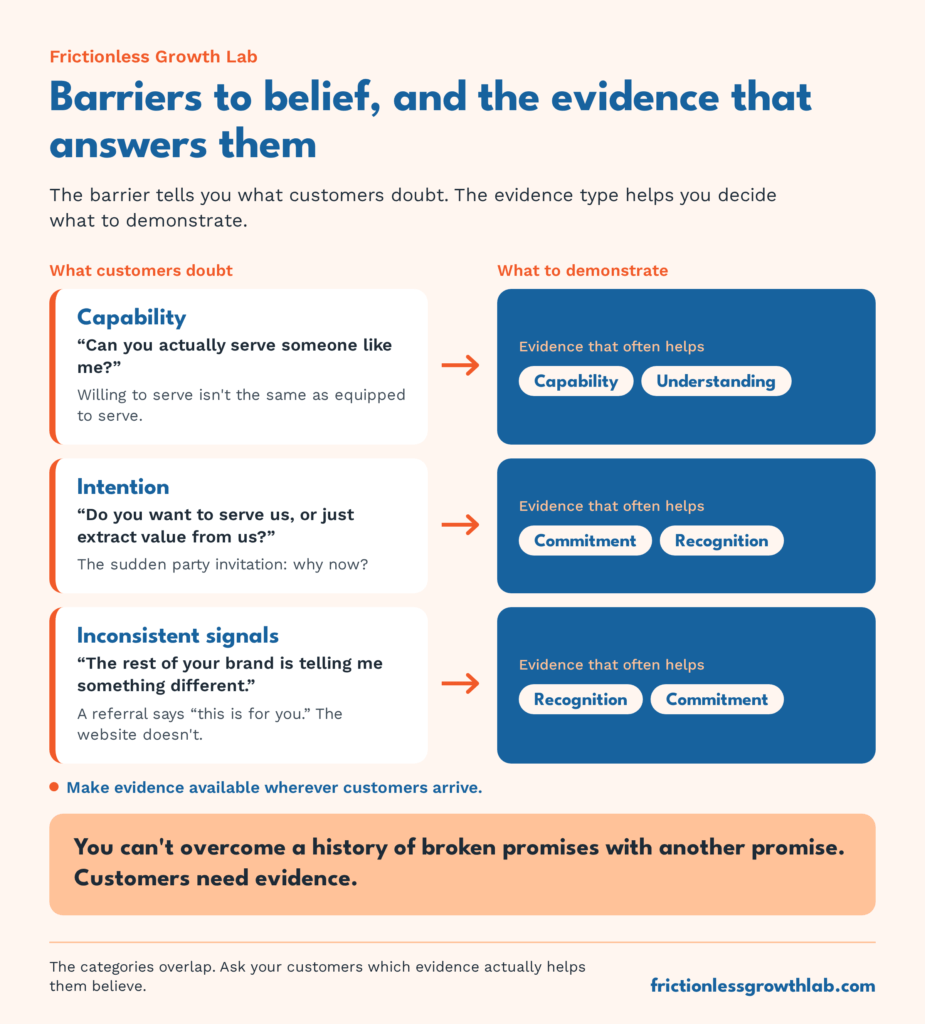
As I put it in the episode, you can’t overcome a history of broken promises with another promise. Customers need evidence. In this article, I’ll walk you through three reasons customers don’t believe brand messages, the four types of evidence that can help them believe, and a practical tool, the Message Believability Check, to help you find out what evidence your own customers find convincing.
Listen on Apple Podcasts | Spotify | Read the full transcript
Why Marketing Messages That Convert Need More Than a Clear Message
Most messaging work focuses on clarity and relevance: the right thing, said to the right person, in a way they’ll understand. That work matters, and I cover it in my guide to making your brand messaging relevant to more of your ideal customers. But between understanding a message and acting on it, there’s a step that’s easy to skip: the customer has to believe you.
Your customers don’t experience your marketing in a vacuum. They interpret it through their societal programming, which comes from society, media, lived experiences and other brands’ marketing. In What Your Brand Messaging Communicates Without You Realizing It, I explored how that programming shapes the way customers interpret what you say. This article picks up at the next step. Even when a customer receives your message exactly as you meant it, their experiences with other brands may tell them not to take it at face value.
It’s kind of like someone who’s been on five consecutive bad first dates. They’ve heard all the “I’m different” lines before, and after a while, those lines stop working. Your marketing messages can run into the same wall.
Some of your ideal customers have tried products advertised as working for everyone that didn’t work for them, or walked into businesses that claimed to welcome everyone but weren’t equipped to serve them. Repeated disappointments like these teach customers that marketing claims aren’t always reliable for people like them.
This won’t be true for every one of your ideal customers, but some of the Mosaics you want to serve have likely had these experiences. Your brand may inherit distrust it didn’t personally create. Even if your product or service genuinely meets their needs, their past experiences may make them skeptical of your promises.
Three Reasons Customers Don’t Believe Your Marketing Messages
When a message reaches the right people and doesn’t convert as many of them as you’d expect, there are plenty of possible explanations, including price, timing, awareness and fit. Disbelief belongs on that list too. A conversion report can show where customers stop, but it won’t necessarily tell you whether disbelief is why. In the episode, I described three barriers to belief. Each one can contribute to lost consideration, conversions or repeat purchases.
1. Capability: “Can you actually serve someone like me?”
A lot of Black women have shared experiences of going to hairstylists, makeup artists and even photographers who didn’t know how to work with their hair texture, match or apply makeup for their skin tone, or light them appropriately. None of those providers necessarily turned them away. Many were happy to take the appointment. But being willing to serve someone isn’t the same thing as being equipped to serve someone.
A while back, I did a series on buyer personas built around Go-Getter Gabby, a professional woman who wants to advance her career and is looking for a career coach. In Ep. 210, I showed how Gabby can hold several different identities. These are different Mosaics within the same persona, and each one changes what she needs a coach to show her.
In one version, Gabby practices the Muslim faith and wears a hijab at work. There are no Muslim leaders in her organization, so it’s hard for her to find mentors who understand her lived experience, and important meetings sometimes get scheduled during her religious holidays. She wants a coach who understands her experiences and point of view and who will ask about them instead of making assumptions. A coach who has never worked with someone navigating what she’s navigating may be completely willing to help and still not be equipped to give her effective advice. So this Gabby isn’t going to commit to a coach until she has reason to believe that coach can actually help her meet her goals.
In another version, Gabby has returned from maternity leave and is still nursing her child. She wants to keep moving forward in her career while managing circumstances most of her peers aren’t, and she needs a coach who understands her situation and how things work inside her company. Advice that ignores those circumstances may give her strategies and scripts that don’t fit. She wants evidence that a coach will understand the difference before she trusts that person with her career goals.
Both versions of Gabby would hear the same promise, “I’ll help you reach your career goals,” and each would need different evidence before believing that a coach’s expertise applies to someone like her.
2. Intention: “Do you want to serve us, or just extract value from us?”
Sometimes consumers question whether you actually want to serve them, as well as whether you can. This is what I call the extraction problem. Many of your ideal customers, particularly those in communities that have historically been underrepresented and ignored by brands, may be wondering: “Does this brand really value people like me, or does it just want our money?”
I like to describe it this way. Picture someone who was never invited to the party. They’ve watched a brand invite all kinds of other people over and over, and never them. Then one day the brand walks up and hands them an invitation. That person is more likely to wonder why than to celebrate. What changed? What’s different? Why now do you want to invite me, when you couldn’t be bothered with me all those other times before?
That’s what happens when brands suddenly discover the purchasing power or influence of a historically overlooked community. Some brands and industries also have a long history of targeting specific communities in predatory ways, and others have pursued communities because it was trendy, without investing in understanding and serving them well.
So when you show up on their doorstep with an invitation, these are the kinds of questions customers may be asking:
- Why are you showing up now?
- Is it because someone realized how profitable our community is?
- Do you actually understand us?
- Are you invested in serving us, or are you just here because you want our money?
- Will you still be here when we’re no longer the trending demographic?
Brands are businesses, and of course they need to make sales. There’s nothing wrong with recognizing a growth opportunity and earning revenue from serving a community well. The problem comes when a brand wants what a community can give it without doing the work to serve that community well.
You can’t settle that question with a single campaign, and customers will keep weighing your intentions over time. What you can do is make your investment in serving them visible, so they have something concrete to weigh.
3. Inconsistent signals: “The rest of your brand is telling me something different.”
Sometimes the doubt comes from the smallest details of how a brand presents itself. Representation matters. It can signal belonging. It can signal relevance. But representation alone doesn’t establish trust, and simply swapping out a photo doesn’t automatically solve the problem.
Here’s an example from my own inbox. There’s a creator I follow on LinkedIn, and I also get his email newsletter. In one issue, he mentioned a team that was helping him with part of his marketing and linked to them in case readers wanted to learn more. I was curious, so I clicked through.
This creator is part of the same Mosaic I am. He’s a Black creator, and I had developed trust in him through his content. So I expected the company he worked with to feel like it was for people like us. Instead, I spent time on several pages and didn’t see anyone who looked like me. Nothing on the site reflected him, and he wasn’t featured anywhere.
His recommendation didn’t diminish the trust or respect I have for him. But that trust didn’t carry over to the brand. His newsletter told me, “This is for people like you.” The website gave me no signals that said the same thing, and the gap between the referral and the destination left me with more questions than answers.
Customers enter your ecosystem from many places, rarely in the order you designed. Wherever they arrive, they’re asking, “Is this for someone like me?” They notice who is absent, who appears only sparsely and what looks like a one-off. A photograph can help someone see themselves in your marketing, but the rest of the experience has to give them a reason to believe that your brand is genuinely for them. If you want to go deeper on how representation and social proof affect conversion, relevant social proof is a good next read.
The Four Types of Evidence That Can Make Marketing Messages Believable
If another marketing promise or a new image isn’t enough, what is? Customers who have been let down before need credible evidence that their experience with your brand can be different. Content and campaigns that only repeat your brand’s core message probably won’t convert as many of these customers as you need them to.
In the episode, I described four things your content and experiences can demonstrate for the specific Mosaics you want to reach and convert. Each one answers a different kind of doubt.
1. Recognition: “We see you.” Recognition shows customers that you’ve considered people like them, and it goes further than token representation by reflecting their particular needs, experiences and realities. For a gluten-free diner, recognition can be as simple as gluten-free dishes clearly marked on a menu they can read before they go. For neurodivergent customers, sensory-friendly content and experiences show that their needs were part of the plan.
2. Understanding: “We understand you.” Understanding shows that you know a specific Mosaic’s needs, wants and challenges, and how they experience your brand and your category as a whole. It addresses concerns that general-market marketing can’t. A restaurant that explains how it prepares gluten-free dishes and prevents cross-contact speaks directly to the question I’m asking before I walk in.
3. Commitment: “We value you.” Remember the person who suddenly got the party invitation? Commitment evidence makes the work and investment your brand has made visible, and it shows that serving this community is more than a temporary campaign. Make that investment visible where the customers evaluating your promise can find it. For customers in larger bodies, for example, fit demonstrations, relevant sizing information and thoughtful product design are visible signs of investment. Evidence like this gives customers something real to weigh, even though it can’t prove a brand has no ulterior motives. The experience they have over time matters, too.
4. Capability: “We can deliver for you.” Capability is especially important for conversion. It shows relevant expertise, demonstrates how your products and services perform for specific customers and features credible customer experiences and outcomes. A photographer whose portfolio shows real skill photographing darker skin tones, or a hair care brand that demonstrates its products across different hair textures, gives customers a reason to believe the outcome will work for them. For a gluten-free diner, it might be reviews from other gluten-free diners who ate safely and enjoyed the food.
Notice how the gluten-free examples differ. Clearly marked dishes tell me the restaurant thought about people like me. An explanation of how it prevents cross-contact tells me the kitchen understands what’s at stake. Reviews from other gluten-free diners give me another signal about how the restaurant has handled needs like mine. Each one answers a different question, and I may need all three before I’ll book a table.
The categories overlap, and a single piece of content can do more than one job. Looking at them separately still helps, because a customer’s doubt often leans toward one or two of them. Gabby, back from maternity leave, mostly needs evidence of understanding and capability; the person holding the party invitation mostly needs evidence of commitment. Different Mosaics also need different evidence, and people within the same Mosaic won’t all find the same evidence convincing, so the next step starts with your customers. If you want to see what this kind of content looks like in practice, I walked through six types of campaigns that reach customers general-market marketing misses in Part 1 of this series.
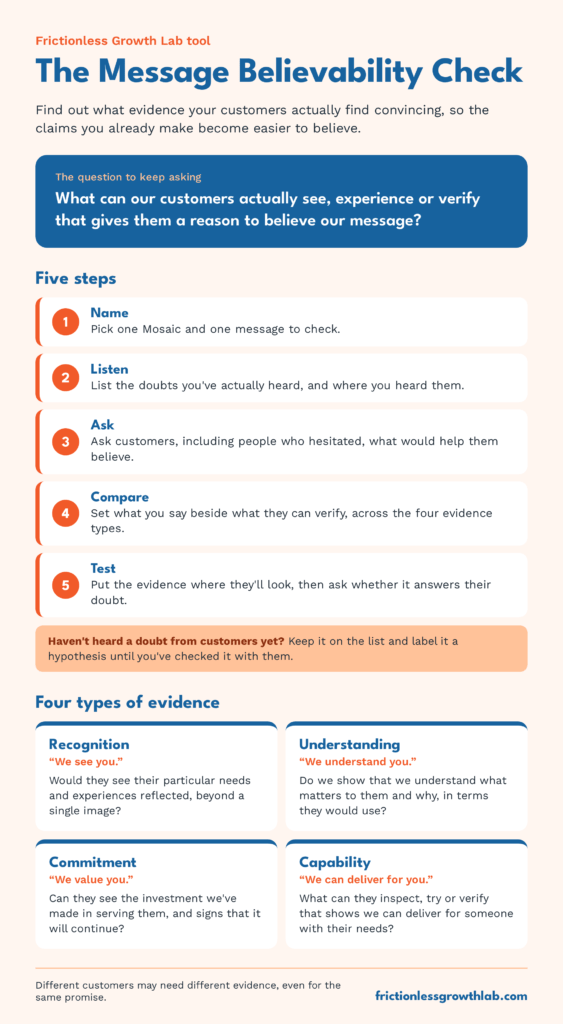
The Message Believability Check
Use this check when a message reaches the right people but doesn’t convert as many of them as you’d expect. Work through it for one Mosaic and one message at a time. Its purpose is to help you discover what evidence your customers actually find convincing, so you can make the claims you’re already making more believable instead of making bigger ones.
1. Name the Mosaic and the message. Be specific about who you’re checking and which promise you want them to believe.
2. List the doubts you’ve actually heard. Pull them from sales conversations, support tickets, reviews, social comments, customer interviews and, if you can reach them, people who considered you and didn’t buy. Note where each doubt came from. If you suspect a doubt but haven’t heard it from customers, keep it on the list and label it a hypothesis until you’ve checked it. Then note which barrier each doubt points to: capability, intention or inconsistent signals.
3. Ask customers what would help them believe. Talk with people in this Mosaic, including recent customers and people who hesitated. A few questions to start with:
- What made you hesitate before choosing us, or a brand like us?
- Where did you look to find out whether this would work for someone like you?
- What, if anything, would help you check whether we could deliver on this promise?
- Whose experience or expertise would you find useful?
- For customers who bought: what convinced you in the end?
Listen for differences within the Mosaic as well as patterns across it.
4. Compare what you say with what they can verify. For each evidence category, write the claim your marketing makes in one column. In the other, write what this customer can actually see, experience or verify that gives them a reason to believe it, and note whether customers told you it matters or whether it’s still a hypothesis. If the second column is empty or vague, you’ve found a gap.
- Recognition: Would this Mosaic see their particular needs and experiences reflected, beyond a single image?
- Understanding: Do we show that we understand what matters to them and why, in terms they would use?
- Commitment: Can they see the investment we’ve made in serving them, and signs that it will continue?
- Capability: What can they inspect, try or verify that demonstrates our ability to deliver for someone with their needs?
5. Check where they’ll look, then test it. Make sure the evidence shows up wherever this customer is likely to look, including your website, a partner’s page, reviews, a referral or the experience itself, and that the experience backs up what your content shows. Then go back to customers and ask whether the evidence answers the doubt they told you about.
Here’s what the side-by-side comparison could look like. These rows are illustrations to test with your own customers, not requirements for any community. Each pair keeps the same brand promise so you can see how the evidence may change even when the claim doesn’t. The barrier tells you what customers doubt; the evidence type helps you decide what to demonstrate.
| Evidence type | What the brand says | Customer Mosaic | Evidence that could help this customer verify the promise |
|---|---|---|---|
| Recognition | “There’s something on our menu for everyone.” | Gluten-free diners | Gluten-free dishes clearly marked on a menu they can read online before they go, with more than one option to choose from. |
| Recognition | “There’s something on our menu for everyone.” | Neurodivergent diners | Information about noise, lighting and quieter times to visit, so they can plan around their sensory needs. |
| Understanding | “Coaching built around your career goals.” | Gabby, who practices the Muslim faith and wears a hijab at work | Client stories or content showing the coach has helped people navigate challenges like hers, such as finding mentors when few leaders share her lived experience, plus a first conversation that asks about her experiences instead of assuming them. |
| Understanding | “Coaching built around your career goals.” | Gabby, back from an extended maternity leave and still nursing | Content and client stories about returning to work while nursing, with advice that accounts for how her company actually operates. |
| Commitment | “Styles for every body.” | Shoppers in larger bodies | Their sizes carried in the core collection season after season, with fit demonstrations and sizing information. |
| Commitment | “Styles for every body.” | Taller shoppers | Length options carried consistently across product lines, with measurements published for every item. |
| Capability | “Beautiful portraits for every client.” | Black women | A portfolio showing skill lighting and photographing darker skin tones. |
| Capability | “Beautiful portraits for every client.” | Clients who use wheelchairs | Details about an accessible entrance and studio setup, plus portfolio examples showing thoughtful posing and composition for clients who use wheelchairs. |
The promise in each pair stays the same while the evidence changes. Marketing messages that convert across different Mosaics tend to rest on this kind of specific evidence, which is why a general-market message repeated more often or targeted more precisely may not be enough on its own.
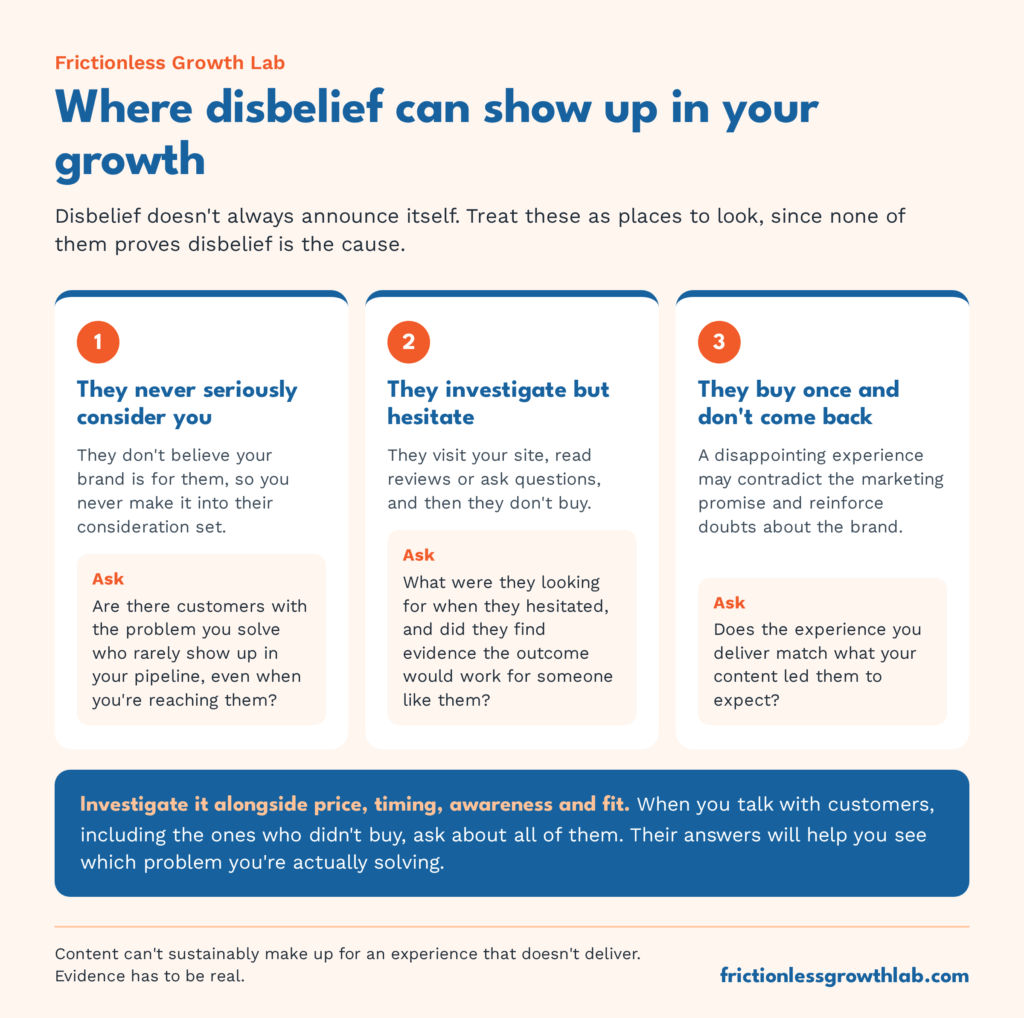
Where Disbelief Can Show Up in Your Growth
Disbelief doesn’t always announce itself, and it can look like other problems. Price, timing, awareness and fit can produce the same patterns, so investigate them together rather than one at a time. Here are three places disbelief may be part of the story.
Some ideal customers never seriously consider you. They don’t believe your brand is for them, so you never make it into their consideration set. Are there customers with the problem you solve who rarely show up in your pipeline, even when you’re reaching them?
Others investigate but hesitate. They visit your site, read reviews or ask questions, and then they don’t buy. What were they looking for when they hesitated, and did they find evidence that the outcome would work for someone like them?
Some buy once and don’t come back. If the experience contradicts what the marketing promised, a first purchase can confirm the very doubt the customer arrived with. That’s a version of the bait-and-switch problem I’ve written about before. Does the experience you deliver match what your content led them to expect?
Treat these patterns as places to look, since none of them proves disbelief is the cause. When you talk with customers in that Mosaic, including the ones who didn’t buy, ask about price, timing and fit alongside belief, and their answers will help you see which problem you’re actually solving.
Where disbelief is part of the problem, better targeting doesn’t necessarily overcome it, and more advertising doesn’t automatically make a promise more believable. Your brand may already have products and services that could serve these customers exceptionally well, but some of them don’t know it or don’t believe it. And content can’t sustainably make up for an experience that doesn’t deliver. Evidence has to be real, and the experience has to back it up.
How This Connects to the 7C Framework
Belief shows up across the 7C Frictionless Growth Marketing Framework. It starts with Customer Intimacy (C2), because you can’t create evidence that helps customers believe until you understand what made them skeptical, and that understanding has to come from the people you want to serve. Circle of Influence (C3) is where referrals like my LinkedIn creator’s can carry belief, as far as the rest of your ecosystem supports it. Customer Experience Design and Delivery (C4 and C5) are where evidence becomes real. And Customer Loyalty (C7) is where you can see whether the experience confirmed what your marketing promised.
Earn Belief From the Customers You’re Already Equipped to Serve
Your customers need a way to see the understanding, commitment and capability behind your promise. That starts with learning what customers in each Mosaic have reason to doubt, then making credible evidence available where they’ll look for it. Your brand may be equipped to serve people who aren’t yet considering or choosing you. Giving them reasons to believe can remove a barrier to that decision—and open up growth that stronger promises alone may miss.
Here are three questions to bring to your next planning conversation:
- What have your ideal customers’ experiences taught them to expect from brands like yours, and how do you know?
- What evidence are you giving them that challenges those expectations, and have you asked them whether it’s convincing?
- Does the experience you deliver throughout your ecosystem back up what you’re promising, wherever a customer enters?
If your brand has work to do before more of your ideal customers will believe what you’re saying, that’s what Mosaic Studio is built for. We create content, programming and experiences that show your customers your brand’s understanding, commitment and capability, grounded in what those customers need to see, so your marketing gives them evidence to believe instead of one more promise to weigh.
And if you missed Part 1 of this series, start with the six types of campaigns that reach customers general-market marketing misses.
Growth accelerates when you remove friction for your customers and for your business.
Frequently Asked Questions
What makes marketing messages convert?
Marketing messages that convert reach the right people, communicate something relevant and credible, and give customers a reason to act. For customers who have learned to question brands’ promises, that may mean showing evidence of recognition, understanding, commitment and capability. The evidence that matters will vary by customer and context, so ask rather than assume.
Why do customers understand a marketing message but still not buy?
Understanding a message and believing it are two different steps. A customer can grasp exactly what you’re offering and still doubt it’s true for someone like them, often because other brands made similar promises and didn’t deliver. Marketing messages that convert close that gap with evidence the customer can see, experience or verify. Disbelief is one possible cause among several, so look at it alongside price, timing, awareness and fit.
How do you find out what evidence your customers need to believe your message?
Ask them. Start with the doubts you’ve actually heard in sales conversations, reviews, support tickets and customer interviews, and label anything you haven’t heard directly as a hypothesis. Then ask customers in that Mosaic, including people who hesitated or didn’t buy, what they looked for and what would have helped them believe your promise. Different Mosaics, and different people within the same Mosaic, may need different evidence.
Is representation in marketing enough to make customers believe your message?
Representation can signal belonging and relevance, and it matters. On its own, though, it doesn’t show that your brand understands a customer, values them or can deliver for them. If the imagery says “this is for you” and the rest of the experience doesn’t back it up, customers notice.
What’s the difference between how customers interpret a message and whether they believe it?
Interpretation is what a customer takes away from your message, shaped by their societal programming and everything your marketing communicates implicitly. Belief is whether they trust that message enough to act on it. Interpretation calls for reviewing what your marketing communicates. Belief calls for evidence.
Related reading: Why Trust Is the Growth Lever Modern Marketing Can’t Ignore, my conversation with Bennie F. Johnson about why trust has become central to marketing. For what Black consumers say brands need to do to earn their trust, listen to Ep. 44.
Full Episode Transcript
Transcript of Frictionless Growth Lab Ep. 238, “Why Your Ideal Customers May Not Trust Your Marketing Promises (And What to Do About It).” Lightly edited for readability.
Sonia Thompson: Some of your ideal customers have been programmed not to trust you, and it may not even be because of anything that you’ve done, but their experiences with other brands over the years. So whenever your marketing communicates, “Hey, this is for you,” they don’t necessarily automatically believe you. They don’t take your word at face value because they don’t know yet if they can even trust you. It’s kind of like someone who’s been on five consecutive bad first dates. They’ve heard all the “I’m different” lines before, and after a while, those lines stop working because a person who’s been on those dates have recognized that there’s a pattern here, and they don’t wanna fall for it again.
It’s the same with your marketing messages. When past experiences have taught people that words are just words, another promise isn’t necessarily going to convince them, and that lack of trust can be costing you customers that you are ideally suited to serve. So let’s talk about how to change all that, and we’re gonna get into all of it after this short break.
How past experiences create a trust problem
So let’s talk a little bit about why past experiences can create a trust problem for your ideal customers. It’s helpful to understand that the people that you want to serve don’t experience your marketing in a vacuum. They are interpreting it through the lens of previous experiences. Now, we’ve talked in previous episodes about how consumers are bringing their societal programming to whatever messages you are communicating to them, and they are evaluating or receiving those messages through the lens of that programming. And to be clear, that programming comes through society, it comes through media, it comes through other marketing from brands, and of course, it also comes through lived experiences.
So there are a number of ways that we can talk about all the other programming exists, but I wanna dig in a little bit to the programming that comes from experiences from other brands. For some specific customers that you want to serve, some specific mosaics, the experiences that they have had with previous brands over the years or even over a short time period could be reinforcing for them the idea that certain products, services, and experiences aren’t really designed for people like them. I’ve experienced this a lot over my more than 10-plus years being someone who follows a gluten-free diet for health reasons. I have learned through a long string of experiences with restaurants that I just can’t walk into any restaurant sight unseen and expect that they are going to have something gluten-free on the menu that will work for me. I have learned that doing so is a really big gamble on my part, and more often than not, it probably will leave me hungry without anything sufficient to eat.
So as a result, I’ve changed my behavior. I need to confirm that that restaurant or cafe or whatever it is is gonna have something for me before I ever even step foot into it. Now, I wanna reiterate, this isn’t going to be true for every single one of the ideal customers that you are trying to reach. It’s not gonna be your total addressable market. But if you’re looking at all the different types of customers that you want to serve and all the different mosaics that exist within them, you will start to see that different mosaics are having these types of experiences that are gonna influence whether or not these consumers will trust you in what your brand messages are saying.
So let’s talk a little bit about the programming that many of your ideal customers have probably started to embrace in their heads that influences how they’re receiving your marketing. For some of them, they will have experienced products that were advertised as being working for everyone, and then they tried it, and it didn’t work for them. Other times, people will talk about businesses that claimed to welcome everyone, but they really weren’t equipped to serve them in their specific identity or needs. Or they encountered services that were designed around different assumptions that didn’t reflect their reality. These types of repeated disappointments create expectations around what future realities might be when encountering different brands.
And as a result, consumers are learning that marketing claims aren’t always reliable, specifically for people like them. They’ve heard it all before, and unfortunately, their experiences have not always matched those promises. Let’s walk through a few specific examples. A lot of Black women have complained about going to different hairstylists, makeup artists, and even photographers who don’t know how to work with different hair textures, skin tones, or even how to light them appropriately. Being willing to serve someone isn’t the same thing as being equipped to serve someone.
A while back, I did a series on buyer personas, and one of the personas that I talked about was Go-Getter Gabby. She is a professional woman who is looking to advance her career, and she is on the hunt for a career coach. So now there are a couple of different identities that Go-Getter Gabby can hold, and these are just different mosaics within the Go-Getter Gabby persona. In one instance, Go-Getter Gabby was a Muslim woman who wore a hijab, and she was trying to navigate her career progression as she had different cultural norms that were different from many of her peers. That meant that she wanted to know that a career coach that she was gonna be working with understood her unique needs and different points of view and experiences that are going to influence the way in which they would coach her and give advice.
Someone who may not have had previous experience working with someone who is of the Muslim faith or who had a different faith and different types of experiences that this version of Go-Getter Gabby was experiencing, they might not be equipped to give her the effective career advice that she needs to help her reach her goals, even though they are very willing to be able to do so. And that version of Go-Getter Gabby isn’t going to want to work with a career coach until they first can prove that she can trust that they are gonna be able to help her meet her needs. Another version of Go-Getter Gabby was a woman who had just recently come back from an extended maternity leave and was still nursing her child. She also wanted to progress in her career, but she was navigating some different circumstances that many of her peers weren’t experiencing at the same time. So she wanted to make sure, of course, that her career coach can give her the right advice that helped her navigate her specific circumstances at that point in time, while having an understanding of the current culture and lay of the land and the way things operated within her company.
She needed a coach that specifically understood her needs and could serve her needs and give her the right advice to be able to help her navigate her particular type of situation. And this version of Gabby knew that she needed to find a coach who understood her specific needs because she had spent years before following a playbook and working with a different coach who had no clue about why her situation was different, and she was applying strategies and approaches and scripts that just didn’t apply to her situation. So the key takeaway here is that your brand may inherit distrust from your ideal customers that it didn’t personally create. And even if your product or service genuinely meets their ideal customer’s needs, their past experiences may make them skeptical of your promises. But there’s also another layer to this.
The extraction problem
Consumers sometimes aren’t just questioning whether or not you have the ability to serve them. Sometimes they’re questioning whether or not you actually want to. This is what I call the extraction problem. And for many different segments of your ideal customers or your mosaics, they might be wondering, “Does your brand really value people like me, or do you just want our money?” Trust isn’t only about whether or not a brand can deliver.
It’s also about whether or not a consumer trusts the brand’s intentions. Consumers wanna know, “Does this brand even care about me and other people who are like me, or are they just interested in getting my credit card?” This is something that is especially true for consumer groups who are part of communities that have historically been underrepresented and ignored by brands. I like to describe it as you’ve got this person who was never invited to the party. They see a brand in particular inviting all these different other people to a party and never you.
And so you get a little frustrated by this. And then one day this brand walks up to you and gives you an invite to the party. If you’re the person who’s getting this invite, you’re not necessarily gonna be suddenly overjoyed and jumping for joy, excited to just go and attend. You’re gonna be wondering why. What, what changed?
What’s different? Why now do you want to invite me when you couldn’t be bothered with me all those other times before? This is what happens with a lot of brands who are suddenly discovering the purchasing power or the influence that specific historically overlooked communities have. It also comes from marketing teams who are suddenly identifying growth opportunities within specific communities, or that they have a lot more purchasing power and influence that they didn’t realize they had before. And quite frankly, some brands and industries have a long and frustrating history of targeting specific communities in predatory and exploitative ways.
And then, of course, you’ve got other brands who’ve pursued specific communities because it was trendy or they thought it was the right thing to do and without actually making any type of investment in them or making any real effort to try to understand and serve them well. There’s a difference between genuinely wanting to serve a community and just wanting to access what they have, be it their cash or their influence. So here are some questions that some of these consumer groups might start to ask now if you suddenly show up on their doorstep wanting to invite them to your party. Why are you showing up now? Is it because someone realized how profitable our community is?
Do you actually understand us? Are you invested in actually serving us, or are you just here because you want our money? Will you still be here when we are no longer the trending demographic? Now, I do wanna make this distinction. Brands are businesses, and of course, they need to make sales.
What I’m not saying is that there is something wrong with a brand recognizing a growth opportunity and trying to serve a community and earn revenue from serving a community. The problem comes when it’s only about extraction, when it’s only about what you can take from the community, what you can benefit from the community, without doing the work to serve that community well or leave them better than the way you found them. So remember, customers aren’t just questioning whether or not you can serve them well, they also want to know why you want to serve them and what it is that you are really after. Which leads us to another point to consider.
Why swapping out a photo doesn’t solve it
Sometimes the uncertainty that consumers have that make them not trust a brand quite so much comes from even some of the smallest details of how a brand presents itself. We know that representation matters, and it makes a big impact on whether or not consumers will trust your brand and whether or not they feel like your brand is for people like them. But simply swapping out a photo to be representative of the people that you are looking to serve doesn’t just automatically solve a trust problem. Representation can signal belonging. It can signal relevance.
But representation alone doesn’t establish trust. So there’s this creator that I follow on LinkedIn, and I also receive his email newsletter. And just today, I got his newsletter in my inbox, and in it, he talked about a specific team that was helping him with an aspect of his marketing and put a link to that team in case you wanted to learn more about them. So I was curious, and I went poking around, and I landed on that brand’s website. To be clear, this creator is someone who is part of a same mosaic that I am in.
This is a Black creator that I follow. So in my mind, I was completely expecting to feel like the people who are showcased on this website of this brand that he’s been working with were going to be more representative because I feel like trust was established by he and I. But whenever I got to that brand’s website and I spent some time on a few different pages, I didn’t see anyone who looked like me. There was nothing that was representative of this creator. Even this creator, this influencer, wasn’t even on the brand’s website.
And of course, not all creators or influencers are gonna be there, but it felt like the trust that I had built up with him wasn’t automatically extending to this brand because what I saw on the brand’s website didn’t feel congruent or that it aligned with them partnering with this creator. Now, of course, he’s going to get a benefit from anybody who signs on and is referred through him, and him putting this link in his newsletter doesn’t diminish the trust or the respect that I have for him. It just was a reminder for me that trust doesn’t automatically translate just because the representation in some way, shape, or form is there. In this case, representation extended through a referral, but the story on the other side of that referral, it left me with more questions. It didn’t match up.
It didn’t align. The promise that I felt and the trust that I had with him, it didn’t carry over to the brand because the brand’s representation only existed in that one area. It wasn’t something that existed throughout the brand experience. So what does this example illustrate? Visuals communicate who a brand appears to serve.
Visuals can even communicate who a brand wants to start serving. But customers aren’t just looking at one touch point. They notice who is absent throughout your customer experience, who is sparse throughout your customer experience, and what feels true to your brand versus what may look like a one-off. A lack of representation can introduce uncertainty even when trust already exists. It’s also important to understand that different touch points throughout your customer experience can send different signals, so it’s very important that you are sending signals that are uniform throughout because you never know who’s entering through what aspect of your brand’s ecosystem.
So it’s in your best interest to make sure that it’s communicating throughout your ecosystem that absolutely this brand is for people like you. That’s what I was trying to find out. Whenever I received the email from this creator and he was talking about his team, there was already an inherent, “Yes, this is for people like you,” but whenever I got to their website, there were zero signals that communicated that, “Yes, this is for people like you.” And that’s where that trust dynamic fell apart. The entire arc of the experience that your brand delivers needs to communicate that, yes, the people that you’re trying to serve can trust you.
A photograph can help someone see themselves in your marketing, but the rest of the experience has to give them a reason to believe that your brand is genuinely for them.
How Mosaic content helps rebuild trust
So if another marketing promise or a simple image aren’t enough to deliver the signals that make the community that you’re trying to serve trust you and know in their heart that you are for people like them, what is it that will? This is where mosaic content fills that gap. It helps provide very specific evidence that the customers that you want to serve need to believe to genuinely feel that your brand can and will serve people like them well. We have to bridge the gap between promises and proof. You cannot overcome a history of broken promises from brands with another promise.
Your ideal customers, and particularly those from these mosaics who are a little jaded, they need credible evidence that their experience with your brand can be different. And the same old types of content and campaigns that do more of just reinforcing your brand’s core message probably isn’t going to move the needle as much as you would hope or need it to to be able to convert a much larger percentage of the ideal customers that you are looking to reach. This is where mosaic content becomes so valuable. In episode 236, which I will link in the show notes, we explored six different types of campaigns and content that can reach and convert customers that general market campaigns just aren’t able to build that l- needed trust with. And this episode was all about explaining why that specific type of content is even necessary, not simply about making your marketing more representative.
It’s about overcoming very specific and very real trust barriers that conventional marketing messages have not addressed. So here are four things mosaic content can demonstrate for the specific mosaics that you are trying to reach, build trust with, and convert. One, it communicates recognition. We see you. It helps the brand communicate that we have considered people like you, and it does a good job of moving beyond token representation.
Number two, it also communicates that we understand you, and it does it because it demonstrates knowledge of a specific community’s, or mosaic’s, specific needs, wants, and challenges. It directly addresses concerns that general market marketing cannot. It shows that you as a brand understand how different communities experience your brands and the category as a whole. Third, it communicates a commitment that we value you. Remember those jaded consumers who haven’t been invited to the party and suddenly they get the invite?
This is demonstrating that, “Yeah, like, we really do want you here. We don’t have an ulterior motive. We’re not gonna do any type of trick or bait and switch or anything like that. We actually want you here. We actually want to serve you.
We actually see you, and we value you.” So this type of content can show the work and the investment that the brand has made in the community. It helps to demonstrate that serving this community isn’t just a temporary campaign, and it makes genuine engagement and commitment visible, not just some backdoor secret type of thing that, “Hey, you know, we’re good, but we don’t need everybody else to know about it.” And the last thing that it communicates, which is especially important for conversion, is capability, that we as a brand can deliver for you. It helps you demonstrate relevant expertise.
It helps you demonstrate how your specific products and services perform for specific communities, particularly for the ones who’ve been underrepresented and underserved for a very long time. It helps you feature credible customer experiences and outcomes. And of course, it gives people reasons to believe that your brand delivers on its outcomes. It is reprogramming all of those bad experiences and skepticism that have been fed into your ideal customers, which have been blocking a lot of your brand’s messages. Different mosaics need different evidence.
The type of content and campaign that builds trust with one type of consumer doesn’t automatically do the same with another. To be clear, mosaic marketing isn’t about convincing consumers to trust a brand that has not earned it. We’re not about that at all. It’s about making genuine understanding, capability, and commitment visible. You can’t create content and campaigns that create trust with the ideal consumers that you want to serve without understanding what caused them to be skeptical in the first place.
Why rebuilding trust is a growth opportunity
Rebuilding trust with the communities that you want to serve is a growth opportunity, even if you weren’t the one who broke the trust. Trust barriers create friction, and friction limits growth. Mosaic content is a mechanism to remove that friction and pave the way for more growth for your brand. So if your brand is one that’s got products and services that can benefit more of your total addressable market, more of your ideal customers, more of the different mosaics who have the problem that your brand solves, but you’re not sure about some already existing programming that may prevent them from trusting you in what it is that you’re communicating to them through your marketing, mosaic content can help you close that gap. And as a result, it can help you tap into a new layer of growth.
Opportunity here isn’t just to reach more people. It’s to earn the trust of more people that you are already equipped to serve. Create the content and campaigns that removes the friction so you can get to more growth.
Questions for marketing leaders
So here are a few questions for marketing leaders to help you think through this a little bit more. What have your ideal customer experiences taught them to expect from brands like yours? Where might those expectations be creating friction in their journey with your brand? What evidence are you giving to them that challenges those embedded expectations? Are you simply telling customers that you are for people like them, or are you demonstrating it?
And the last thing is, does the actual experience that your brand is delivering throughout your entire ecosystem, does it effectively reinforce the trust that you are trying to build so that it doesn’t just fall apart if somebody enters into a different part of your ecosystem that you may not have been expecting? If you’re listening to this and thinking that your brand has some work to do to build trust with the different mosaics of ideal customers that you are trying to serve, and you’re not exactly sure what types of campaigns and content that can help you do that, I got you covered. This is something that Mosaic Studio can help you with. I will drop a link into the show notes for you so you can get more details. Also, if you haven’t already, check out that previous episode on the six different types of mosaic content that you could create to help you convert more of your ideal customers.
Until next time, remember, growth accelerates when you remove friction for your customers and for your business. Thanks so much for listening. Talk to you soon.
Found this post useful?
There’s more where that came from—get insights on the new rules of growth delivered to your inbox.

