I can’t tell you the number of times I’ve searched Google for hairstyle ideas—braided updos, buns, short bobs—only to scroll through the results and realize most of them weren’t really for me. To find examples that worked for my hair, I had to search again: “Black updos.” “Black braided hairstyles.” “Textured hair.” “4C hair.”
The first search wasn’t necessarily giving me bad results. It was giving me results based on a default that didn’t reflect my needs. I had to do extra work to find what was relevant to me.
General-market marketing works much the same way. It was designed to reach the masses, but your ideal customers aren’t one homogeneous mass. So a campaign built around a default customer may work for some of them while leaving others doing extra work to figure out whether your brand is meant for them.
General-market campaigns aren’t designed to work equally well for all your ideal customers. So what should brands create instead?
The answer starts with what I call Mosaic Marketing. Mosaic Marketing recognizes that your ideal customers are made up of different communities, or mosaics, each with different needs, experiences, barriers, questions and beliefs. It means choosing the mosaics you want to serve, understanding what each one needs from you and designing marketing that delivers it.
Much of that work happens in your messaging. But content and campaigns can do strategic work too, and that’s what this article is about.
Below are mosaic marketing examples from brands like Pinterest, Dove, Procter & Gamble and Ralph Lauren, organized by the job each one was doing, plus a simple tool for deciding what your next campaign should do.
Listen on Apple Podcasts | Spotify | Read the full transcript
Mosaic Marketing Examples, Organized by the Six Jobs They Do
When I looked across brands doing this kind of work—and it’s actively happening right now, across categories—I found that their content and campaigns generally perform one of six strategic jobs.
I call them The Six Jobs of Mosaic Content & Campaigns.
| The job | The question it answers for your customer | What it aims to change |
|---|---|---|
| 1. Prove product fit | “Will this actually work for someone like me?” | The purchase decision |
| 2. Prepare the soil | “What must I believe, feel or experience before I’m ready to participate?” | Readiness |
| 3. Normalize their presence | “Can I see people like me naturally existing in this brand’s world?” | Perception |
| 4. Spotlight the community | “Will this brand make space for our stories, interests, culture and experiences?” | Visibility |
| 5. Build understanding | “Can you help other people understand something about our experience that they may not see?” | Understanding |
| 6. Drive change | “What needs to change around this community?” | Behavior, policies and practices |
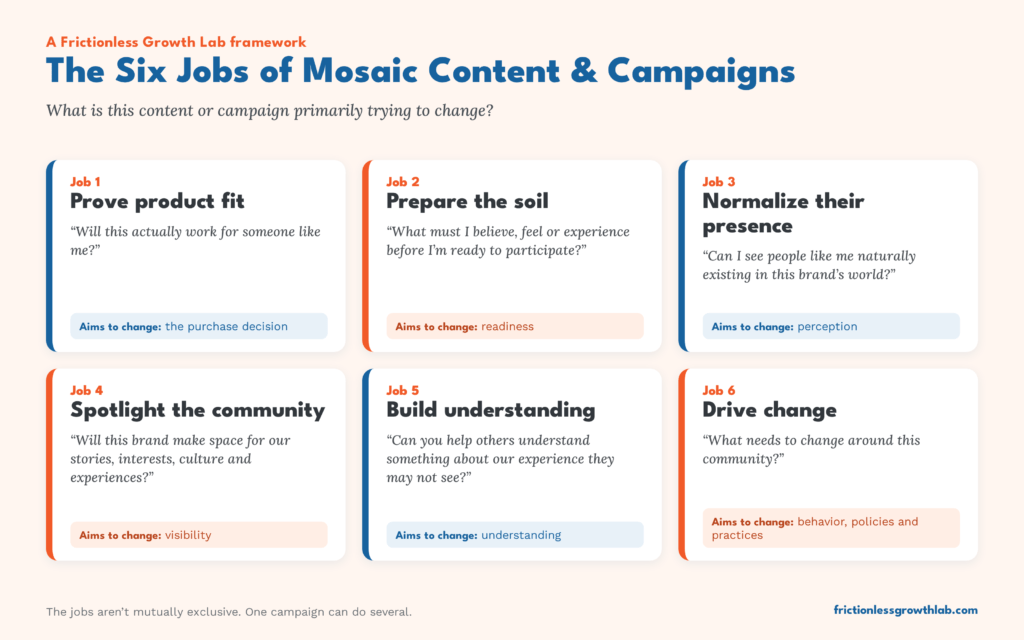
Here’s the distinction that makes this framework useful.
The strategic question isn’t what kind of content or campaign to create. It’s what that content or campaign needs to change.
A video can prove product fit or drive change. A podcast can prepare the soil or spotlight a community. The format is just the expression. The job is the strategy.
The jobs aren’t mutually exclusive, and one campaign can do several. But when you’re planning or evaluating a piece of work, ask what it’s primarily trying to change, and judge it against that.
If you’d rather hear me walk through the framework first, here’s the full episode.
For each job below, I’ve unpacked one example in depth—the customer need behind it, what the brand created and why it illustrates that job—and listed a couple more you can explore.
1. Prove Product Fit: “Will This Actually Work for Someone Like Me?”
Your ideal customers ask this question constantly, consciously or not, whenever they consider a new product or service.
Product-fit content answers it by addressing the specific features, objections or use cases that matter to a particular mosaic. Of the six jobs, it sits closest to conversion.
General product content tells people what a product does. Product-fit content shows that it works for people with needs like theirs, which is also why relevant social proof can be more persuasive than generic testimonials.
Example: Pinterest Hair Pattern Search
In August 2021, Pinterest launched hair pattern search, which lets people filter hair searches by six patterns: protective, coily, curly, wavy, straight, and shaved or bald.
Pinterest said it built the feature with Black, Brown and Latinx users in mind, with input from hair professionals including stylist Naeemah LaFond, and it has since expanded to more countries.
Pinterest recognized a challenge familiar to people with curly, coily and textured hair: finding hairstyle inspiration that actually reflects their hair type. Its hair pattern search feature addresses that need directly, helping users find more relevant inspiration without having to rely solely on increasingly specific search terms.
That’s product-fit content in action. Pinterest developed a feature for a specific customer need and communicated how it could make the experience more useful for those customers.
There’s an important lesson here.
Product-fit content can only prove fit the product actually has.
If your product works for a mosaic and your marketing doesn’t show it, you have a messaging gap, and content can close it.
If the product doesn’t work for them yet, you have a product or experience gap, and no campaign will fix that on its own.
More product-fit examples:
- Google Pixel, “Javier in Frame.” The 2024 Super Bowl ad showed how the Pixel camera’s Guided Frame feature helps blind and low-vision people take photos independently. I discussed it in Episode 148.
- TurboTax Live Full Service en Español. Intuit launched the service in 2023 with bilingual advertising showing Spanish-speaking customers they could have an expert prepare their taxes in Spanish.
2. Prepare the Soil: “What Must This Audience Believe or Feel Before They’re Ready?”
Sometimes the barrier comes before the product decision.
It’s a belief: This category isn’t for people like me.
If product fit removes barriers to choosing your product, preparing the soil removes barriers to participating in the category.
Prepare-the-soil content addresses what a mosaic needs to believe, feel or experience before they’re ready to participate in your category at all.
The insight behind this job is societal programming: the messages people absorb over years, sometimes decades, about who belongs, who’s beautiful and what’s possible for someone like them.
For some customers, that programming makes them fertile ground for your message. For others, there’s work to do before your message can land.
I explain how programming shapes the way people read your marketing in my article on brand messaging effectiveness.
Example: Dove, Love Your Curls
In 2015, Dove Hair launched Love Your Curls after research found that only 10% of U.S. women with curly hair felt proud of it, and only four in ten girls with curly hair thought their hair was beautiful.
The film focused on young girls who didn’t like their curls, and its message to the women around them was simple: the best way to help girls love their curls is to show how much you love yours.
What makes this prepare-the-soil work is the sequencing.
Dove didn’t open by selling curl cream to people who’d absorbed years of programming that straight hair was the standard.
It encouraged women and girls to embrace their natural hair before asking them to buy products designed to care for it.
Someone trying to minimize their curls may not be receptive to products that celebrate them. Someone who’s decided their curls are beautiful may be.
More prepare-the-soil examples:
- Sephora, Classes for Confidence. In 2018, Sephora extended the free program with beauty classes for transgender and nonbinary people, building skills and confidence.
- The North Face, She Moves Mountains. The 2018 initiative shared women explorers’ stories to help more women and girls see themselves as people who belong outdoors.
3. Normalize Their Presence: “Can I See People Like Me Naturally Existing in This Brand’s World?”
Many people from underrepresented and underserved communities rarely see themselves in mainstream media and marketing, and that absence shapes whether they feel a brand or category is for people like them.
Normalizing content shows people from a mosaic simply existing in your brand’s world, without making their identity the point.
People get to be customers, adventurers, experts, romantic leads, beautiful, successful and ordinary.
The underlying message is: “Of course you’re here.”
Example: Sports Illustrated Swimsuit and Martha Stewart
In May 2023, Sports Illustrated Swimsuit put Martha Stewart on the cover of its annual issue.
At 81, she became its oldest cover model, with a full photo spread shot in the Dominican Republic.
The Swimsuit Issue is traditionally associated with youth and one very specific body type.
Giving an 81-year-old woman the same kind of shoot every other cover model gets normalized her presence in that world.
Nothing in the images argued that she belonged there.
She was simply there.
For women who’ve been told, directly and indirectly, that desirability has an expiration date, seeing someone like them presented as a matter of course says something no explanation could.
Sometimes the power is in not explaining.
More normalizing examples:
- Amazon Alexa’s Super Bowl ad with Michael B. Jordan. The romantic lead is a dark-skinned Black woman with natural hair, and none of that is the point of the story. I break down why it works in my article on brand messaging effectiveness.
- Royal Caribbean’s Spanish-language email newsletter. Spanish-speaking cruisers get communications in their preferred language as a routine part of the relationship. I walked through it in Episode 155.
Normalization integrates people naturally into the picture.
Sometimes, though, it’s important to deliberately turn the camera toward a particular community.
4. Spotlight the Community: “Will This Brand Make Space for Our Stories?”
Spotlighting content centers a mosaic’s stories, interests, culture and experiences.
The community isn’t simply present. They’re the focus.
Where normalization says, “Of course you’re part of this world,” spotlighting says, “For this story, your world matters.”
This content doesn’t need to explain the community to outsiders. It can simply be valuable, entertaining or affirming to the people it’s about.
Example: Ralph Lauren, Polo Ralph Lauren for Oak Bluffs
In July 2025, Ralph Lauren introduced Polo Ralph Lauren for Oak Bluffs, a limited-edition collection and campaign telling the story of Oak Bluffs, the Martha’s Vineyard community that has been a coastal haven for Black families for more than a century.
Morehouse and Spelman alumni working at Ralph Lauren conceptualized and designed it, and it included pieces made in collaboration with both HBCUs.
The details nod to island life, down to the “five-to-sevens,” the front-porch socials residents hold before dusk.
This is spotlighting because the campaign didn’t drop Black customers into a generic summer story.
It made a specific community’s history, traditions and style the subject.
And it was made by people connected to the institutions and culture being celebrated, which helps make a spotlight credible.
More spotlighting examples:
- Netflix’s community channels. Netflix built social brands for specific audiences: Strong Black Lead, Con Todo for Latino audiences, Golden for Asian and Pacific Islander audiences and Most for LGBTQ+ audiences. I dig into how that started in my article on general-market marketing.
- Toyota and Sonoro, Chasing Sueños. This 2025 video podcast, hosted by AJ Ramos, centers Latin musicians and artists pursuing their dreams. I talked about Sonoro’s work with Toyota in Episode 154.
5. Build Understanding: “Can You Help Others See What We Experience?”
Some customer experiences are invisible to people who don’t live them.
Understanding-building content makes those experiences visible to people outside the community.
It reveals context, challenges assumptions and helps people see why customers with a particular identity may experience the world differently.
This is different from visibility.
The goal is understanding.
And when a brand helps others understand a community’s experience, it can draw the people in that community closer too—a potential ingredient in loyalty.
Example: Procter & Gamble, The Talk
In 2017, Procter & Gamble released The Talk as part of My Black Is Beautiful, a platform started by Black women at P&G in 2006.
The film moves across several decades, showing Black parents preparing their children for the racial bias they’ll face.
One mother tells her daughter that “pretty for a Black girl” isn’t a compliment.
Another, whose daughter has just passed her driving test, tries to prepare her for being pulled over by police:
“This is not about getting a ticket. This is about you not coming home.”
The consumer insight. According to the team behind the campaign, research into what mattered most to the Black women My Black Is Beautiful serves kept surfacing the same thing: mothers said it was more important than ever to have “the talk” with their children.
It’s a conversation Black parents have had for generations, and one most people outside the community have never had to have.
What P&G created. A short film that aired on national TV and spread online, with no product in it.
Instead, it invited people to continue the conversation with #TalkAboutBias and closed with: “Let’s talk about ‘the talk’ so we can end the need to have it.”
What makes it identity-relevant. The conversations are specific.
For many Black viewers, these weren’t unfamiliar scenarios. They were conversations they’d had with their parents or their own children, presented with care and without explanation.
That specificity is what makes it resonate with the community at its center, and what makes it revealing for everyone else.
Why it’s a build-understanding example. The film’s primary job is to help people who’ve never had “the talk” understand what it means for the families who have.
It also spotlights the community, which shows how one piece of work can do more than one job.
But what it’s primarily trying to change is understanding.
What we know, and what’s interpretation. The documented outcomes are reach and recognition.
The campaign team reported more than 1.86 billion earned media impressions and coverage from more than 900 outlets. The film won the Primetime Emmy for Outstanding Commercial and a Grand Prix in Film at Cannes Lions in 2018.
It also drew criticism, with some accusing P&G of using race to sell.
Those are documented reactions and outcomes.
My interpretation is that this kind of investment tells the women P&G serves, “We understand what you carry,” which can be a powerful loyalty signal.
That’s an inference about strategic value, not a measured sales result.
More understanding-building examples:
- Merck, A Touch of Sugar. Narrated by Viola Davis and debuted at Tribeca in 2019, the documentary explores type 2 diabetes through the cultural, family and systemic factors affecting different communities.
- Libresse and Bodyform, #wombstories. This 2020 film visualized experiences of menstruation, infertility, miscarriage, endometriosis and menopause that often go unspoken.
Sometimes understanding isn’t enough.
Sometimes the conditions around a customer need to change.
6. Drive Change: “What Needs to Change Around This Community?”
Drive-change content educates people about what to do differently and mobilizes changes in behavior, policies and practices.
Building understanding says, “Now you see what someone else experiences.”
Driving change says, “Now, what are we going to do differently, so people don’t have to keep facing this?”
Example: Dove and the CROWN Act
In 2019, Dove research found that Black women were 80% more likely to change their natural hair to meet social norms or expectations at work and 1.5 times more likely to have been sent home from work, or know a Black woman who was, because of her hair.
That year, Dove co-founded the CROWN Coalition with the National Urban League, Color Of Change and the Western Center on Law & Poverty to push for the CROWN Act (Creating a Respectful and Open World for Natural Hair), legislation prohibiting race-based hair discrimination.
California passed it first, in July 2019, and more than half of U.S. states now have some version of a CROWN law.
Dove has kept the research going, including a 2023 study with LinkedIn.
This is driving change because Dove didn’t stop at helping people understand hair discrimination.
It used research, education and advocacy to change the rules that allow it.
The documented outcome is legislative, though Dove is one of several forces behind those laws, so no single brand gets credit for every state.
My interpretation: for Black women with textured hair, a brand working to change the conditions they face sends a clear signal about whose side it’s on.
More drive-change examples:
- L’Oréal Paris, Stand Up Against Street Harassment. Launched in 2020 with the nonprofit Right To Be, Stand Up trains people in the 5Ds, practical ways to intervene safely when they witness street harassment.
- YSL Beauty, Abuse Is Not Love. YSL Beauty created the program in 2020 to help prevent intimate partner violence. Its 2025 film Don’t Call It Love, one part of that wider program, helps people recognize overlooked warning signs of abuse.
One Brand, Two Jobs: What Dove’s Campaigns Teach
Dove shows up twice in this article on purpose.
Both campaigns serve women with curly, coily and textured hair. But they address different barriers, so they do different jobs.
| Love Your Curls (2015) | The CROWN Act (2019 onward) | |
|---|---|---|
| The barrier | How women and girls felt about their own curls | How workplaces and schools treated natural Black hairstyles |
| What needed to change | Readiness | Behavior, policies and practices |
| The job | Prepare the soil | Drive change |
| What Dove created | A film and a confidence message | Research, a coalition and advocacy for legislation |
Same brand, overlapping customer communities, different barrier, different job.
The lesson isn’t to pick a format and look for a reason to use it.
It’s to identify what matters to the community and create what that moment requires.
That’s the framework in one comparison.
How to Choose What Your Next Campaign Should Do: The Campaign Job Finder
The goal isn’t to create all six types of content and campaigns, or to check six boxes.
It’s to understand what matters to the community you want to reach, identify what needs to change and create work that accomplishes that job.
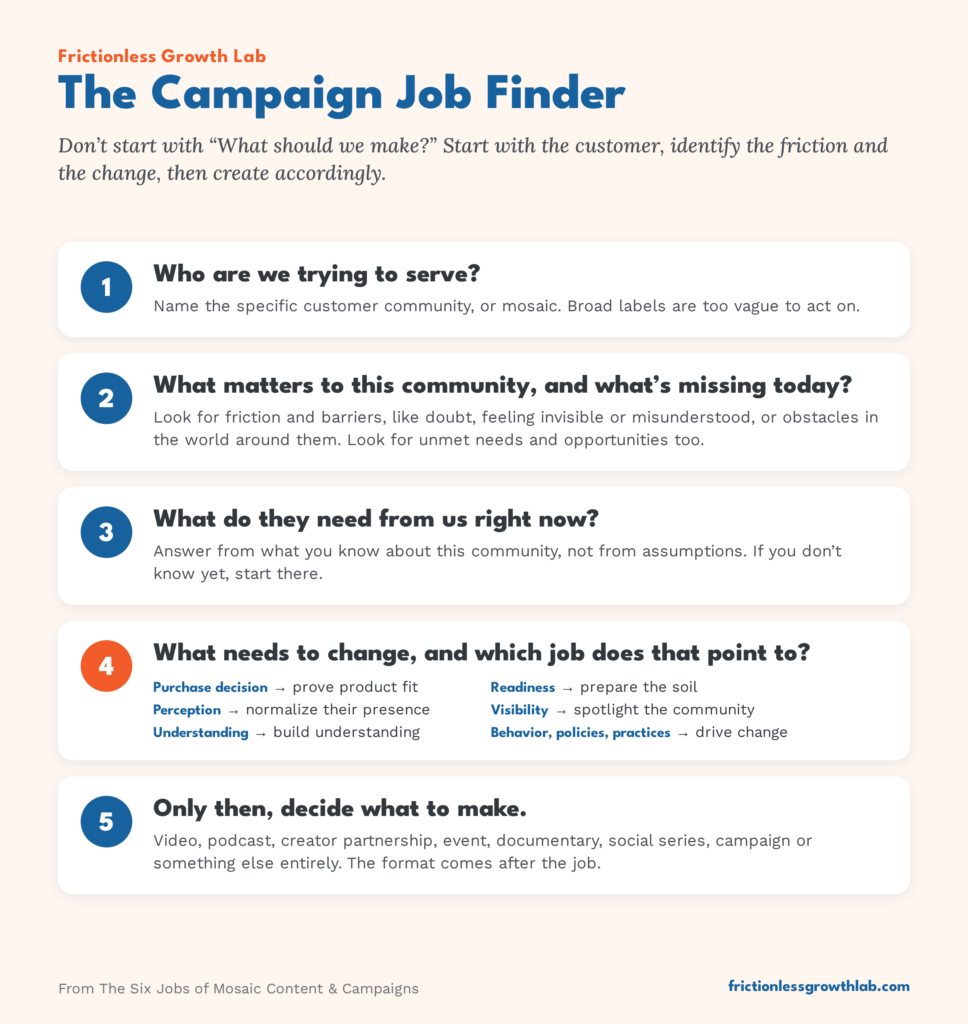
So don’t start with “What should we make?”
Use this five-step sequence instead.
I call it the Campaign Job Finder.
Step 1: Who are we trying to serve?
Name the specific mosaic.
“Women” or “multicultural consumers” is too broad to act on.
“Black women with natural hair considering our styling line” or “Spanish-dominant customers comparing tax-prep options” is specific enough.
Step 2: What matters to this community, and what’s missing today?
Look for friction: doubt that the product works for them, a belief that the category isn’t for them, feeling invisible or misunderstood, or a barrier in the world around them.
Look for opportunity too: unmet needs, stories no one is telling, interests no brand is serving well.
Step 3: What do they need from us right now?
Answer from what you actually know about this community, not from assumptions.
If you don’t know yet, that’s your first piece of work.
Step 4: What needs to change, and which job does that point to?
A purchase decision points to proving product fit.
Readiness points to preparing the soil.
Perception points to normalizing their presence.
Visibility points to spotlighting the community.
Understanding points to building understanding.
Behavior, policies or practices point to driving change.
Step 5: Only then, decide what to make.
Once you know the job, you can choose the right expression: a video, podcast, creator partnership, event, documentary, social series, campaign or something else entirely.
Run Dove through it and you can see why its two campaigns look so different.
The broad community at step one overlapped. The answer at step two changed—from how women felt about their curls to how the world treated their hair—so step four pointed to a different job, and step five produced different work.
To put this to work, run your current campaign calendar through step four.
You may find most of your work is doing one job, often product fit, for one default customer, while the mosaics you most want to grow with need a different job entirely.
Why This Work Draws Customers Closer: Three Signals
When content and campaigns do their job well, customers can pick up on three signals.
“This is for someone like me.” That’s relevance. They can tell you considered their particular needs, questions and context.
“This brand gets me.” That’s understanding. You’ve shown knowledge of something about their experience most brands overlook.
“This brand is investing in people like me.” That’s investment. You’ve devoted attention, creativity, resources, distribution or influence to something that matters to them.
Brands often underestimate the last one.
Customers can tell the difference between swapping a face in the creative and building a feature, funding a film or spending years working to change a law.
How the Six Jobs Connect to the 7C Framework
The Six Jobs put two of the 7Cs of Frictionless Growth Marketing into practice.
The first is Customer Intimacy: the first three steps of the Campaign Job Finder are Customer Intimacy work, and you can’t choose the right job for a community you don’t understand.
The second is Circle of Influence, the people and institutions your customers already trust.
Several of the strongest examples here worked through that circle: Ralph Lauren with Morehouse and Spelman, Toyota with Sonoro, Dove with civil rights and legal organizations.
When trusted voices help make the work, the signals of understanding and investment become far more believable.
What Should Brands Create Instead of General-Market Campaigns?
Effective Mosaic Marketing doesn’t start by choosing a creative format.
It starts by understanding a customer community, identifying what needs to change and creating content or campaigns that accomplish that job.
Sometimes that means proving your product works for them.
Sometimes it means preparing the soil, normalizing their presence, spotlighting their stories, helping others understand their experience or helping change the conditions around them.
Do that well, and more of your ideal customers can look at your brand and say:
“This is for someone like me.”
What Could Your Brand Create if You Started With the Customer Instead of the Campaign?
At Mosaic Studio, we develop content, programming and experiences built around the communities brands want to grow with.
We start by understanding those customers—their needs, experiences, interests and the friction standing between them and your brand.
Then we create work designed to make them feel seen, understood and connected.
Start with the consumer. Not the content.
FAQs About Mosaic Marketing Examples
Can one campaign do more than one of the six jobs?
Yes. The jobs aren’t mutually exclusive, and strong work often does several at once.
P&G’s The Talk builds understanding and spotlights the Black community.
Naming the jobs helps you get clear on what a piece of work is primarily trying to change, so you can design it, and evaluate it, against the right goal.
Is Mosaic Marketing the same as representation in advertising?
Representation is part of it, and normalizing a community’s presence is one of the six jobs.
But Mosaic Marketing is broader.
It’s about understanding what each customer community needs from your brand to move forward and building that into everything from product to messaging to the content and campaigns you create.
Sometimes a mosaic needs to see themselves.
Sometimes they need proof the product works for them, a reason to believe the category is for them or a brand willing to help change the conditions around them.
Do you need a big budget to do this?
No.
Some examples here are Super Bowl ads and national campaigns, but the jobs scale down.
A Spanish-language newsletter normalizes a mosaic’s presence.
A workshop series can prepare the soil.
A podcast or creator partnership can spotlight a community.
What matters is choosing the right job for a specific community and doing it consistently.
Full Episode Transcript
Transcript of Frictionless Growth Lab Ep. 236, “6 Types of Campaigns to Convert Customers General-Market Campaigns Miss.” Lightly edited for readability. Sponsor messages are marked.
Sonia Thompson: General-market marketing was designed to reach the masses. But your ideal customers aren’t just one homogenous mass, so naturally it only works for a fraction of them. Now, if you want your marketing to work for more of the customers that you want to serve, you need marketing designed around the different communities within your customer base so they know without a shadow of a doubt that your brand is absolutely for people like them. And whenever you do that, instead of only converting a fraction of your ideal customers, you create opportunities to convert more of them. So today, we’re getting into six different types of content campaigns that you can incorporate within your marketing to help you do just that.
And of course, I’m gonna include examples for each. We’re gonna get into all of it after this short break.
[Sponsor break]
When a buyer asks AI for a solution like yours, does your business come up? Most companies have no idea, and by the time they find out, they’ve already lost the deal to someone who did. HubSpot AEO helps you show up in those moments with the right answers buyers are looking for before the first click, before the first form fill. That’s the moment HubSpot AEO is built for. Check out hubspot.com, the agentic customer platform for growing businesses.
[End of sponsor break]
What Mosaic Marketing is
So the big idea here is that more brands need to be incorporating more mosaic marketing into the overall marketing that they are producing. At its core, mosaic marketing recognizes that your ideal customers aren’t just one big homogenous group. Different communities within your customer base have different needs, experiences, barriers, questions, and beliefs. In previous episodes, we’ve talked about developing the right messages for each of your mosaics or ideal customer groups, but those messages aren’t only expressed through website copy, emails, and advertisements. Content and campaigns can do strategic work as well.
Now, as I looked across different examples of this kind of work, because it’s actively happening today, I found that they generally perform one of six strategic jobs. I think of these as the six jobs of mosaic content and campaigns. Now, these aren’t necessarily mutually exclusive. One campaign can perform several of these jobs. Big question is, what is the content or the campaign primarily trying to change?
Purchase decision, readiness, perception, visibility, understanding, behavior?
Job 1: Prove product fit
So let’s get into the first job, and that is proving product fit. Ultimately, proving product fit is trying to answer a very simple question that your ideal customers are asking constantly, whether it’s consciously or subconsciously, whenever they’re considering a new product or offering, and that is, “Will this actually work for someone like me?” Now, solving this job is the closest of the six jobs to conversion. It addresses the specific product questions, features, objections, or use cases that matter to a specific mosaic. Now, here are some quick examples of the way in which some brands are using content and campaigns to solve this specific job.
A couple years ago, Google Pixel showcased the Javier in Frame ad during the Super Bowl, and in it they were demonstrating how its feature guided frame helps blind and low-vision consumers independently take photos. Pinterest does it with hair pattern search, where it shows users with different hair textures how Pinterest can help them find ideas more relevant to their particular hair type. I can’t tell you the number of times that I have been searching for different examples of hairstyles, braided updos or updos, buns, short bobs, and after getting the initial results, I realize I actually needed to type in Black updos, Black braided hairstyles or curly hair or textured hair or 4C hair to get the examples that were much more relevant to the type of hair that I have. So what Pinterest is doing is super, super, super helpful and appreciated. TurboTax offers Spanish language support, and they created ads and campaigns that communicate that they do.
So these campaigns are demonstrating how Spanish-speaking and bilingual consumers can receive tax assistance in Spanish. General product content tells consumers what the product actually does. Product fit content demonstrates that it works for people with specific needs like theirs. It moves from one to, “Hey, that looks useful, but I’m not sure if it’ll work for someone like me,” and it moves them to, “Hey, that could work for someone like me, ’cause I see people like me that it’s working for.”
Job 2: Prepare the soil
But sometimes the barrier that consumers are experiencing comes before the product decision or product consideration. Someone may not even see themselves as a person who belongs in that category at all. So job number two of your campaigns and content is to prepare the soil. The strategic job of preparing the soil content is to answer a very specific question: what must this audience believe, feel, or experience before they’re ready to participate? Sometimes the obstacle isn’t price, quality, or product functionality.
It’s this market, this product type, this type of thing isn’t for people like me. Let’s reprogram this unfortunate thinking that we’ve been getting from different sources, from different societal programming that’s probably been happening for years, if not decades, that yes, you do indeed belong here. Yes, absolutely, this is for you specifically. So one way that Dove used campaigns and content to do just that for specific communities was through a Love Your Curls campaign. There are a large percentage of people with curly and textured hair who have really mixed or negative feelings about their curls and their textured hair because of this societal programming.
So what did Dove do? They created this campaign to encourage women and girls to embrace their natural curls before asking them to buy their products to care for their curls. Sephora did this by introducing classes for con-… confidence. And in those classes, they helped transgender and non-binary people develop beauty skills and confidence. And The North Face did it by introducing a campaign called She Moves Mountains.
This particular campaign helped more women and girls see themselves as people who belong outdoors. So if product fit removes barriers to people choosing your product, preparing the soil content removes barriers that prevents people from participating in the category altogether, because they absolutely should be participating in it. This type of content can move someone from, “This isn’t really for people like me,” to, “Absolutely, this is for people like me, and I’m gonna be one of those people.”
Job 3: Normalize their presence
Job number three of the content and campaigns that you could choose is to normalize their presence, specifically of the mosaics that you are trying to reach. There are a lot of people from underrepresented and underserved communities who unfortunately feel invisible, and they just don’t see themselves in mainstream media and marketing. That kind of programming influences the way in which they feel sometimes about themselves, as well as whether or not they feel like they belong, or whether or not a brand or a category is for people like them. So the strategic job of this type of content is to answer the question, “Can I see people like me naturally existing in this brand’s world?” This isn’t about explaining someone’s identity.
It’s about allowing them to simply exist. Here are some quick examples. Royal Caribbean Cruise Lines offers a Spanish-speaking email newsletter. Just like in their English language newsletter, it serves Spanish-speaking cruisers by sending them communications in their preferred language as a routine part of maintaining and nurturing the customer relationship. One of my favorite examples of this is from Amazon Alexa, whenever they put a Super Bowl commercial with Michael B.
Jordan, in which the lead for the ad wasn’t Michael B. Jordan, but it was a dark-skinned woman with natural hair. She was a romantic lead, and her race, her skin tone, nor her hair type were the point of the story. Loved it, loved it, loved it. And Sports Illustrated Swimsuit did it in 2023.
They put 81-year-old Martha Stewart on the cover of their swimsuit edition and gave her a full spread in a place that is traditionally associated with youth and a s- very specific body size and type. Sometimes the power in this type of campaign isn’t in explaining that someone has the right to be there or that they are there and present. People get to be customers, adventurers, experts, romantic leads, beautiful, successful, ordinary. So in your communications, the underlying message to these particular types of consumers is, “Of course, you’re here,” because there’s no reason why they shouldn’t be. So normalization integrates people naturally into the picture.
But sometimes it’s important to deliberately turn the camera toward a particular community. Which brings us to job number four, jo—
[Sponsor break]
Okay, I’ve got another podcast recommendation for you. It’s This Old Marketing, hosted by Joe Pulizzi and Robert Rose, and it’s brought to you by the HubSpot Podcast Network, the audio destination for business professionals. Joe Pulizzi and Robert Rose are two of the most well-known experts in the content marketing space. And in this show, they are talking about the latest content marketing trends, and they discuss how businesses can use content to attract and retain customers. One really great episode that you should tune into, and it’s super timely, is The State of Content Marketing 2027: What Comes Next? And here’s another one for you to consider: Is Blogging Dead or Mostly Dead? Listen to This Old Marketing wherever you get your podcasts.
[End of sponsor break]
Job 4: Spotlight the community
Job number four, spotlight the community or the mosaic that you are trying to reach. The strategic job of this type of content is to answer this question: will this brand make space for our stories, our interests, our culture, and our experiences? Here, the community isn’t just simply present, they’re the focus. Here are some quick examples of how brands have been doing this. In 2025, Ralph Lauren introduced its Oak Bluffs campaign which celebrates the history, traditions, and style of Martha’s Vineyard’s Oak Bluffs Black community through a collection and campaign created in association with Morehouse and Spelman Colleges and designed by alumni of the two HBCUs at Ralph Lauren.
Netflix has done it by creating social media handles designed to speak to very specific communities. For reaching the Black audience, they’ve got Strong Black Lead. For reaching the Hispanic audience, they have Con Todo. For the Asian community, it’s Golden, and for the LGBTQ+ community, it’s Most. In essence, Netflix built editorial platforms on social media to reach specific communities.
And Toyota did it with Chasing Sueños. It’s an original podcast series that centered the ambitions and experiences of young Latino creators and entrepreneurs. So where normalization says, “Of course you are a part of this world,” spotlighting says, “For this story, your world matters. Let’s prop it up for all the world to see.” That type of content doesn’t necessarily exist to explain the community to other people who aren’t a part of that community.
It simply can be a valuable, entertaining, interesting, or affirming to the people it’s actually about.
Job 5: Build understanding
The fifth job is all about building understanding. Its strategic job is to answer this question: can you help other people understand something about our experience that they may not see? Some customer experiences are absolutely invisible to people who don’t have those lived experiences. Content can make their plight more visible. So here are some examples of some brands who have done this.
Merck did this with a documentary called A Touch of Sugar. It explored type 2 diabetes through cultural, familial, and systemic factors affecting different communities. Procter & Gamble did it with The Talk. It was a short and very powerful video that showed conversations Black parents have with their children about racial bias and what that means for them as they move and operate throughout the world. Bodyform Libresse did it with #wombstories, which visualized experiences around menstruation, infertility, miscarriage, endometriosis, and menopause that often remain unspoken.
So this type of content is very different from visibility because it’s all about revealing context and inspiring empathy. It can challenge assumptions, make invisible experiences visible, and help people understand why specific consumers with a specific identity may experience the world differently from the way that they do. The desired outcome here is understanding. And helping to facilitate that understanding makes a world of a difference for the people who are part of the communities who are very much understood, and it draws them closer to your brand from an emotional standpoint, which of course is a very important key in fostering customer loyalty.
Job 6: Drive change
But sometimes pure understanding isn’t enough. Sometimes the entire conditions that surround a consumer and a specific barrier or challenge that they experience needs to change. And that brings us to the sixth job that your content and campaigns can be hired to do, which is all about driving change. The strategic job of this type of content answers the question: What needs to change around this community? Content can educate people about what to do differently and mobilize changes in behavior, policies, and practices.
So here are some examples of brands who have done this well. Dove did it with the CROWN Act. This campaign used education and advocacy to address race-based hair discrimination. L’Oréal Paris did it with a campaign all about standing up against street harassment. The actual campaign gives people practical techniques for intervening when they witness harassment.
And YSL Beauty did it with a really fascinating campaign called Don’t Call It Love, and it helped people recognize frequently overlooked signs of intimate partner abuse. So whereas the previous job of building understanding says, “Now you see what other people experience,” driving change says, “Now, what are we gonna do differently about this experience so that people don’t have to experience this challenge any longer?” That could mean changing a behavior, a policy, an institutional practice, society’s way of thinking and operating, and of course, what people recognize as a problem in the first place.
Three signals
So this type of mosaic content works, and it works really well to draw more of your ideal customers closer to you, specifically from those communities that you are working to try and reach. And they are so effective because they send three important signals. First is, “This is for someone like me.” It signals relevance. The customer feels like, as a brand, you consider their particular needs, context, and questions.
The second signal is, “This brand gets me.” It signals understanding. So the consumer will say that you as a brand are demonstrating knowledge of something about my experience that most people and most brands overlook. And the last signal is, “This brand is investing in people like me.” It’s signaling investment.
When you’ve devoted resources, creativity, distribution, or influence towards something that matters to this community, that’s much more powerful than just changing who appears in an advertisement. You’ve devoted attention, creativity, resources, distribution, or influence towards something that matters to this community.
Start with the customer, not the content
So as you’re thinking about which of these six types of content you should be creating for the different mosaics that you want to reach, don’t start with, “What should we make?” Instead, start with, “Who are we trying to serve? What’s preventing them from moving forward, and what do they need from us right now?” Then ask yourself, “What needs to change? Do we need to prove product fit, prepare the soil, normalize their presence, spotlight their community, build understanding, or drive change?”
Only then are you ready to decide what to make. Once you understand the strategic job, you can determine whether the right expression is a video, podcast, a creator partnership, event, documentary, social series, campaign, or something else entirely. Now, the goal isn’t to create all six types of content and campaigns, and it isn’t to check six boxes. The goal is to understand what is the friction point for the community that you are trying to reach, and create content and campaigns that are capable of removing that friction for them. Don’t start with the content.
Start with the customer. Identify the friction, identify the change, and then create accordingly. And if you’re listening to all these examples and the six types of content and you could use some help in figuring it all out, definitely this is something I can help you with with Mosaic Studio. We develop content and campaigns rooted in real customer insights and experiences designed to make the people that you want to reach say, “This brand gets me. This brand sees me.
This brand is for someone like me.” I’ll drop a link to Mosaic Studio in the show notes for you so you can learn more. Until next time, remember, growth accelerates when you remove friction for your customers and for your business. Thanks so much for listening. Talk to you soon.
Found this post useful?
There’s more where that came from—get insights on the new rules of growth delivered to your inbox.