Think about a cake that looks delicious. You take a bite and realize something is missing. Frosting can’t put an ingredient back into a cake that’s already baked.
I see a version of this in marketing. Teams build campaigns that reach the people they intended, and the results still fall short. Often the missing input sits in the buyer personas that guide their creative briefs, messaging, acquisition and customer experience.
The tricky part is that you may never notice. If you’ve never tasted the version with every ingredient in it, the incomplete version starts to look like what marketing delivers.
This is Part 1 of my four-part series on buyer personas. We’ll cover what they are, what most teams leave out, and how to check yours.
Listen on Apple Podcasts | Spotify | Read the full transcript
What Is a Buyer Persona?
A buyer persona is a research-based profile of an ideal customer that guides marketing decisions. It usually takes the form of a named, semi-fictional person who stands in for a group of real customers. The persona describes their situation, what they’re trying to achieve, what gets in their way, and how they learn about and choose solutions like yours.
Everything in your marketing ecosystem points back to it. Every ad traces back to a creative brief, and so does every website experience, email and piece of content. At the core of each of those decisions sits the same input: who you’re actually speaking to. That’s why so much marketing advice comes back to the same idea. Know your ideal customer, create for one person and speak directly to them. That advice holds up. The real question is how well the persona guiding all of those decisions reflects the customers it’s meant to represent.
Here’s where teams tend to use buyer personas:
- Campaign and creative briefs, where the persona tells writers, designers and agencies who the work is for.
- Messaging, from your core brand messaging strategy to the messaging matrix that organizes what each customer needs to hear at each touchpoint.
- Customer acquisition, including which channels you invest in, which creators and partners you work with, and what you lead with in paid media and search.
- Website experiences, from the examples on your homepage to the proof on your product pages.
- Customer experience, including onboarding, support and the moments that decide whether someone stays.
In my 7C Frictionless Growth Marketing Framework, buyer personas sit across two components. Customer Intimacy, the second C, is the research: deep knowledge of your customers’ identities and lived experiences. Customer Experience Design is how you apply that insight when you architect the customer journey. A persona is where the first becomes usable for the second. When the research behind it is thin, the design built from it inherits the gaps.
What Goes Into a Buyer Persona?
Most buyer personas follow a familiar structure. To make it concrete, here’s a sample persona I walked through in Episode 181, built for a software company that makes video editing tools for social media. Her name is Creator Carmen.
Basic profile. Carmen is 18 to 34, Hispanic, and has a bachelor’s degree.
Background. Carmen is an aspiring creator who dreams of going full time. She built her audience through written posts and image-based content, and she knows platforms now prioritize video. She doesn’t have the budget to outsource, so she’s looking for affordable tools that let her produce high-quality, professional-looking content herself.
Goals. She wants to grow her audience, her trust and her profile as a creator. She wants to create engaging, professional videos quickly across multiple platforms, using popular editing features and techniques that help her content stand out.
Challenges. Most editing tools are built for phones, and she wants an intuitive desktop option. She wants to repurpose clips across YouTube Shorts, Instagram Reels and LinkedIn without a lot of hassle. She wants affordable royalty-free music and built-in captions, and she doesn’t want a steep learning curve or a monthly membership that doesn’t make sense for someone just starting out.
How she learns and decides. She learns new skills through YouTube tutorials, creator communities and by studying design elements in other creators’ videos. She gravitates toward brands that feel approachable, supportive and aligned with her values.
That’s a solid persona. It draws on the three inputs most personas are built from: demographics (age, ethnicity, education), psychographics (her ambitions and values) and behavioral details (how she learns, what she buys, which platforms she uses). A team could write a creative brief from it today.
What Most Buyer Personas Leave Out
A useful buyer persona helps your team understand what customers need to know, see or experience before buying. What most personas leave out is how a customer’s identity shapes those needs.
By identity, I mean how customers see themselves and the experiences, circumstances and constraints that shape what feels relevant to them. That context helps your team understand what counts as credible proof and what kind of experience a customer needs. It’s the layer that takes a persona from C+ to A+.
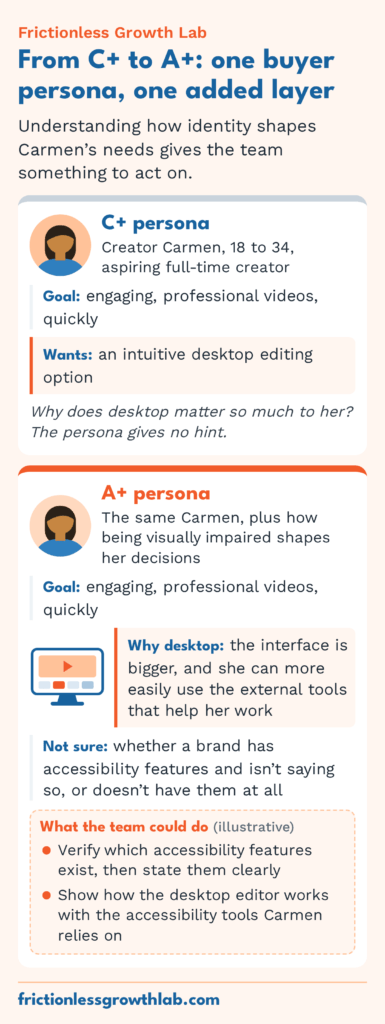
When I first walked through Creator Carmen on the podcast, I added a few variations. In one, Carmen is visually impaired. In another, she’s an immigrant who reads English and prefers to learn new concepts in Spanish. In a third, she’s Afro-Latina. Knowing any of those facts is a start. On its own, though, the fact doesn’t help your team make a single decision. An identity detail becomes useful when your team understands how it shapes Carmen’s decision-making and buyer journey.
So for the version of Carmen who’s visually impaired, I recommended adding a separate section to the persona covering her identity-related challenges, frustrations and wishes:
- Editing video on her phone is more cumbersome, so she prefers her desktop, where the interface is bigger and she can more easily use the external tools that help her work.
- Disability representation is scarce compared with how many people have disabilities around the world, and she likes seeing people like her succeed with the brands she buys from.
- Not enough brands talk about their accessibility features. She’s never sure whether a brand has them and isn’t saying so, or doesn’t have them at all.
- When accessibility features do exist, they’re often clunky and take extra steps. It feels more like a checkbox than equal access.
Now look back at the original persona. Carmen wanted a desktop editing option before we added anything, and the C+ version gives no hint of why that matters so much to this version of her. The A+ version explains it, and it gives the team something to act on. The team could verify which accessibility features exist and state them clearly. It could also show how the desktop editor works with the accessibility tools Carmen relies on, featuring only capabilities it has confirmed. That’s the job of identity in a persona. It changes what your team would do.
Underneath all of this is the question every customer is answering, consciously or not, whenever they encounter your brand: ”Is this for someone like me?” It’s a question about relevance, and identity shapes the answer. I’ve written about how that question decides whether you even make it into a customer’s consideration set. In many cases, there’s a meaningful gap between how a customer would answer it and how the brand has defined the answer in its personas. That gap is where relevance breaks down. In a later episode, I unpack how that question works as a trust test: several questions firing at once, about whether something was designed for someone like me, whether people like me succeed with it and whether it’s worth the risk right now.
You can see the question at work in very different places. I recently saw a video of a woman explaining that she only takes parenting advice from boy moms because, in her words, their mothering experience isn’t the same. To her, advice from someone who wasn’t raising boys was less credible for her situation, however good it might be. Her filter was about the messenger’s experience, and it decided who she’d listen to before any advice got evaluated.
I see a similar pattern with the healthcare organizations I work with, whether they’re in pharma, biotech, medical devices or hospital systems. These teams want strategies that reflect their world of healthcare. Until they see that, there’s hesitation, a sense that this might work, though probably not for them. And it shows up in B2B as much as it does with consumers.
One Persona, Three Customer Contexts
Here’s how this plays out with a single persona. Let’s say you’re a leadership coach, and one of your personas looks like this: professional women aged 25 to 44 who want to keep progressing in their careers and get on track for the C-suite, and who feel they’ve been passed over for opportunities they were more than qualified for.
That’s a reasonable persona. It captures the psychographics and the pain point. Now picture three women who fit it exactly. One wears a hijab at work. One just returned from maternity leave and is breastfeeding while she rebuilds her presence at work. One is an immigrant leader who built her career and earned real authority in another country, and who is now building credibility again in a new professional culture, in a language that isn’t her first. All three are professional, ambitious, qualified and passed over. All three will look at the same coaching website, the same marketing and the same messaging, and they may each be asking a different version of the same question.
Their circumstances can overlap, too. The immigrant leader might also be a new mom. One woman can carry several of these contexts at once, and each one can shape what she needs to see from a coach.
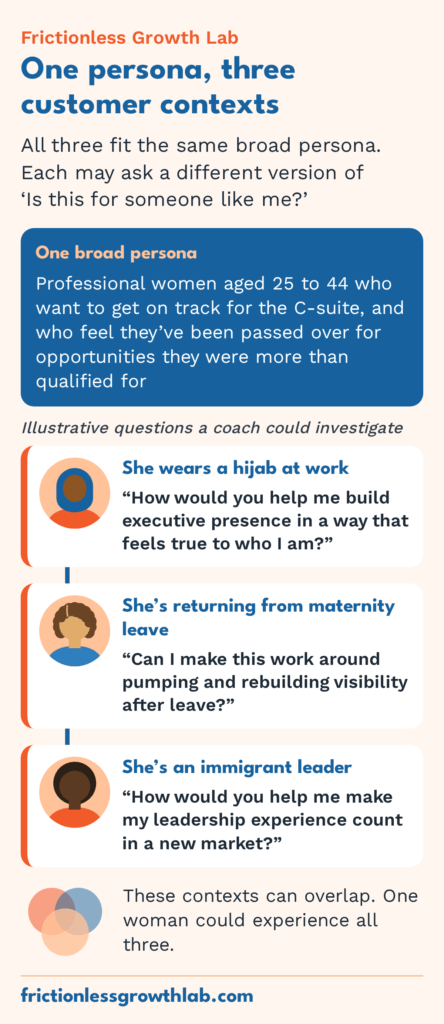
These illustrative questions show what a coach could investigate before deciding how to communicate or deliver the service.
She wears a hijab at work. “How would you help me build executive presence in a way that feels true to who I am?” Ask what executive presence means to her and where previous advice has fallen short. If she wants examples of building visibility in ways that feel authentic to her, the coach could show how their approach helps clients do that.
She’s returning from maternity leave. “Can I make this work around pumping and rebuilding visibility after leave?” Ask what her schedule is like and what rebuilding visibility means in her organization. If timing turns out to be a barrier, the coach could explore flexible session times. Make those options easy to find on the site once they’re available.
She’s an immigrant leader. “How would you help me make my leadership experience count in a new market?” Ask how her colleagues interpret her past work and which achievements she wants them to understand. If her prior results are getting overlooked, the coach could explain how they help clients communicate those achievements in a new professional context.
The questions guide the research. Use what you learn to decide what to change, and make sure any promise or case example reflects what the coach can substantiate.
How Context Gets Missed and What It Can Cost
These gaps often start with the way teams research and build personas.
When marketers research their ideal customers, they often end up profiling people who are similar to those already in their world: people they know, people who look like their existing customers, people who fit the image they already have of who they serve, and people who tend to show up in mainstream media, marketing and research results. We default toward the familiar. In persona work, that default can produce personas that describe a version of the customer and leave out the rest. They capture what people do, what they believe and what they want to achieve, without capturing who they are. The people the offer could serve, who don’t resemble the existing customer base, can end up missing from the research entirely.
The cost shows up when a buyer believes your solution works and still doesn’t see evidence it will work for them. Selim Dahmani was a senior growth manager at HubSpot focused on the French market when he joined me on Episode 127, and he described exactly this when we talked about brands trying to reach new markets without speaking to them directly:
“If you come as an American company in France trying to sell something and you don’t advertise it in a way that the French audience can say, ‘Okay, that’s going to work for me,’ the assumption is that it’s not. If all the examples that I’m shown are about, you know, an American delivery company, American fast foods, American train systems, booking systems that don’t exist, I’m like, okay, it works, but it won’t work for me.”
Imagine that buyer is the person you meant to reach. They believe your product works, rule it out for their situation, and move on without telling you why. What looks like a messaging problem can begin with what the persona leaves out.
There’s a second cost that’s easy to overlook. Many teams keep personas broad because it feels like a way to reach a bigger piece of the pie. Leaving identity and relevance out can have the opposite effect: when fewer people feel the brand is for someone like them, the share of the market you can realistically win gets smaller. I’ll get into what that looks like in numbers in Part 2.
Is Your Buyer Persona Complete?
Here’s a short check you can run on any persona your team uses today. Pick one persona and answer each question as honestly as you can.
- Can your team explain how context shapes a decision? Which identities and circumstances matter to this purchase, and how do they shape what customers need to know, see or experience? Document the implications your research supports and flag what you still need to learn.
- What evidence supports that interpretation? Is it grounded in customer interviews, focus groups, social listening or other research with the people you want to serve, or in assumptions the team made along the way?
- Whose experiences might the research have missed? Look at who shows up in your customer base and who has the problem you solve. If the two don’t match, the people who are missing are a good place to start. I first named this signal back in Episode 10, and it still holds.
- Would customers recognize themselves in the words you use? This is the language test. Including identity in a persona is a start, and the wording matters as much as the presence. For example, a team might use “professional women of color” as shorthand even when some of the customers it’s describing use different words for themselves. Use the language your interviews surface and document what those words mean in the context of the decision. Customers never read your internal persona, but the words in it shape the briefs, copy and creative that customers do see. The test is whether the customer you’re describing could read your persona description, or what I like to call your Mosaic, and think, “That’s me. That’s me exactly.”
If you answered “I’m not sure” more than once, that’s useful information. An incomplete persona usually means the standard process never asked for this layer in the first place, and that’s something you can add.
Turn Persona Insight Into More Relevant Marketing
So what do you do when a persona comes up short? In Part 2, I walk through two options. The first is to add relevant context, or identity layers, to the persona you already have. The second is to build a separate persona, which can make sense when an identity changes the problem the customer is trying to solve, the context they’re in or the way they move through the world enough that you’d need to build, communicate or show up differently for them. I’ll also cover how an incomplete persona can shrink the market you can realistically win, and the research methods that help you fill the gaps.
A more complete persona gives your team a better basis for what to say and what to show. Mosaic Message Mapping™ turns those customer insights into messages and evidence across your touchpoints. If your team is still guessing what customers need to believe before they buy, let’s talk about Mosaic Message Mapping. If the friction runs wider than messaging, the Friction Finder Growth Audit is a good place to start.
Growth accelerates when you remove friction for your customers and for your business. A complete buyer persona is one of the first places to do it.
FAQs About Buyer Personas
FAQ: How is a buyer persona different from a target audience?
A target audience describes a broad group you want to reach, usually in demographic or market terms, such as “professional women aged 25 to 44.” A buyer persona goes deeper on one representative customer within that group: their situation, goals, challenges and how they decide. The persona is what makes the audience usable for creative briefs, messaging and customer experience decisions. A complete persona also captures how identity and lived context shape what that customer needs to see before they buy, which a target audience definition rarely does.
FAQ: Who on your team should use buyer personas?
Anyone who shapes what customers see or experience. That includes the marketing team and the agencies, contractors and creators you brief, plus sales, customer success and support. When personas live only in a marketing folder, the insight in them stops at the creative brief. When everyone with customer contact can use them, customers get a more consistent answer to “Is this for someone like me?” wherever they meet your brand.
Full Episode Transcript
Transcript of the video “Why Most Buyer Personas Lead to an Underperforming Growth Marketing Strategy,” Part 1 of the buyer personas series. Lightly edited for readability.
The missing ingredient in your marketing
Sonia Thompson: Think about the most delicious piece of cake you have ever eaten. Now imagine taking a bite of a different piece of cake that looks absolutely delicious, but the moment you put it in your mouth, you realize that something is just off. You can’t put your finger on it, but you can tell right away that something is missing. A key ingredient didn’t make it in for one reason or another, and because of that, it’s not what it could be. Now you might try to fix it, add some frosting, maybe some dulce de leche or whipped cream, but none of those things changes the core issue.
Something was missing, a key ingredient, before that piece of cake was ever baked. And once that happens, there’s only so much you can do. I see brands doing this all the time with their marketing. They’re trying to build something that performs, something that converts, something that grows, that delivers results. But what comes out on the other side just isn’t what it could be or should be.
And it isn’t because the strategy is wrong or the team is incapable. It’s because there was a missing critical ingredient from the very beginning. And for many brands, that missing ingredient shows up in one place: their buyer personas. Buyer personas are one of the core inputs into your entire growth strategy, your customer acquisition, your creative, your campaigns, your customer experience. And when they’re incomplete, everything built on top of them underperforms.
In today’s environment, that’s expensive. So here’s what makes that even more troubling. You may not even realize your strategy is underperforming. If you’ve never tasted a version where all the ingredients are included as they should be, you might think that what you’re getting with an incomplete version is just what marketing delivers. It’s not.
Better exists and it’s waiting for you. So in today’s episode, we’re gonna get into what’s missing from most buyer personas and why it’s something that the standard marketing process never asks for in the first place. Let’s dig in. Everything in your marketing ecosystem points back to one thing, your buyer personas.
Why buyer personas shape everything
They are the foundation that everything is built on because they determine who it is that you are actually speaking to. Every ad traces back to a creative brief, every website experience, every email, every single piece of content. And at the core of each of those decisions is the same input, your buyer persona. Marketing advice and best practice reinforces this. Create for one person, know your ideal customer, speak directly to them.
And that’s not wrong, but here’s the real question. What happens when the personas that are guiding all of these decisions are only operating at a C+ level because that’s exactly where most buyer personas sit today.
Why most buyer personas are C+
Most buyer personas are built using demographics, psychographics, and behavioral inputs. These are useful, but they are not enough because they miss the one thing that actually determines whether someone leans in or moves on. It’s relevance, not broad relevance, but personal relevance.
“Is this for someone like me?” in real life
I recently saw a video of a woman who was saying that she doesn’t take parenting advice from girl moms, only from boy moms, because as she put it, our mothering experience is not the same. So if you weren’t raising any boys, she didn’t want to hear from you. To her, that experience gap made their advice less credible for her situation, and therefore they felt like their advice would be less applicable for people like them. Anytime I work with healthcare organizations, whether in pharma, biotech, medical devices, hospital systems, you name it, I see the same pattern. They’re not just looking for strategies that work, they’re looking for strategies that reflect their world of healthcare.
And until they see that, there’s hesitation, a quiet sense of, yes, this might work, but probably not for us. And it doesn’t stop in just healthcare or in a direct-to-consumer context. We see it in B2B too. It shows up in every decision context. Selim Dahmani leads growth for the French market at HubSpot, and he described this dynamic clearly when we were talking about what happens when brands try to reach new markets without truly speaking to them directly.
Selim Dahmani: You know, if you come as an American company in France trying to sell something and you, you don’t advertise it in a way that the French audience can say, “Okay, that’s going to work for me,” the assumption is that it’s not. If all the examples that I’m shown are about, you know, an American delivery company, American fast foods, American train systems, booking systems that don’t exist, I’m like okay, it works, but it won’t work for me.
Sonia Thompson: So here we have three different contexts: moms who are scrolling for advice on parenting, a pharma team evaluating a growth strategy, or a French brand that is evaluating a solution that comes from the US market. Three different identities of consumers, same dynamic each and every time. The moment someone can’t see themselves in what it is that you are putting in front of them, they don’t evaluate it on its merits. They’ve already decided that what it is that you are offering isn’t for people like them. That’s not a creative or a messaging problem. That is a persona problem.
This is what separates a C+ persona from an A+ persona, and it’s what is missing from most of the buyer personas that I’ve seen that would have caught all three of those moments before they became lost customers.
The missing ingredient: identity
Identity. Now, this isn’t just who the customer is on paper. It’s about how they see themselves. Their experiences, their context, their constraints, the lens through which they decide consciously or not whether or not they feel like something was built for someone like them. And when that layer is missing from your personas, something very subtle but costly starts to happen.
Your marketing might reach the right audience, but it doesn’t resonate with them. And when it doesn’t resonate, it doesn’t convert. Worse, it gets dismissed entirely because when people don’t see themselves reflected in what it is that you put in front of them, they don’t just disengage, they disqualify. So here’s the dynamic that’s actually driving this. The “Is this for someone like me?” question that every consumer is answering consciously or not whenever they are encountering your brand.
It’s a question about identity. And in most cases, there is a significant gap between how a customer would answer that question and how the brand has defined that answer in their personas. And that gap is where relevance breaks down. And it’s not happening because brands don’t care. And it’s not happening because marketers are cutting corners.
Why personas leave identity out
It’s happening because of the way in which personas get built. When marketers go through the process of researching their ideal customers, they’re often naturally profiling people who are similar to those that are already in their world— people they know, people who look like their existing customers, people who fit the image they already have of who they’re serving, even people that get traditionally picked up or showcased in mainstream media marketing and research results. It’s a well-documented human pattern. We default toward the familiar. In persona work, that default produces personas that describe a version of the customer but not the full customer.
Personas that capture what people do, what they believe, what they want to achieve, but leave out who they actually are. And that’s the gap. So here’s what that looks like in practice.
One persona, three very different women
Let’s say you are a leadership coach and one of your personas looks like this: professional women aged 25 to 44 who want to progress further in their career and get on track to the C-suite, who also feel like they’ve been passed over for opportunities even when they were more than qualified. That’s a reasonable persona. It captures, it captures the psychographics, it captures the pain point. But let’s look at three different women who fit that persona exactly. The first woman wears a hijab at the office.
The questions that she carries into a coaching relationship aren’t just about strategy and visibility. They’re about navigating a workplace that may not always know about how to see her, that doesn’t always connect with how she presents. The second woman who fits into this persona exactly just returned from maternity leave. She’s breastfeeding. She’s trying to rebuild her presence at work while managing a schedule that has real constraints that most of her colleagues don’t have.
Her ambition hasn’t changed, but her reality has, and what she needs from a coach has changed with that. The third woman is an immigrant leader, someone who built her career in another country and earned real authority and credibility there. And now she’s recently transferred or relocated, and now she’s navigating a new professional culture in a language that isn’t her first language, building a new credibility she already had somewhere else. Three women all professional, all ambitious, all super qualified, all passed over, all exactly who the persona is describing. And all three of them will look at the same coaching website, the same marketing, the same messaging, and ask the same question: Is this for someone like me?
And if the answer isn’t clearly yes, they move on. And that isn’t because the coach couldn’t help them, because it’s very possible that this coach absolutely could, but they didn’t see anything specific in marketing that reflected who they actually are and what their current needs are as a result of their identity.
Does your persona use your customer’s words?
Now here’s the tricky part for a lot of brands, even for those who are actively trying to get this right. It’s not just about having identity in your personas. It’s about whether or not the language you use to describe that identity actually mirrors how the consumer would describe herself. A persona that says professional women of color may not make a 40-year-old hijab-wearing professional, a new mom, immigrant professional woman feel seen. They might not even consider themselves women of color or call themselves that even though demographically that is what they qualify as.
Those words may not match their reality at all. They may not even recognize themselves in that description even if the brand is convinced that they are there. Now, of course, we know that consumers aren’t seeing brands’ internal language of a persona, but the way that shows up or translates into the execution of what’s written in that persona is very much often dependent upon the words used in the persona. So the test isn’t just whether or not identity is included in your persona, it’s whether or not your ideal persona would be able to read the articulation of your persona description, or what I like to call your mosaic, and think, that’s me, that’s me exactly. If she wouldn’t, then the persona isn’t complete, and everything built on top of it is working harder than it should be to reach someone who felt like it was never for her in the first place.
That’s the root cause of the C+ persona.
The real cost of incomplete personas
It isn’t maliciousness or carelessness, it’s just incomplete. And incompleteness at the foundational level of your entire marketing strategy costs you more than most brands ever stop to measure. And one of the big problems with that being incomplete is that most people think that that is helping them address a larger piece of the pie. But by actually not thinking about identity and relevance in this way, it’s actually shrinking the market because fewer and fewer and fewer and fewer people will actually feel that the persona or your brand is for people like them and is relevant. Now, if you’ve been listening to this episode and thinking, I’m not really sure whether or not our personas are hitting the mark, if they’re operating at this A+ level, and you know that you need to go back and work to improve them and make them more complete, if you could use some help with that, that’s exactly the type of work that I do with brands.
I’ll drop links into the description for you below on how we can work together and other resources to support you in your efforts to improve your personas. So in the next episode, we’re gonna get into what the fix is for these C+ personas, so you definitely don’t want to miss that one. Make sure you are subscribed to the channel so you don’t miss an episode, especially that one. Until next time, remember, growth accelerates when you remove friction for your customers and for your business. Thanks so much for watching.
Talk to you soon.
Found this post useful?
There’s more where that came from—get insights on the new rules of growth delivered to your inbox.