


A while back, I was talking with a friend about hair. She’d told me a lot about what her hair needed, and I knew of a hair care brand I thought would be perfect for her. So I sent her the link and started telling her why I thought she should give it a try.
Before I could get very far, she stopped me with a question: “Do they ship to Canada?”
I didn’t know. It wasn’t something I had ever considered, because I don’t live in Canada and I’ve rarely had shipping problems with the brands I want to buy from. But for her, it was the first question, and until she had the answer, it wasn’t worth her time and energy to figure out whether the product would work for her hair. We had to go and find out.
Everything the brand said about its formulas and results might have been exactly what she wanted to hear. She needed one specific question answered before she was ready to engage with any of it. Whether the answer turned out to be yes or no, she needed to be able to find it quickly.
That moment captures something many brand messaging strategies leave out. A conventional brand messaging strategy does important work. It defines what you offer, why it matters and what makes you different, and those universal messages can resonate with many of your ideal customers. But some of those same ideal customers need an additional message, one that tells them your brand is relevant to them, before they’ll seriously consider what you offer.
In this article, I’ll show you how to make the brand messaging strategy you already have more complete, and potentially more effective, by adding a second layer I call Mosaic Messaging™. You’ll see why strong messaging can still miss some of your ideal customers, how the two layers work together, what Mosaic Messaging looks like in practice and the four steps of Mosaic Message Mapping, the process I use to put it into action. You’ll also get a self-check you can use on your own brand.
Listen on Apple Podcasts | Spotify | Read the full transcript
What Is a Brand Messaging Strategy?
A brand messaging strategy is the plan for what your brand communicates, to whom and where, so that every message, including the ones tailored to specific customers and touchpoints, supports one coherent brand promise. It typically includes a few foundational elements:
- Positioning: where your brand fits in the market and in the customer’s mind.
- Value proposition: the problem you solve and the outcome customers can expect.
- Differentiation: what makes you a better choice than the alternatives.
- Key messages and proof points: the central promises you communicate, and the evidence behind them.
- Voice and tone: how your brand sounds when it says all of it.
Together, these elements give your team a shared answer to the question, “What do we want customers to understand about us?” That’s valuable. Without it, every campaign, product page and sales conversation starts from scratch, and customers get a different story depending on where they meet you.
A brand messaging strategy can describe a target audience in detail and still overlook the different messages people within that audience need. The universal layer aims to resonate broadly across that audience. In this article, I’ll call that layer universal brand messaging, because it’s designed to resonate broadly across your market. Universal messaging is necessary. For some of your ideal customers, it’s also incomplete on its own.
Why a Strong Brand Messaging Strategy Can Still Miss Some of Your Ideal Customers
The core messages you’ve worked so hard to craft and get just right may not be reaching every ideal customer you want to reach. Some of those customers haven’t yet heard what they need to hear to put your brand into their consideration set.
For many customers, there’s a specific phrase that answers the question running in the background of a buying decision: ”Is this for someone like me?” For me, as someone who follows a gluten-free diet, that phrase is simply “gluten-free.” Until I hear it, I’m likely to tune out the rest of what a restaurant has to say about why its food is so great.
Many of your ideal customers are asking that question when they consider a product, service or experience, whether they’re doing it consciously or subconsciously. And because the question keeps running, they’re constantly scanning for signals that will answer it one way or another.
When they find what they’re looking for, it gives them permission to take the next step forward with you. When the answer is no, or unclear, or they can’t find anything at all, that creates friction. They may hesitate. They may tune your messages out. Or they may walk away from your brand altogether, and you’ll never know they were there.
Often, the customers asking a particular version of that question share something. I call each of those groups a customer Mosaic: a distinct group within your broader market whose needs, motivations, barriers or experiences change how they make decisions. Your ideal customers share the problem you solve, but they bring different identities, needs and experiences with them, and those differences can shape what they need to know before they’ll consider your brand.
That’s the behavioral reason a second layer of messaging matters. Your universal messages answer, “Why should I choose this brand?” A customer who is still asking, “Is this for someone like me?” may never get far enough to hear that answer. I wrote about this pattern in why great brand messaging gets blocked before customers ever hear it for Forbes, and I go deeper on the difference between getting considered and getting chosen in my article on how to get into a customer’s consideration set.
The Two-Layer Brand Messaging Model
Think about Batman from 1989. Batman is the main character. His name is on the poster, Michael Keaton plays him, and the story follows him from beginning to end. But decades later, when people talk about that movie, a lot of them quote Jack Nicholson’s Joker.
The point I want you to take from that movie is that the story needs both characters to work. Without Batman, there’s no story to follow. Without the Joker, the story loses much of what makes it so compelling. The Joker is part of the supporting cast, and he contributes something important that the main character alone can’t deliver. Being part of the supporting cast doesn’t make him insignificant or optional.
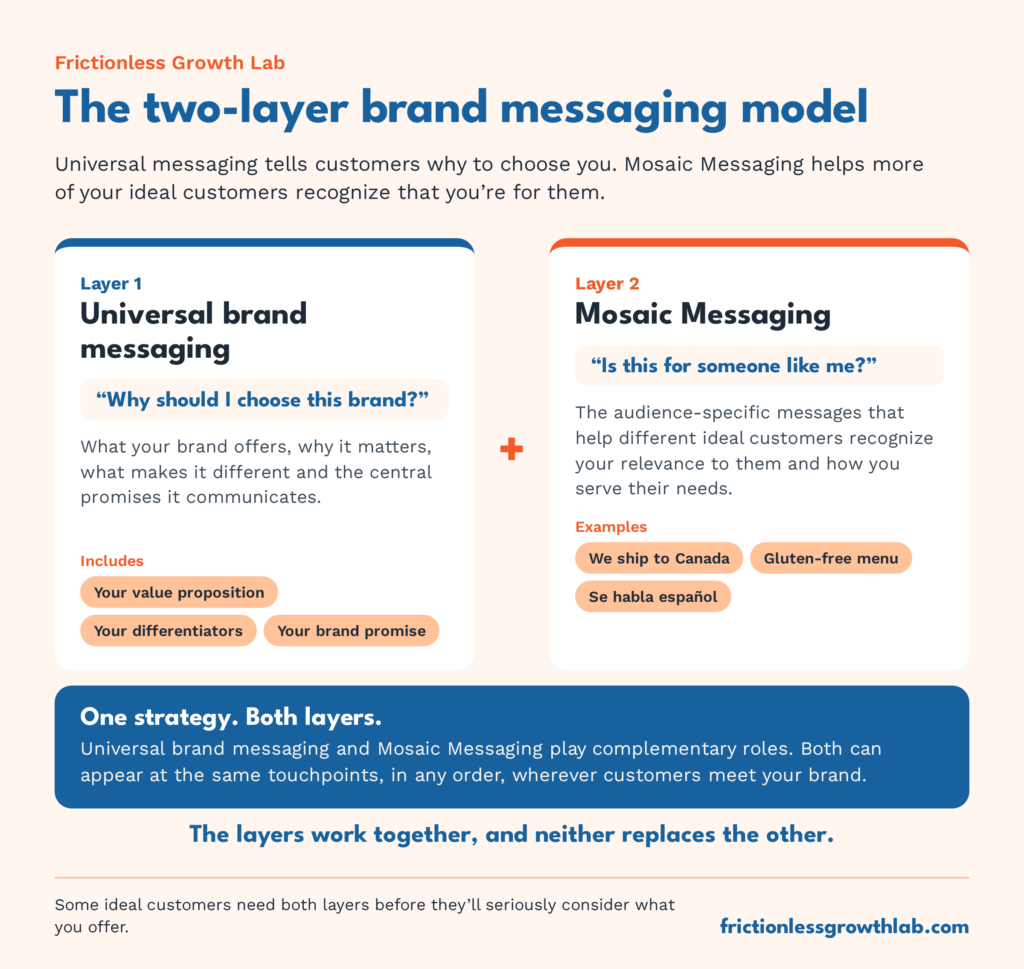
The brand messaging model I recommend brings together two layers:
Layer 1: Universal brand messaging. What your brand offers, why it matters, what makes it different and the central promises it communicates. This is your main character.
Layer 2: Mosaic Messaging. The audience-specific messages that help different ideal customers recognize your brand’s relevance to them and understand how it serves their needs. These messages are often short and specific, which makes them easy to overlook. Yet they’re frequently the messages that get you in the door with the customers who need them.
It’s an AND strategy
Mosaic Messaging works alongside universal brand messaging. As I said in the episode, those core messages very much will still work on people from different Mosaics. Universal messaging can resonate across many of your customer Mosaics, and you should keep presenting it to them.
What I’m recommending is an AND strategy. You need your core messages about your product, your differentiation and how you solve the problem. You also need specific messages that speak to the particular challenges or questions some of your ideal customers have, the ones that may keep them from taking the next step with you if they don’t hear the answer.
The two layers play complementary roles, and neither replaces the other. When brands treat those specific messages like throwaway lines, they narrow the audience that’s willing to see their brand as being for someone like them. A more complete strategy treats them as essential parts of the script and plans for both layers, because some of your ideal customers need both before they’ll seriously consider what you offer.
The layers can appear together
Customers encounter your brand through many different touchpoints, often in no particular order, so the two layers rarely arrive in a fixed sequence. Both can show up together.
A product page might lead with what makes the product great and note, right beside the price, where it ships. A restaurant’s menu can feature its signature burger and mark the gluten-free bun in the same line. Some customers will notice the universal message first. Others will scan straight for the signal that tells them whether you’re for them. A strategy that incorporates both layers makes sure both are there when customers look.
Here’s how the two layers compare:
| Universal brand messaging | Mosaic Messaging | |
|---|---|---|
| Its job | Communicate what you offer, why it matters and why you’re different | Help specific ideal customers recognize your brand is relevant to them and understand how it serves their needs |
| The question it answers | “Why should I choose this brand?” | “Is this for someone like me?” |
| Who it’s for | Broadly, your whole market | Specific customer Mosaics you’ve chosen to serve |
| Examples | Value proposition, differentiators, brand promise | “We ship to Canada.” “Gluten-free menu.” “Wheelchair accessible.” “Se habla español.” |
| When it’s missing | Customers can’t tell why they should choose you over the alternatives | Some ideal customers rule you out, or tune you out, before your other messages get a chance to work |
In the video version of this episode, I walk through the two layers and why your core messages need their supporting cast:
What Mosaic Messaging Looks Like
Years ago, while I was living in Montreal for an internship during my MBA, a good friend described the US as more like a melting pot and Canada as more like a mosaic, where people held on to their heritage while building their lives in Canada. That analogy stuck with me, and I’ve thought about it a lot in relation to marketing. I explain the full idea in my guide to Mosaic Marketing.
Mosaic Messaging is usually short and specific. Here are a few examples of what different customers may need to know before seriously considering a brand:
| Customer Mosaic | What they may need to know | A message that could answer it |
|---|---|---|
| Gluten-free diners | Do you have options I can eat? Are they prepared safely? | “Gluten-free menu.” “Cooked in a dedicated fryer.” |
| People who use wheelchairs, and the caregivers and companions who travel with them | Can we get in, move around and use the facilities? | “Step-free entrance.” “Accessible restroom.” |
| Spanish speakers | Can I get information or talk to someone in my preferred language? | “Se habla español.” |
| Neurodivergent customers | Is there a time or way to visit that won’t be overwhelming? | “Sensory-friendly hours from 8:00 to 10:00 every day.” |
| Plus-size shoppers | Do you carry sizes that will work for me? | “Sizes up to 30.” |
| Families with kids, and people looking for a kid-free experience | Is this place right for the experience we want? | “All children welcome.” “Kids eat free on Tuesdays.” “Adults only.” |
Treat these as possibilities to test with your own customers. People within a Mosaic won’t all need the same answer, and some won’t need a different message at all.
Notice how specific each answer has to be. “Gluten-free menu” tells me a restaurant has options. It doesn’t tell me whether those options are safe for someone who can’t risk cross-contact. “Wheelchair accessible” is a start, and the details about entrances, routes, seating and restrooms are what let someone plan a visit with confidence. Sensory-friendly hours answer one specific question for neurodivergent customers. Other questions, about a website that feels overwhelming or policies that don’t fit how someone works, may need answers of their own.
Notice, too, who’s asking. The question about accessibility doesn’t belong only to the person using the wheelchair. Caregivers and anyone traveling with them need to know the answer too, and if the information isn’t there, the whole group may go somewhere else. And in the last row, some families want to know kids are welcome while other customers are specifically looking for a place without them. Both are legitimate needs, and a brand can’t credibly promise both experiences in the same space at the same time. Which brings us to an important choice.
Choosing which Mosaics to serve
Mosaic Messaging asks brands to proactively choose which Mosaics they’re going to serve. Every brand has many Mosaics within its total addressable market, and serving all of them well can be a tall order, especially with limited resources. Choosing deliberately helps you focus the resources needed to serve those customers well.
My husband Jonathan once sent me the pin for a hamburger place he’d driven past and asked me to check whether they had gluten-free hamburger buns. We’re both gluten-free, so a gluten-free bun is a must for us. I searched their website, Google reviews and social media, and even asked AI. Nothing. After about five minutes, I hit my limit.
Maybe that restaurant has decided not to serve gluten-free customers, and that’s totally okay. It just means that brand isn’t for people like us, and we’ll go somewhere else. But if it does have gluten-free buns, that information shouldn’t be so hard to find. In that case, it has already done the hard part of serving us and is losing our business over a missing message. Plenty of customers won’t search for five minutes. If they don’t find an answer quickly, they’re likely out the door.
Choosing a Mosaic also means being ready to serve it. If a restaurant chooses to serve vegan customers, for example, it will need some menu items, and maybe even some protocols in the kitchen, that make sure it’s okay for vegan customers to eat there. The message comes after the decision, and it has to be true.
How to Add Mosaic Messaging to Your Brand Messaging Strategy: The Four Steps of Mosaic Message Mapping
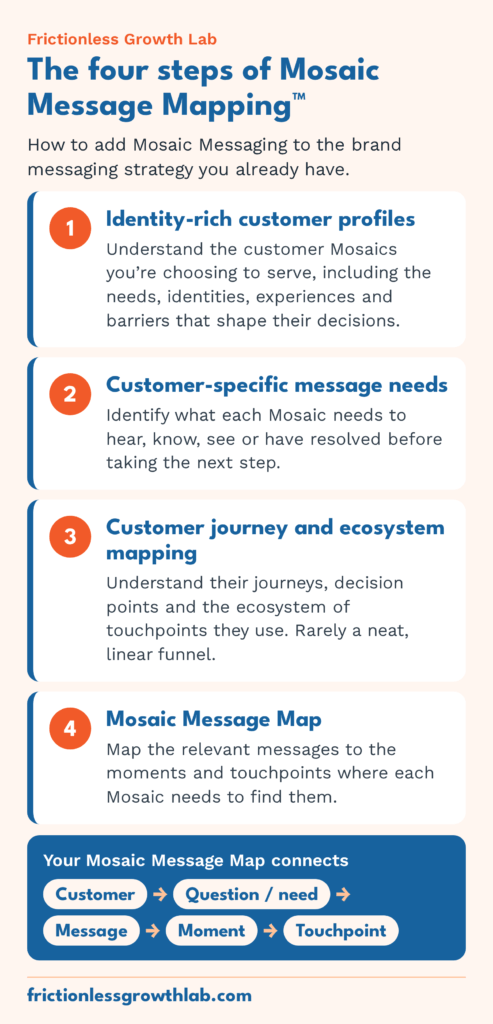
If Mosaic Messaging is what you add to your brand messaging strategy, Mosaic Message Mapping™ is how you add it. Smart brands follow the old marketing adage: the right message, for the right customer, at the right place, at the right time. Mosaic Message Mapping applies that adage to each Mosaic you’ve chosen to serve. Here’s an overview of the four steps.
Step 1: Identity-rich customer profiles
First, understand the customer Mosaics you’re choosing to serve. If you’ve built detailed buyer personas, you may have a head start. But many personas stop at demographics and purchase behavior, things like age, income, location and past purchases. They describe who someone is and leave out how they decide.
Identity has to be part of the equation, because it’s often the lens through which customers see themselves and make decisions. One holiday season, my husband and I chose a doll for our daughter with a skin tone like hers and curly hair like hers, worn in a style similar to the way she wears her hair. There were plenty of dolls we could have bought. We chose that one because identity and representation played a direct role in our decision. That happens for more of your customers than you might think. If your profiles don’t capture identity-based needs, motivations, barriers and decision drivers like that, it’s very hard for your marketing to address them.
Step 2: Customer-specific message needs
Next, identify each Mosaic’s specific message needs: what they need to hear, know, see or have resolved before taking the next step forward with you. This is where “Do they ship to Canada?” lives. It’s the question that has to be answered before the rest of your messaging gets a hearing.
Sometimes this step produces a brand-new message. Sometimes different Mosaics need different messages. Sometimes they need the same message supported by different proof. Sometimes the difference is the imagery, the messenger, the example or the moment. And sometimes there’s no meaningful difference at all. The goal is to find the differences that actually matter to the decision.
Step 3: Customer journey and ecosystem mapping
Then, understand each Mosaic’s journey, their decision points and the ecosystem of touchpoints they use. Many customers move through something far messier than a neat, linear funnel. They may discover you on social media, research you through search or AI, watch a video, hear about you from someone they trust, leave and come back later. At each decision point, ask what this customer is trying to decide, what’s preventing them from moving forward and what they need to hear from you to feel confident taking the next step. Choices can also evolve over time, so a Mosaic’s needs at the first purchase may differ from what they need to come back.
I once saw a remodeling contractor’s van in my neighborhood with a very simple message on the wrap: “Se habla español.” For anyone who wants a Spanish-speaking contractor, that’s a very clear message, delivered at a touchpoint most brands would never think of as part of their messaging strategy.
Step 4: The Mosaic Message Map
Finally, map the relevant messages to those touchpoints. The Mosaic Message Map connects each customer to the question or need they have, the message that answers it, the moment it matters and the touchpoint where it needs to appear:
Customer → Question / Need → Message → Moment → Touchpoint
The map shows your team what to say, who needs to hear it, the question it answers and where it needs to show up. The goal is the right message in front of the right customer at the right place in their journey, without blasting every message everywhere or creating a mountain of new content.
That’s the overview. Each step involves more depth than one article can hold, and the supporting articles in this series go further.
When the Message Needs to Be an Action
Sometimes Mosaic Message Mapping uncovers a need that a better message can’t meet. In those cases, a brand needs to do something differently to credibly communicate that it serves a particular customer. Sometimes the action is the message.
I saw this firsthand with a client that served both end consumers and service providers. During our consulting engagement, we learned that some of their service providers were facing additional challenges with end consumers because of their heritage or the way they looked. Some had to work harder to earn trust. Some who had tattoos found themselves wearing clothes that covered them up. They encountered uncomfortable situations other providers didn’t necessarily experience.
A new message alone wouldn’t have changed what those providers experienced on the job. So one of the recommendations I made was essentially a certification or endorsement program that would let the brand lend some of its credibility to its providers. Instead of each provider carrying the entire burden of proving “you can trust me, I’m good at what I do,” the brand could step in and say, “We’ve vetted this person. They’re qualified.” The idea was to give the brand a way to reduce some of the friction within its own ecosystem, knowing that no program could eliminate the bias those providers encountered.
The same distinction applies to a brand selling products for curly and textured hair. Marketing full of gorgeous curls may work beautifully for the customer who already loves wearing her curls. A customer who has been taught to straighten her hair may need more than another ad telling her to love her curls. Reaching her may call for programming or experiences that help her get there.
That’s why it’s so important to tell the gaps apart:
- A messaging gap means your brand already meets a customer’s need, and customers don’t know it. Better Mosaic Messaging can close it.
- An experience or capability gap means your brand isn’t yet equipped to meet the need. Messaging can’t compensate for a brand that isn’t actually equipped to deliver on its promise.
- Sometimes it’s both. Imagine a hotel that advertises accessible rooms but doesn’t explain how to request one, while the route to those rooms includes a step that prevents some wheelchair users from reaching them. The hotel needs to make the booking information clear and provide an accessible route consistent with the experience it promises.
When you find an experience gap, you have a real choice. You can decide that Mosaic isn’t one you’re equipped to serve right now. Or you can decide you want those customers and change something about the experience, which then gives you something true to say. In Ep. 232, I also talk through how Lyft and Mastercard each changed part of their experience to address a specific Mosaic’s concern.
Message Relevance and Message Believability
Once a message is true, there’s one more distinction that shapes what it can do.
Message relevance asks: What does this customer need to hear to recognize that this brand may be for them? That’s the main work of Mosaic Messaging. A clear answer to “Do you ship to Canada?” is a relevance message.
Message believability asks: What evidence does this customer need to believe the brand can deliver? Some of your ideal customers will recognize that your message is meant for them and still hesitate, because past experiences with other brands have taught them to doubt promises like yours.
Customers may weigh both at the same time. The gluten-free diner who spots “gluten-free menu” is deciding whether the restaurant is for her and whether she can trust it in the same moment. Mosaic Message Mapping helps you identify both the messages each Mosaic needs and the proof that would make those messages credible. I go deeper on believability, and the four types of evidence that can help customers believe your promises, in why your marketing messages aren’t converting customers.
The Two-Layer Messaging Self-Check
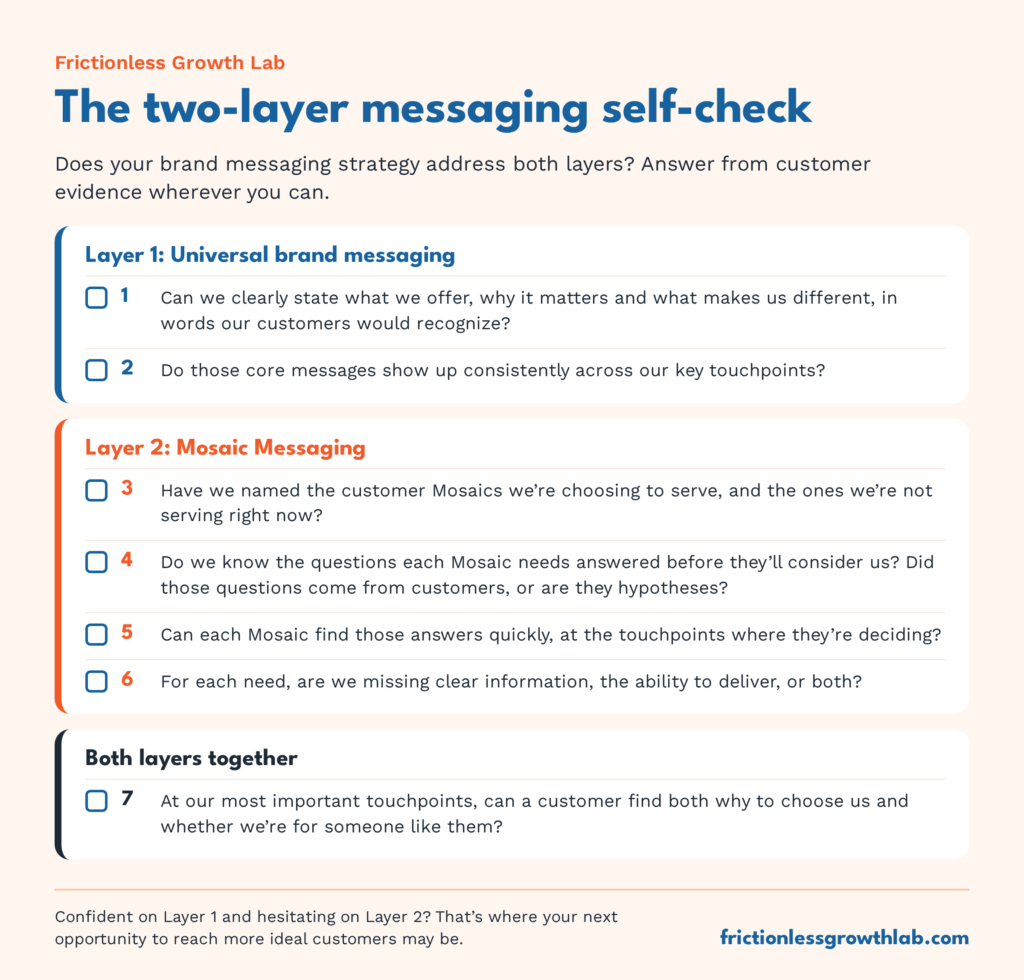
Use this check to see whether your brand messaging strategy addresses both layers. Work through it with your team, and answer from evidence (customer conversations, reviews, sales and support questions, search data) wherever you can.
Layer 1: Universal brand messaging
- Can we clearly state what we offer, why it matters and what makes us different, in words our customers would recognize?
- Do those core messages show up consistently across our key touchpoints?
Layer 2: Mosaic Messaging
- Have we named the customer Mosaics we’re choosing to serve, and the ones we’re not serving right now?
- Do we know the questions each Mosaic needs answered before they’ll consider us? Did those questions come from customers, or are they hypotheses?
- Can each Mosaic find those answers quickly, at the touchpoints where they’re deciding?
- For each need, are we missing clear information, the ability to deliver, or both?
Both layers together
- At our most important touchpoints, can a customer find both why to choose us and whether we’re for someone like them?
If you answered confidently for Layer 1 and hesitated on Layer 2, you’re in good company. That’s where many brand messaging strategies have room to grow, and where the next opportunity to reach more of your ideal customers may be.
How Mosaic Messaging Fits the 7C Framework
Mosaic Messaging sits across two phases of the 7C Frictionless Growth Marketing Framework. The first two steps of Mosaic Message Mapping, identity-rich profiles and customer-specific message needs, are Customer Intimacy work: knowing your customers well enough to see the differences that change their decisions. The last two steps, journey and ecosystem mapping and the message map itself, are Customer Experience Design: deciding where those insights show up across the journey. And when a need calls for an action as well as a message, the work carries forward into how you deliver the experience.
Strengthen Your Brand Messaging Strategy With Both Layers
You’ve probably invested a lot in your universal brand messaging, and that work deserves to be heard. Mosaic Messaging helps more of your ideal customers get far enough to hear it. Your core messages are your main character. Your Mosaic messages are the supporting cast that helps more of the people you want to serve see themselves in the story. Your brand messaging strategy needs both.
If you’ve realized your brand messaging strategy has a strong first layer and a thin second one, that’s a gap you can close by layering into what you’re already doing. Mosaic Message Mapping is how I help brands do it: we build identity-rich profiles of the customers you want to reach, identify the questions they need answered, map where and when they need to hear the answers, and give your team a practical message map to use across your marketing. Explore how we could address the messaging gaps affecting the customers you want to reach.
Until next time, remember: growth accelerates when you remove friction, for your customers and for your business.
Frequently Asked Questions
What is a brand messaging strategy?
A brand messaging strategy is the plan for what your brand communicates, to whom and where, so that every message, including ones tailored to specific customers and touchpoints, supports one coherent brand promise. It usually covers positioning, your value proposition, differentiation, key messages with proof points, and voice. A more complete strategy also includes Mosaic Messaging: the specific messages different ideal customers need to recognize that your brand is relevant to them.
What is Mosaic Messaging?
Mosaic Messaging is the layer of a brand messaging strategy that helps specific groups of ideal customers, or Mosaics, recognize that a brand is relevant to them and understand how it serves their needs. It answers a question many customers are asking: “Is this for someone like me?” Examples include “We ship to Canada,” “Gluten-free menu” and “Se habla español.” Mosaic Messaging works alongside universal brand messaging.
Does Mosaic Messaging replace universal brand messaging?
No. Mosaic Messaging is part of an AND strategy. Your universal messages about what you offer and why you’re different can resonate across many customer Mosaics, and you still need them. Mosaic Messaging adds the specific messages some ideal customers need before they’ll seriously consider your brand. Both layers can appear together at the same touchpoints, and customers may encounter them in any order.
How is Mosaic Message Mapping different from personalization?
The two overlap. Both tailor what customers see so it’s more relevant to them, and personalization tools can deliver Mosaic messages at the right touchpoints. Personalization often responds to individual behavior, like a recommended product or a first name in an email. Mosaic Message Mapping focuses on the differences that change how groups of customers decide, such as identity, needs and experiences, and maps the messages that answer their questions to the moments and touchpoints where they’re deciding.
Full Episode Transcript
Transcript of Frictionless Growth Lab Ep. 224, “Add This to Your Brand Messaging Strategy to Make It Much More Effective.” Lightly edited for readability. Sponsor messages are marked.
Sonia Thompson: You know how in some movies, the person whose name is on the poster, the big star, that isn’t the one that you actually leave the movie talking about? Take Batman from 1989. On paper, Batman is the star. Michael Keaton is the lead. It’s his movie.
But then, and still decades later, what are people talking about whenever they’re referencing that movie? They’re not usually quoting Michael Keaton’s Bruce Wayne. They’re quoting Jack Nicholson’s Joker. Batman carries the story, but the Joker is the character that most people remember the most as the standout. Marketing works a lot like that.
Most brands spend almost all of their time perfecting the big, broad message that’s designed to appeal to as many people as possible. And to be clear, you need that message. Batman still needs to be Batman. But the messages that often determine whether or not your ideal customers see your brand as for someone like them are usually treated like supporting cast members. They’re often smaller, more specific, often overlooked, yet those are the messages that make the story resonate for the ideal customers you are trying to serve.
Now, when brands treat those lines like throwaway messages rather than essential parts of the script, they narrow the audience that’s willing to see their brand as for someone like them. And as you’ve probably heard me say before, answering that fundamental question for consumers quickly and clearly is absolutely essential. So today, I’m gonna show you a framework called Mosaic Message Mapping. It’s a practical way to identify which messages different consumers need to hear so that your core marketing messages have a chance to do their job. Now—
[Sponsor message] When a buyer asks AI for a solution like yours, does your business come up? Most companies have no idea, and by the time they find out, they’ve already lost the deal to someone who did. HubSpot AEO helps you show up in those moments with the right answers buyers are looking for before the first click, before the first form fill. That’s the moment HubSpot AEO is built for. Check out hubspot.com, the agentic customer platform for growing businesses. [End of sponsor message]
Why core messages don’t reach every ideal customer
A lot of times, marketers don’t necessarily realize this, that their core messages, the ones they’ve spent so much time working to cultivate, carefully craft, and get just right, aren’t always reaching the ideal customers that they want to reach because these consumers haven’t heard what it is that they need to hear to even put your brand into their consideration set. Now, for many consumers with different identities, until they hear that magic phrase that answers the question, “Is this for someone like me?” and for me, as a gluten-free person, that phrase is very simply “gluten-free,” they’re gonna tune out or they’re not even gonna pay attention to the other messages about what makes your product so great and why they should give it a try. Now, smart brands follow the old marketing adage, right message for the right customer at the right place at the right time. And so what we’re seeing in a lot of instances today is that brands are working on those right messages, which are much more often focused on general market consumers. But what’s not always clicking for them, and they’re not always embracing, is that specific consumers, particularly those with specific identities or from specific communities, need to hear very distinct messages that answer that question, “Is this for someone like me?” that will enable them to say, “Okay, yeah, I can consider this brand,” before they’ll actually move forward with you.
Until they get an answer to that question, they’re likely not even gonna tune in to anything that you have to say. So to help marketers with the solution to that challenge, I have developed what I call Mosaic Message Mapping. Years and years ago, I spent some time living in Montreal, Canada, while I was doing an internship during my MBA, and I had a very good friend who spent some time explaining to me what he felt were some key differences between the US and Canada. From his perspective, he said the US is a melting pot, meaning you’ve got people who come to the US from all over the world and who live there, and whenever they get there, they consider themselves to be American, and they focus more so on their American identity rather than bringing with them their culture from whatever country it is that they came from. Whenever he was describing Canada, the way in which he described it is Canada is more like a mosaic.
You find people, again, who come from different countries all over the world, but whenever they come there, they’re still very much holding on to that original identity. So they might say, “I am from Jamaica,” or, “I am from China.” So they might consider themselves Chinese Canadian, Jamaican Canadian, whatever country that is, but they’re holding on to the identity of their home country, at the same time integrating that with their Canadian roots.
From melting pot to Mosaic
Whether you agree with his analogy of US more like a melting pot and Canada more like a mosaic, that analogy stuck with me for a very, very long time, and I remember thinking a lot about that as it relates to marketing. Whereas a lot of brands will treat their ideal customers as a melting pot, they really focus on taking a general market marketing approach, where they are treating everyone very much as if they are the same. They’ve got the same challenges, the same characteristics. They’re really focusing on the product level and not always taking into account that different consumers have different identities that impact their decision-making process. What I have dubbed mosaic marketing is identifying that your ideal customer groups operate more like a mosaic.
They bring their identity along with them, and that is included in their decision-making process, whether they know it or not. It’s not something that they can just check at the door. So of course, there are gonna be different consumers from different identities who have different degrees of how they’re incorporating their identity in their decision-making process, but it’s always there, not like in the melting pot where it just kind of forgets that identity is even rolled up in there.
Understanding the Mosaics in your market
The core idea that I really want you to latch onto is that your total addressable market isn’t just one large melting pot of a lot of different consumers who are focused on one particular goal. It is made up of a mosaic of consumers who are also focused on a very specific goal, but they’ve got different identities that play a role in how they go about considering what their options are. So if we’re thinking about your total addressable market as different mosaics rather than a melting pot, it makes total sense that you would need to understand what different messages each different mosaic may need to hear to allow them to move forward and consider your brand as an option that is for them. So when it comes to mosaic message mapping, making sure that you’re getting the right message to the right consumer at the right place at the right time, there’s really three core steps that ensure that you get this right. And the first step is really just understanding the different mosaics that make up your total addressable market.
Now, if you have taken the time to make sure that you’ve gone very in depth with your buyer personas, you might already have this stepped up. The core thing that I wanna make sure that you’re remembering is whenever you are focusing on who the mosaics are, identity has to be a part of the equation because that’s the way in which those consumers are thinking of themselves, and those are the lenses that are infusing their decision-making process. So if you don’t have your customers broken out or you don’t think about your customers in the context of their identities, this step probably is gonna need some work so that you can understand better the messages that you need to deliver to them based upon their identity or their mosaic.
[Sponsor message] Okay, I’ve got another podcast recommendation for you. It’s This Old Marketing, hosted by Joe Pulizzi and Robert Rose, and it’s brought to you by the HubSpot Podcast Network, the audio destination for business professionals. Joe Pulizzi and Robert Rose are two of the most well-known experts in the content marketing space, and in this show, they are talking about the latest content marketing trends, and they discuss how businesses can use content to attract and retain customers. One really great episode that you should tune into, and it’s super timely, is The State of Content Marketing 2027: What Comes Next? And here’s another one for you to consider, Is Blogging Dead or Mostly Dead? Listen to This Old Marketing wherever you get your podcasts. [End of sponsor message]
Identifying the messages each Mosaic needs
Now, once you understand the different mosaics of customers that are in your total addressable market, the next step is to understand what about their journeys, about their identity, about their decision-making process could be different from other people who don’t share their identity or who, quote-unquote, are, aren’t considered to be the masses. If you have someone who has a disability, perhaps they’re in a wheelchair, often the message that they need to hear in advance before they go to a specific venue is wheelchair accessible. Because if it’s not gonna be wheelchair accessible, for them, they’re not going to bother taking the time to investigate if it’s going to meet their needs because they can’t physically get into the place where they’re looking for. More and more, we are seeing brands write something like se habla español to make sure that people who speak Spanish know that this is a place that is welcome for them or it, it is for someone like them, and that they can get their questions answered, they can talk to people, and have a good overall customer experience whenever they’re interacting with a specific brand. There’s so many more examples.
People who, who are neurodivergent will probably look for specific examples or specific messages that let them know this is for someone like them. Someone who has kids, someone who doesn’t want to go to a place where kids are welcome. There’s so many different identities, which is why it’s important in the first step to identify the identities that are specifically in your ideal customer and that you want to serve, so that whenever it’s time to understand what’s different, you can focus on those specific identities who are part of the people that you want to be your customer. So once you develop a deeper degree of intimacy with the different mosaics who are part of your total addressable market, once you’ve got a good, firm understanding of what about their journey, what about their decision-making process makes them different and that they need to hear about from you to give them permission to take the next step forward with you, the next step is to identify what those specific messages are that they need to hear. I was talking to a friend of mine a while back, and I was telling her about a haircare product that I thought was gonna be really great for her based upon the things that she had told me about her needs.
And I was like, “Yeah, you should check out this brand,” and I was sending her the link. And the first question she asked me was, “Do they ship to Canada?” And I was like, “Ooh, I don’t know. That wasn’t something that I had considered because I don’t live in Canada, and I’ve never really had shipping problems with different places where I’ve wanted to buy.” Until she knew that this particular brand shipped to Canada, it wasn’t even worth her spending her time and energy trying to figure out if this was going to be a great product for her.
She needed to hear that we ship to Canada message to give her permission to spend some time investigating whether or not this product was gonna work for her or to even give it a try.
Keeping your core messages and adding Mosaic Messaging
Now, I wanna be clear. This whole process isn’t about creating a bunch of different messages or creating a bunch of different content. It’s really about getting the right message to the right customer at the right place at the right time. And if you aren’t thinking about your messaging at the identity level where customers are often making decisions and understanding what it is that they need to hear to take the next step forward, it doesn’t matter if your product solves the problem heads and tails above for all the other… If it isn’t going to solve the problem or address the key barriers for people like them, for people with a specific identity.
So whenever we’re looking at this mosaic message mapping process, really you’re gonna end up with two groups of messages. The first messages are the ones that you probably already spent a bunch of time developing, and that in your core messages that you’re using for the majority of the people that you are trying to reach. To be clear, those messages very much will still work on people from different mosaics. So we’re not telling you to just abandon them or to never even present those messages to people who are part of the different mosaics. What we’re saying is it’s an and strategy.
You need those core messages about your product, about your differentiation, about how you solve the problem, and you also need these other tailored specific messages that are speaking to specific communities, specific identities about specific challenges that they are encountering because of their identity that may prevent them from taking the next step forward with you if they don’t hear that message. Remember, a movie needs both the star and the supporting characters to make a dynamic story that people are gonna want to see and flock to over and over and over again. Your brand’s messaging needs the same. If you are listening to this and you’re not sure whether or not your brand has dug into mosaic messaging specifically for the different types of people who are part of your total addressable market, don’t fret. This is something that you can layer into what it is that you’re already doing, and it will make your messaging more effective.
As a result, you will start to see your conversion rates increase and your overall marketing ROI improve. If you need help with this process, it’s something that I can totally help you with, and if you’re not sure if you need help and you need someone to kind of look at what it is that you’re already doing, that’s also something that I can help you with. I will post details in the show for you so you can get details on how we might be able to get the ball rolling on making sure that you are delivering the right messages to the right consumers at the right place at the right time. In other words, that you’ve got the right mosaic message mapping in place for your brand so that your messaging can work harder for you. Until next time, remember, growth accelerates when you remove friction for your customers and in your business.
Thanks so much for listening. Talk to you soon.
Found this post useful?
There’s more where that came from—get insights on the new rules of growth delivered to your inbox.

