A while back, I saw a woman share on LinkedIn that she would have bought an Apple Watch years earlier if she had known about its accessibility features. She relied on accessibility features in her day-to-day life, but hadn’t known what the Apple Watch offered. Apple had already built those features and published information about them. That information simply hadn’t reached her. The product could have served her years earlier, but she didn’t know it. As I wrote in my article on building a messaging matrix, the right message in the wrong place is still a missed opportunity.
Many brands have a version of this story. You’re already spending money to reach prospective customers who would be a great fit for what you sell. Your product can serve them, and your customer experience can deliver. Some of those prospects still aren’t choosing you, because they haven’t seen the information or proof they need to feel confident buying from you. The content may require an investment. The opportunity is to help more of the prospects you already reach move forward before increasing acquisition spend. That’s how you can convert more prospects into customers.
That’s what this article is about. It’s Part 3 of my Mosaic Studio series, and it covers the type of content that helps more of your ideal customers move forward: Mosaic Content. You’ll see how it works, how it fits alongside the marketing you already do, and my answers to the five questions marketers most often ask before they start.
Listen on Apple Podcasts | Spotify | Read the full transcript
How Mosaic Content Helps You Convert Prospects Into Customers
Mosaic Content includes campaigns, stories, demonstrations, and experiences designed to remove the friction that keeps different groups of your ideal customers from taking the next step with your brand. I call those groups Mosaics: customers whose identities, needs, lived experiences or circumstances shape what they need to know before they decide. One person can belong to several Mosaics at once.
Sometimes the friction comes down to a missing answer to one fundamental question: ”Is this for someone like me?” Sometimes it’s a trust issue. Either way, it’s tied to who that customer is, and until you address it, those customers will be hard to convert, even when they fit your ideal customer profile exactly.
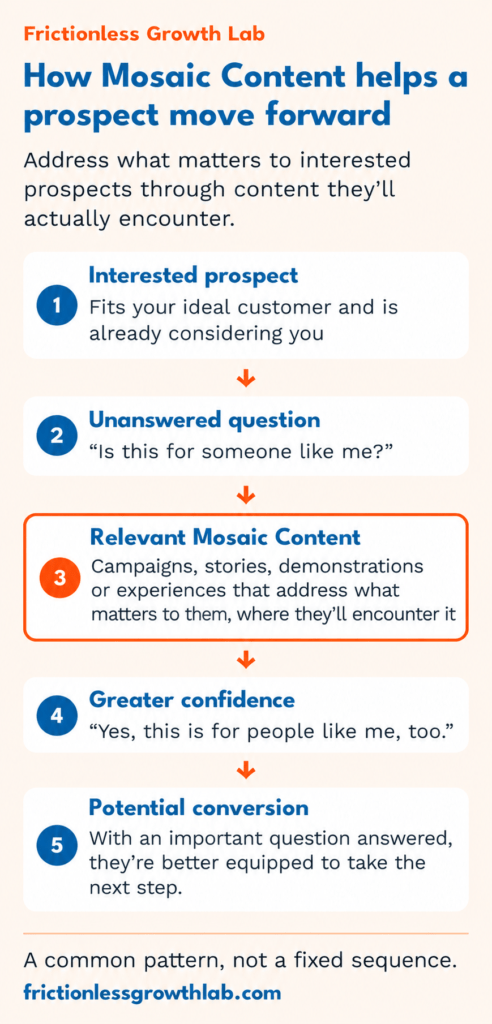
One way Mosaic Content helps interested prospects move forward is by addressing questions or concerns that broader marketing leaves unanswered. Here’s what that can look like. It’s a common pattern, though real customers don’t always move through it in a straight line:
- An interested prospect. Someone who fits your ideal customer and is already considering you.
- An unanswered question. Something your broader marketing hasn’t told them, often whether your brand is for people like them.
- Relevant content. Content that answers that question, placed somewhere they’ll actually encounter it.
- Greater confidence. They can now see that your brand fits their needs.
- A potential conversion. With an important concern addressed, they may be better equipped to take the next step or choose you.
What that looks like in real life
My husband is from Argentina, and Spanish is his first language. The day after Christmas one year, after working a lot over the holidays, he needed a haircut, and his usual barber wasn’t available. We were out and about, so he searched on his phone for “peluquería near me,” looking for a nearby place to get his hair cut. No nearby barber shops came up.
Standing right next to him, I searched “barber shop near me” in English. A barber shop less than 50 meters away popped up.
We went in, and it turned out there were Spanish-speaking barbers working there. My husband didn’t need a Spanish-speaking barber, but the shop was already equipped to serve people like him. It showed up in my English-language search and not in his Spanish-language search. That’s a discoverability gap worth investigating—and a Mosaic Content opportunity: making the shop easier to find in the languages customers actually search in. (I also shared this story in my article on the modern growth marketing playbook.)
Like the Apple Watch, the barber shop shows that the right information has to reach customers at the touchpoints they actually use. That’s why planning where each message lives matters as much as planning what it says.
Mosaic Content usually doesn’t have to be big. Sometimes the missing piece is a tutorial, a demonstration, an FAQ or a customer story. Sometimes it’s an expanded SEO strategy, or partnering with the creators and organizations a community already trusts.
What Mosaic Content can and can’t do
Mosaic Content works when your product and experience can already serve the customer. It can answer questions your marketing has left open, and it can make capabilities you’ve already built visible to the people who need them. It can’t make up for a product or experience that doesn’t meet a customer’s needs. If customers try what you offer and it doesn’t work for them, the gap is in the product or experience, and that’s where the fix belongs.
Why Your Universal Content Needs Mosaic Content Alongside It
Your universal, or general-market, content still matters. It makes the broad promise that helps the people you want to serve see your brand’s value. It just can’t answer every question for every group of your ideal customers, because customers aren’t a monolith. Different people have different questions, different needs and different trust signals they’re looking for.
So the strategy is both. Keep your universal content, and add Mosaic Content alongside it to answer the questions and concerns your broader marketing doesn’t address.
The two work together. Mosaic Message Mapping identifies what different customers need to hear, see and believe before they’ll choose you. Mosaic Content delivers it. (If you want the bigger picture on that first step, my guide to brand messaging strategy covers it.)
In Part 1 of this series, I walked through six jobs Mosaic Content and campaigns can do. In Part 2, I explained why some customers need evidence, beyond another promise, before they believe your marketing. This part focuses on putting it to work.
5 Questions Marketers Ask About Mosaic Content, Answered
More marketers now recognize that their ideal customer base is made up of many different kinds of people, and that Mosaic Marketing can help them reach more of those customers. When it comes to doing something differently from the way it’s always been done, though, questions come up. In essence, teams are asking their own version of the customer’s question: ”Is Mosaic Content for a business like ours?”
Those questions are reasonable, and leaving them unanswered creates friction. So here are the five I hear most often, and my answers.
1. Is Mosaic Content worth it?
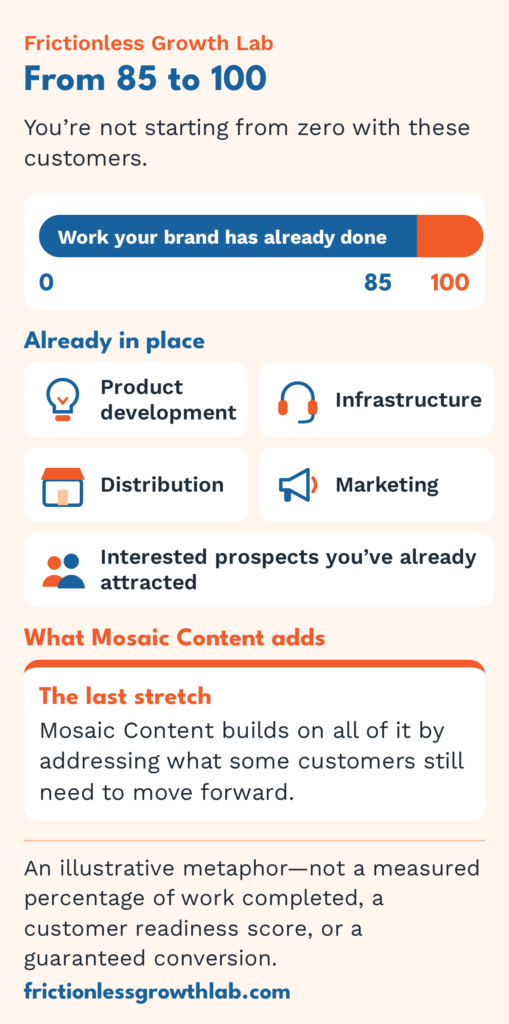
Yes, and a big reason is that your brand has probably already done most of the work to win these customers.
Here’s how I think about it. With these prospects, you’re starting from 85 and moving toward 100. That’s a way of picturing the work, not a readiness score, and no single piece of content converts someone on its own. These prospects are already interested. They have the problem your brand solves. What they’re missing are a few confirmations, a few signals, a few answers to specific questions that tell them clearly, “Yes, this is for people like you, too.”
Think about the work you may have already done to reach them:
- Product development. The Apple Watch’s accessibility features are a good example. Apple had already built the capability for a specific Mosaic.
- Distribution and availability. You may already sell your product in markets where your marketing doesn’t speak to the people who live there.
- Operations and infrastructure. Maybe you already have the infrastructure to serve Spanish-speaking customers. If your marketing never invites them in, that infrastructure goes underused.
- Marketing and customer acquisition. You’re already showing up where your ideal customers spend time, and you’ve already attracted interested prospects. Many of them see your product, understand it could help them, and still aren’t sure it’s for people like them.
Electronics are a simple example. Many phones and cameras already support multiple languages. The capability is there, and so are the product documentation and the instruction manuals. If your marketing doesn’t speak to people who use those languages, or reach them through the creators they follow and the organizations they belong to, they won’t know. Your brand may already be equipped to serve them. They just may not yet recognize your relevance to people like them.
Mosaic Content builds on everything you’ve already put in place. It addresses what some customers still need to move forward. That’s how Mosaic Content can help you convert more of the prospects you’ve already worked to attract.
2. Why can’t our general-market campaigns do this?
Put more specifically: why can’t our general-market campaigns communicate, “Yes, this is for people like you”?
General-market campaigns are still valuable, and they still have a place in your marketing mix. They’re often incomplete, though, because they tend to assume a universal customer, someone whose needs, and whose reasons to believe your product is for them, are the same as everyone else’s. (I go deeper on that assumption in my article on general market marketing.)
I started my career in healthcare. I spent nine years at Johnson & Johnson, and I’ve done a lot of consulting with pharmaceutical and biologic companies. Without fail, whenever I’ve presented a new tool or concept to people in that industry, the same questions come up: “Does this work in healthcare? Can you show us some examples in pharma?” So I always made sure to include healthcare examples. I knew the question was coming, and I knew they wouldn’t feel comfortable moving forward until it was answered. People look for that kind of confirmation everywhere, whether it’s about their industry, their country or the size of their company.
You don’t have to answer every question every customer might have. Identify the Mosaics within your ideal customer base and answer the questions general-market marketing isn’t designed to answer. Your general-market campaigns make the broad promise. Mosaic Content makes sure the specific questions that matter to different customer groups don’t go unanswered.
3. Why create content for smaller audiences?
When a customer group looks small on paper, look beyond audience size. Consider unmet needs, purchase influence, conversion potential, customer lifetime value and competitive opportunity.
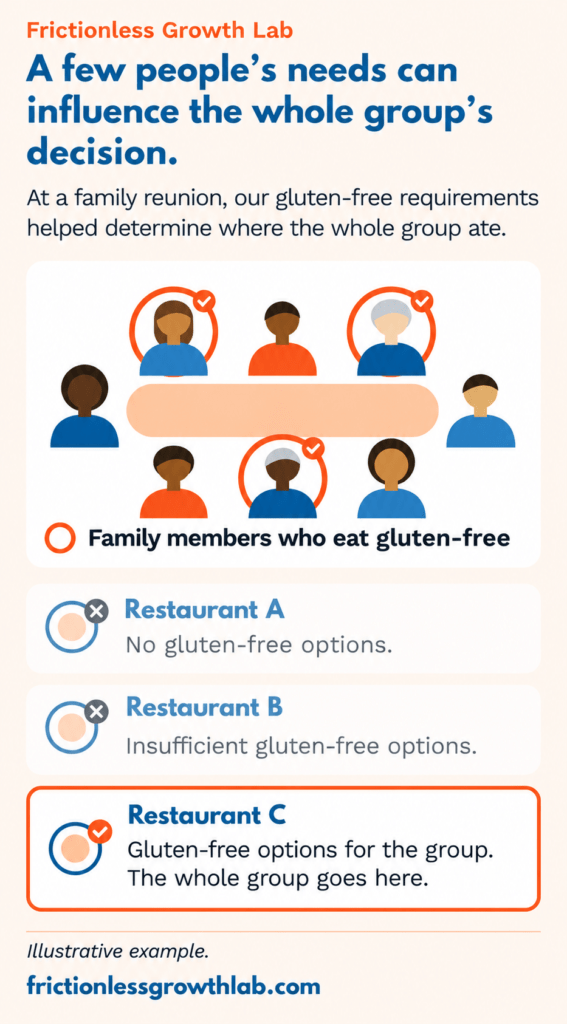
Purchase influence is the one brands most often miss. My family is a good example. I’m gluten-free, and so are some of the people closest to me. At a family reunion in New Orleans, our big group was deciding where to eat, and no restaurant was even considered unless it had enough gluten-free options for us. Our needs decided where the whole group went. People want to include the people they love, and if a choice doesn’t work for one of them, it often doesn’t work for the group. (I shared a similar moment in The Glitch in Modern Marketing.)
The same dynamic plays out at scale. The very first article I published for my Forbes column, Why McDonald’s, Coke and General Mills Made African-Americans Their Lead Consumer, looked at how those brands recognized a group’s influence extending well beyond its share of the population.
There’s also a simpler way to look at it. Brands spend a lot of time and money optimizing their marketing. Teams will work hard to move a landing page from a 2% conversion rate to 2.5%, or an email from a 45% open rate to 51%, because small gains add up. The same logic applies to content that helps you convert a larger share of a customer group you’re already reaching.
4. What if we can’t guarantee results?
In most of what we do in marketing, we can’t guarantee results.
When TikTok was new, plenty of brands started experimenting with it, and plenty of others said, “It’s new. It’s unproven. Why would we need to be there?” Over time, more brands moved in. TikTok offered the promise of a return, never a guarantee. The same is true of every channel today, from YouTube to email to influencers. You may have examples and benchmarks, and you still build, test and learn your way to results.
What you can do is look closely at the customers who aren’t moving forward—and at the signals that might explain why. I worked with a pharmaceutical client a few years ago that had already identified African American consumers as a very likely customer for one of its products, based on the numbers, the disease state and the brand’s segmentation work. On paper, this was an ideal customer.
When the team looked at the data, though, African American consumers had the lowest rates of usage, stayed on the product for the shortest time and had the lowest emotional connection with the brand. The right question was about the brand: what wasn’t it doing to realize the potential that existed with this ideal customer?
Everything the brand had been using was general-market marketing. Part of my recommendation was to create Mosaic-specific content that spoke to this community directly, addressed its needs and concerns, and made it clear the brand was for people like them.
The same thinking applies after someone becomes a customer: look at their experience and the questions that may still be unanswered. You can start learning without a guarantee. Choose the signs of progress before publishing, so you know what you’re looking for. Look at the questions customers ask, the next steps they take and the feedback they share—not just content views.
5. Can we start small?
Yes, you can. Often, you can begin with a focused investment in one customer question. Here’s how I’d approach it:
- Pick a customer group that fits your ideal audience and is showing actual interest—through inquiries, product exploration, demo requests or sales conversations—but isn’t moving forward as you’d expect.
- Identify the friction holding them back. Ask what’s getting in their way rather than assuming content is the answer. What questions or concerns does your broader marketing leave unanswered?
- Create relevant content that addresses it, and put it at the touchpoints where they’ll actually find it.
- Watch customer behavior for signs of progress.
How you start matters as much as how much you spend, though. One of the major reasons customers from some Mosaics don’t move from 85 to 100 is a lack of trust. That can come from societal programming or from bad experiences with other brands. For some communities, it stems from a lack of commitment. People aren’t sure why a brand is suddenly paying attention to them when brands have ignored people with their needs and identities in the past.
So when a brand comes in and it feels like it’s just dipping a toe in the water, people can tell. Customers, particularly those from underrepresented and underserved communities, need to know you’re committed to them for the long term. Nobody wants to feel like a test-and-learn. No one wants to feel like a trial.
I see a pattern play out often. A brand takes the toe-dip approach, doesn’t get the results it hoped for and stops trying to win that community. Sometimes the brand stops before it understands what happened. Did customers encounter the content? Was it useful? Did the experience support the message? Did the brand give people reasons to trust its commitment? As I wrote in Part 2 of this series, you can’t overcome a history of broken promises with another promise.
A better approach is to identify the friction points for this community, then use the budget you have to remove them one by one. No one expects you to remove everything at once. If customers can see you’re methodically removing the barriers, you give them an easier way to trust what you’re doing.
You can test your approach without treating your commitment to the customer as a test.
How Mosaic Content Connects to the 7C Framework
Mosaic Content draws on several parts of the 7C Frictionless Growth Marketing Framework. Customer Intimacy is where you learn which questions are going unanswered. Circle of Influence explains why one group’s needs can shape what a whole group chooses. Customer Experience Design and Delivery make sure the right information reaches customers at the right touchpoint, and that what you promise is what they get. Customer Loyalty grows from the long-term commitment that keeps customers from feeling like a test.
Convert More of the Prospects You’re Already Reaching
The goal is to turn more of your prospects, your ideal customers, into actual customers. You’re taking growth you’ve left on the table and working to access it on purpose.
Keep your general-market campaigns, and add Mosaic Content alongside them. Before you spend more to reach more people, look at the interested prospects you’re already reaching and ask what they still need to see, hear or believe to choose you.
Notice what this article just did: it answered five questions that might have kept you from moving forward with Mosaic Content. That’s Mosaic Content for marketers—and it’s the same approach you can use to help interested customers move from 85 toward 100.
If you can see that you’re leaving growth on the table with the Mosaics you serve, and you’d like help creating the content that answers their questions, that’s what Mosaic Studio is for. We help brands create Mosaic Content and campaigns grounded in what their customers need, so more of the prospects they’re already reaching can recognize the brand is right for them. Let’s talk about the Mosaic Content that could help more of your prospects choose you.
Until next time, remember: growth accelerates when you remove friction, for your customers and for your business.
Frequently Asked Questions
How do you convert prospects into customers with content?
Start with the prospects who already fit your ideal customer and show interest but aren’t buying. Find out what question or concern is holding them back, often “Is this for someone like me?” or a trust barrier. Then create content that answers it, such as a tutorial, a demonstration, an FAQ or a customer story, and place it at the touchpoints where those prospects will actually find it. Watch how their behavior changes, and keep removing friction over time.
What is Mosaic Content?
Mosaic Content is content and campaigns designed to remove friction for a specific group of your ideal customers, which I call a Mosaic. A Mosaic is a group whose identities, needs, lived experiences or circumstances shape what they need to know before they decide. Mosaic Content answers the questions your general-market marketing isn’t built to answer, so more of those customers can see that your brand is for people like them.
Do I still need general-market content?
Yes. General-market, or universal, content makes the broad promise that helps the people you want to serve see your brand’s value. It can’t answer every specific question every group of your ideal customers has. Keep your general-market campaigns, and add Mosaic Content alongside them. Mosaic Message Mapping identifies what different customers need to hear, see and believe, and Mosaic Content delivers it.
Is Mosaic Content worth it for smaller customer groups?
It often is, because audience size is only one measure. Look at unmet needs, purchase influence, conversion potential, customer lifetime value and competitive opportunity, too. Many smaller groups influence what larger groups choose, from where a family decides to eat to broader cultural trends. And because these prospects are often already interested, small improvements in conversion can add up, the same way they do when you optimize a landing page.
How do you start with Mosaic Content without a big budget?
Pick one customer group you’re already reaching but not converting the way you’d expect. Identify the friction holding them back, create content that addresses the most important friction point, place it where they’ll find it and watch their behavior for signs of progress. Then keep working through the rest. Avoid a short toe-dip campaign that customers can tell lacks commitment. You can test your approach without treating your commitment to the customer as a test.
Full Episode Transcript
Transcript of Frictionless Growth Lab Ep. 239, “This Type of Content Turns More Prospects Into Customers.” Lightly edited for readability. Sponsor messages are marked.
Sonia Thompson: So you’re already spending money to reach prospective customers who would be a great fit for what you sell. Your product can serve them, your customer experience can deliver, but some of those prospects still aren’t choosing you. What if they haven’t seen the information or the proof that they need to feel confident buying from you? So before you spend more money to reach more people, let’s talk about the type of content and campaigns that you could create to convert more of the prospects you’re already reaching, and help you reach some new ones. We’re gonna get into all of it after this short.
[Sponsor message] When a buyer asks AI for a solution like yours, does your business come up? Most companies have no idea, and by the time they find out, they’ve already lost the deal to someone who did. HubSpot AEO helps you show up in those moments with the right answers buyers are looking for before the first click, before the first form fill. That’s the moment HubSpot AEO is built for. Check out hubspot.com, the agentic customer platform for growing businesses. [End of sponsor message]
Great.
What Mosaic Content is
All right, so the specific type of content that I’m referring to here is what I call Mosaic Content, and at its core, Mosaic Content is all about removing the friction that exists for different types of consumers or Mosaics that prevent them from taking the next step forward with you. Sometimes that friction boils down to they don’t have a clear answer on that fundamental question, “Is this for someone like me?” Sometimes that friction is a trust issue. There are a number of things that could be standing in their way and is related specifically to who they are, their specific Mosaic, their specific identity as a consumer. And until you address that friction, those customers are gonna be hard for you to convert, even though they are your ideal customer.
Even though marketers are starting to realize more and more that they need to embrace Mosaic Marketing and they need to embrace the different types of consumers who make up their ideal customer base, sometimes when it comes to doing things a little bit different from the way they’ve always been done, some internal friction exists within the organization, and that brings up very legitimate investment questions that need to be adequately answered before you are able to move forward. In essence, internally, organizations are asking, “Is Mosaic Content for a business like ours?” So today, we’re gonna address five core questions that you might have about Mosaic Content to help you better evaluate the business case for it so that whenever it comes time to explain why it is that you are investing in this type of campaign and content, there is no question, no friction, no barriers that are preventing you from getting the funding that you need to do so. I’ve done a couple of episodes that go more in depth on what Mosaic Marketing is and what Mosaic Content in case you want to explore that a little bit deeper. I will put links to those in the show notes for you below.
I will put links to those in the description for you below.
Question 1: Is Mosaic Content worth it?
All right, so let’s dig into those questions, and question number one gets right to it. Is Mosaic Content worth the investment? And of course, my answer is going to be yes, and a big reason for that is brands have already invested significant resources to attract their different Mosaics who are part of their total addressable market or who are their ideal customers. Mosaic Content is really all about helping your brand get over the finish line with those particular customers that you’ve already invested resources trying to attract and retain. Like I said before, it’s all about helping you remove friction that helps move an interested consumer with questions and hesitations to an actual consumer of yours.
We’re not trying to start from zero and move someone to 100 to convert them. We’re starting from 85 and moving them to 100 to convert them. And I say that because I want you to think a little bit about some of the ways you’ve already invested in reaching these ideal consumers. There’s been research and development, product features and capabilities. I always go back to this example from a woman that I saw on LinkedIn who talked about how she would’ve bought an Apple Watch years earlier had she known about all the accessibility features that they had.
This woman was hearing impaired, and accessibility features were a part of her day-to-day. The brand had already done the work, and they’d already invested in having these accessibility features available for her exact Mosaic, for her exact type of need. They just hadn’t done a very good job of communicating the value that they had already baked into their product for people like her. Another way that you might have already invested is through distribution and availability. If you’ve already made your product available in different markets but don’t have specific marketing campaigns that speak to people in those markets, have already invested in everything to sell to them, but you might need some very specific things to, again, move them from that 85% to the 100% to get them over that finish line.
Maybe it’s operations and infrastructure. Do you already have an infrastructure to support maybe speaking to Spanish-speaking consumers? But if you don’t actually put marketing in place to serve those people or to get them in the door so they can engage with that infrastructure that you’ve already put into place, then you’ve already invested, but you need to get those Mosaics to be your actual customer. And of course, a very common one is your marketing and customer acquisition efforts. You’ve already shown up in the places where your ideal customer hangs out.
You’ve already given them the core messages about your product. And a lot of times, these exact consumers see your product, and they understand that it could be beneficial to them, but they’re not sure specifically if it’s for people like them, and they just need a few confirmations, a few signals, a few answers to some specific questions that let them know clearly, “Yes, this is for people like you, too.” And until they get those questions answered, they’re not gonna move forward. We’re moving them from 85% to 100%. Your brand is probably already equipped to serve ideal customers within specific Mosaics, but they just may not yet recognize the relevance of your brand to them, to people like them.
And they just need a little bit of content, a few campaigns that make it very clear to them that you are. Another quick example that I like to use is any type of electronic device, whether it’s a phone, a camera, they are already equipped for people who speak multiple languages. The capability is already there. Product documentation is already there. The instruction manuals is already there.
But if your marketing doesn’t speak to people who speak those different languages, if it doesn’t reach people in those specific communities where they’re hanging out, perhaps with the creators that they follow or the organizations that they are part of, they’re not gonna know. They’re not gonna have the information or the trust signals that they need to know that you are for people like them. Sometimes that missing piece that’s needed is a tutorial, a demonstration, an FAQ, or a customer story. Perhaps all you need is an expanded SEO strategy. My husband is a Spanish speaker.
He’s from Argentina, and I’ll never forget one day, uh, he had worked a lot during the holidays, and it was the day after Christmas, and he needed a haircut. And we were out and about. The normal barber that he goes to wasn’t available. Went and typed into his Google search, “Pelucaria near me,” which means barber shop near me. No barber shops close by popped up.
I, at the same time, searched barber shop near me, and I was standing right in front of my husband and a barber shop not 50 meters away from us popped up. We ended up going into that barber shop. There were actually Spanish-speaking barbers in there, and he didn’t actually need a Spanish-speaking barber, but this shop was already equipped to serve my husband and people like him. But because their SEO strategy hasn’t been activated for Spanish-speaking consumers to make sure that that barber shop was showing up in local search, they were missing out on customers. They just needed a little bit added to their marketing strategy.
They just needed a little bit of Mosaic campaigns and content to be added to move a customer from 85% to 100%.
Question 2: Why can’t general-market campaigns do this?
All right, so let’s move on to question number two, and that is, why can’t our general market campaigns accomplish this? Specifically, they’re probably asking, why can’t our general market campaigns communicate, “Yes, this is for people like you”? Now, I wanna be clear. General market campaigns are still valuable. They are still useful.
They still have their place in your overall marketing mix. But they are often incomplete because general market campaigns assume that you’ve got a universal type of customer, that everyone is pretty homogenous, or the specific needs that they have or reasons what they need to believe why your product is for them are pretty universal. But consumers aren’t a monolith. Different people have different questions. Different people have different needs.
Different people have different trust signals that they’re looking for, and you’re trying to serve a broad variety of consumers, and it becomes very hard to do that with one particular type of campaign. One size does not fit all. I started my career in the healthcare industry. I spent nine years working at Johnson & Johnson, and I have spent a lot of time consulting in the healthcare industry with pharmaceutical and biologic companies. And I can tell you, without fail, whenever I was actually working in corporate as a marketer and as a consultant, every time you present a new resource, a tool, a concept to people who work in this particular industry, the question is always going to come up.
“Ah, does this work for people in healthcare? Ah, can you show us some examples in pharma where this works? Ah, can you show us some examples in biotech? Oh, we understand this in theory, but we really need to see some healthcare examples. We need to really see some examples of where this might have worked in the diabetes market.”
And the healthcare industry isn’t unique in this. People are always looking for very specific answers or confirmation that it’s gonna work for someone like them, whether that be their industry, whether that be their country, whether that be the size of the company, the, in terms of revenue or the number of employees that they have. There’s no shortage of someone like me questions. And I wanna be clear here, I’m not trying to say that you need to answer every single question that every different type of customer may have. What we’re trying to do is help you identify the different Mosaics that exist within your ideal customer, within your total addressable market, within your world or pool of ideal customers, and answer the questions that general market marketing is not designed to answer.
So in the case of healthcare, whenever I was doing my consulting work, always made sure that I included examples within healthcare that they were going to be able to see, “Ah, yes, this will work for us. This will work for our needs.” I needed to make sure that I was adapting and tailoring what I was doing specifically for them because I knew the question was going to come up, and they weren’t gonna be satisfied. They weren’t going to feel sufficiently comfortable until they had an answer to that question. Why leave the questions unanswered?
That just creates friction that creates a problem between you and your ideal customer that we absolutely do not want, especially as you’re working to grow. Your general market campaigns can make the broad promises that are needed to help the people that you want to serve see your brand’s value. Mosaic Content makes sure that the specific questions that matter to different customer groups don’t go unanswered.
[Sponsor message] Okay, I’ve got another podcast recommendation for you. It’s This Old Marketing, hosted by Joe Pulizzi and Robert Rose, and it’s brought to you by the HubSpot Podcast Network, the audio destination for business professionals. Joe Pulizzi and Robert Rose are two of the most well-known experts in the content marketing space. And in this show, they are talking about the latest content marketing trends, and they discuss how businesses can use content to attract and retain customers. One really great episode that you should tune into, and it’s super timely, is The State of Content Marketing 2027: What Comes Next? And here’s another one for you to consider: Is Blogging Dead or Mostly Dead? Listen to This Old Marketing wherever you get your podcasts. [End of sponsor message]
Question 3: Why create content for smaller audiences?
So that brings us to question number three, and that is why invest content in smaller audiences? I wanna implore you to look beyond just audience size. Consider unmet needs, consider purchase influence, consider conversion potential, customer lifetime value, as well as competitive opportunity. A lot of times, different consumer groups appear smaller on paper, but they have a lot of influence with other types of customer groups. The very first article I published for my Forbes column was why African American consumers are often the lead consumer for brands, and in it I gave examples from McDonald’s, Ford, General Mills.
They were using African American consumers as the lead consumer in their general market campaigns. Why were they doing this? And I had a number of different quotes. I’ll link this article in the show notes for you. Was because they recognized that African American consumers specifically, even though in the US they’re just 13% of the population, they had a lot of influence with other people who were not African American.
These brands realized this, and they were using this particular community and the influence they had to help grow their brand. And another example of this, I’m gluten-free, my husband’s gluten-free, my sister is gluten-free. I remember we were at a family reunion in New Orleans, and we were all looking at different options for where our big group was going to eat, and how did we make the decision about where we were going to eat? We went to a place that had sufficient gluten-free options that worked for me, my husband, and my sister. So there were just three of us, but no other restaurant was even gonna be considered if it did not work for us three.
Our niche or smaller community became the lead consumer once again. People often want to include other loved ones and family members in outings or different things that they’re gonna be engaging with, and if it doesn’t work for them, then it doesn’t work for the group. I remember talking to one of my business friends, and she is vegan, and she was planning a company retreat for her company and for some extended partners. And whenever it came time to book the hotel where they would host their retreat, she only picked places that had sufficient vegan items on the menu. Why?
Because she’s vegan, and she needed to be able to eat there. The decision that worked for the entire group came out of the needs of one specific person. This happens all the time, more than you realize. So you can’t just look at what on paper looks like one particular group because their influence often s- extends well beyond their, their numbers. And again, we’re not talking about starting from scratch with these communities.
We’re talking about moving them from 85% to 100%. You’ve already done so much work preparing them to be able to be your customer. You’re just doing a couple little things to move them over the finish line. One other thing that I wanna bring to your attention when it comes to perspective shift around perhaps this might be a smaller community, is just this whole idea of optimization. Brands across the board spend a ton of time and resources working to optimize their overall marketing mix, the different content that they’ve created, whether it’s landing pages, whether it’s their email, whether it’s their YouTube channel.
Brands will invest significant resources to improve from a 2% conversion rate to a 2.5% conversion rate, or to move from a 45% open rate to a 51% open rate. Small changes make a big difference in the context of a brand. So if we aren’t asking teams, “Hey, should you really be investing in optimizing those YouTube thumbnails so that you can get a higher conversion rate?” Or, “Hey, are… Should we really be doing all that work to increase our conversion rate on this landing page?”
If we’re not asking those same questions because we know that even incremental progress can make a big difference on the bottom line, then we shouldn’t be asking those same questions here when we’re talking about making some incremental improvements or additions in content and campaigns to overwhelmingly convert a larger percentage of different customer groups who can absolutely make a difference on your brand’s bottom line. Ultimately, what I want to communicate to you is that as your brand is looking to grow, I do not want you to leave growth on the table. And I’ve talked to a number of chief marketing officers from different brands who are very much committed to doing the same thing. One of those CMOs was Allyson Witherspoon, who is the CMO at Nissan USA, and she was telling me about how these days consumers have zero tolerance for friction, and the minute they, they encounter it, they’re gone. So one of the things that Nissan is doing is trying to make sure that the experiences that they deliver are as frictionless as possible for the customers that they want to serve.
One of the ways that they’re doing that is through actual product. They recognize that different groups of their ideal customers that they want to reach had different needs, especially as it relates to electrification of their vehicles. And their strategy as a result was to provide different powertrain options for the different needs of those different consumers or different family types, including having hybrid cars that, that could also use gasoline. There were plug-in hybrid options, and there were also e-power approaches that they were taking into consideration for their Nissan Rogue. So they were creating three whole different types of options for Nissan Rogue consumers that address their different needs and preferences with regard to electrification.
The brand didn’t just say, “Hey, this is what we have. Take it or leave it. We don’t wanna do the work to eliminate this friction that exists.” They went out and created three different products to address those specific needs because they didn’t wanna leave any customer on the table. You may not need to go out and create new products the way that Nissan did.
In a lot of instances, Mosaic Content may be all that you need, and there are a number of different ways that Mosaic Content can show itself.
Question 4: What if we can’t guarantee results?
Question number four is how do we justify investment in these particular communities without being able to guarantee results? And the answer here is that in most things that we do in marketing, we are not able to guarantee results. I remember whenever TikTok was super new and then there were a lot of brands who were dipping their toe in TikTok and getting started with it, and there are plenty of other brands who are like, “No, we don’t need to do that. It’s new. It’s unproven.
Why would we need to go into this new channel?” And then slowly more and more brands started directing resources to TikTok. It might have had a promise of a return, but there was never a guaranteed return. Even today as TikTok and other channels, YouTube, email, UGC influencers, there is no guarantee of return. You might have some examples.
You might have some benchmarks, but there’s no guarantee that you as a brand are going to see those results. There’s this common stat that people use for email marketing that says, I believe for every $1 you spend on email marketing, you can expect a $46 return. Email marketing has a super high return, but there’s no guarantee that if you start doing email marketing that automatically you are going to receive that return on your investment. You have to take some time to start to build the right team, to make sure that you’re testing and learning and applying different things, and over time you should be able to get there. But there’s never any guarantee, like with any marketing channel.
So instead of just focusing purely on the numbers and trying to get a guarantee that if you invest this much you’re gonna get this kind of return, think about this type of content in a different way. Think about the specific types of customers that you are trying to convert. Look a little deeper to help uncover what evidence suggests that they are interested. And there should be a lot of evidence because they already fit within the parameters of who your ideal customers are. They have the problem that your brand solves.
Identify what friction is holding them back, and then start to think about what content could theoretically address it. What customer behavior would signify progress? I remember I worked with a client a few years back in the pharmaceutical industry, and for the product that they had in market they had already identified that African American consumers was a very likely consumer for them, and this was based upon the numbers, disease state, as well as the psychographic profile of this consumer based upon the brand segmentation that they had done. But when they actually started to peel back the layers and look at the data, they started to see that African American consumers, even though they were an ideal customer for them, they had the lowest rates of usage, they stayed on the product the least amount of time, and they had, and they had the lowest percentage of emotional connection with the brand. Now, on paper, they should have been a great ideal customer, but the actual data showed something different, and it wasn’t a matter of what’s wrong with this customer.
It’s what wasn’t the brand doing to make sure that they are actually realizing all this potential that existed with the ideal customer. Of course, part of the recommendations that I brought to my client was making sure that they were creating Mosaic-specific content to speak to this community directly. None of what had been created that the brand was using, it was very much general market marketing, and if they wanted to speak to this consumer and have them have a better reaction to what the brand was producing, they had to take a different approach and speak to that community directly in what their needs were and what their concerns were, and make it clear to them that this brand was specifically for people like them. The absence of guaranteed performance does not mean the absence of a business case, which connects nicely to the last question that we are gonna cover today.
Question 5: Can we start small?
And that is, can we test Mosaic Content in campaigns without committing a larger budget? And the answer, of course, is sure, you can. Never do you need to commit a large budget. But I wanna be clear in, on this in terms of how you’re thinking about the opportunity in the community. One of the major reasons why a lot of consumers from different Mosaics have friction and they don’t necessarily move forward with a brand, they don’t move from where they are at 85% to 100%, is because they lack trust with the brand.
Whether it’s through societal programming, whether it’s through bad experiences with previous who were in the market but not yours. There are a number of reasons why consumers may not have the trust that they need, and sometimes for particular communities, those trust issues stem from a lack of commitment. They’re not really sure why a brand suddenly is starting to give them their attention whenever the brands have ignored them and people like them and who have their particular needs, lived experiences, and identities in the past. So whenever a brand comes in and it feels like they’re just trying to dip their toe in the water to see, often enough you aren’t going to get the type of results that you think that you’re gonna get because people can tell that you’re not committed. Consumers, particularly those who are from underrepresented and underserved communities, need to know that you are actually committed to them and their community.
They need to know that you are in it for the long term. They need to see you put your money where your mouth is. Whenever you’re saying, “Yeah, this is for people like you,” you actually have to demonstrate that, and that often requires investment. Not to say that you need to be perfect from day one or day two, but you do need to show that you have some type of commitment to the community. So maybe you’re not rolling out an all-out, fully baked, all-in campaign, but you do something, and it’s okay if it’s at a smaller scale, that you’re addressing a very important problem.
You’re addressing a need, but in a way that doesn’t feel like it’s an afterthought or, “Hey, let’s just kinda throw some money and see if it works, and if it gives us a high enough return on investment, then maybe we’ll invest more.” Nobody wants to feel like they are a test and learn. No one wants to feel like they are a trial. If you want to earn the trust from particular communities, you have to earn that trust, and sometimes earning their trust means investing with them and showing that you’re committed to them and that you’re gonna be there over the long term and that you are willing to stick around and walk beside them and make life better for them to be able to do that. And sometimes, and I see this happen a lot, and a lot of times brands take this approach and they wanna do it, and they don’t get the results that they’re looking for, and so they, they stop trying to win this community.
And it’s not because the test didn’t work, it’s just that consumers could feel that your intentions in your heart wasn- really wasn’t in it. So why are they going to invest their time and their resources into a brand that clearly isn’t demonstrating that they want to invest fully their resources into them? A better way to address this is to identify what are all the friction points for this community, and then take whatever budget or investment you can devote to it and start to chip away at those friction points one by one. It’s not expected that you’re gonna be able to chip away at everything all at once, but if you can show that you are methodically working to remove those barriers that may exist, then that gives them an easier way to trust what it is that you’re doing without making it feel like you are giving them sloppy seconds. You can test your approach to different communities without treating your commitment to the community as a test.
The goal here is to turn more of your prospects, more of your ideal customers, into your actual customers.
Convert more of the prospects you’re already reaching
We’re taking all that growth that you’ve previously left on the table, and we’re proactively working to access it and convert it. I’m not saying that you need to ditch your general market campaigns. I am saying that you need to add Mosaic Content to supplement it, to help you reach those consumers and address the concerns of those consumers that general market content just isn’t designed to do. Now, if you’re listening to this and you realize that, yeah, we are leaving money on the table, we can do a better job with the different Mosaics that we serve, and giving them the information and the content and answering their questions and removing the friction that exists for them, if this is something that you feel like is an opportunity for your brand and you need a little bit of help with that, I’ve got some resources to help you do that. I will drop links to them or Mosaic Studio where we actually help you create some of the Mosaic Content that you need.
Until next time, remember, growth accelerates when you remove friction for your customers and for your business. Thanks so much for listening. Talk to you soon.
Found this post useful?
There’s more where that came from—get insights on the new rules of growth delivered to your inbox.