The way many brands practice modern marketing is incomplete. As a result, it’s less effective than it should be — and brands are losing sales because of it.
That incompleteness shows up when brands stop applying personalization once identity enters the picture
This gap — between what brands already know works and where they choose not to apply it — creates friction. And that friction costs brands trust, relevance, and sales.
This manifesto explains the real glitch in modern marketing, why “general market” thinking is less effective, and how identity completes — rather than replaces — personalization as a driver of sustainable growth.
Listen on Apple Podcasts | Spotify | YouTube Music
We Already Know How to Personalize for Needs and Preferences
Every time we go to the pet store to buy food for our dog, Mora, I’m reminded of something that should make every marketer pause.
Just within the one brand we buy, there are options for:
Puppies.
Adult dogs.
Senior dogs.
Big dogs.
Small dogs.
Dogs that need weight control.
Dogs that need digestive support.
Then there’s the choice of protein — chicken, beef, salmon, bison.
And whether you want wet food or dry food.
On the brand’s website, they proudly say they offer more than 80 different formulas — designed to support a dog’s unique nutritional needs and taste preferences at every stage of life.
Eighty.
That’s not confusion.
That’s clarity.
That’s a brand acknowledging something we all understand instinctively:
one size does not fit all — and pretending it does would be irresponsible.
And this kind of personalization isn’t unusual.
Think about your car — the models, the trims, the configurations.
Think about shoes — styles, widths, sizes, colors, use cases.
Even in highly regulated industries like pharmaceuticals or biologics, personalization exists. Because scientists and healthcare professionals understand that when you ignore differences, outcomes suffer. So there are different doses, different modes of delivery, and even different flavors.
Most marketers get personalization.
They’re fluent in it.
They optimize for it.
They profit from it.
But there’s one moment where that fluency disappears.
This isn’t where brands lack sophistication.
It’s where sophistication suddenly vanishes.
Because when personalization intersects with identity, something changes.
You can hear it when identity comes up — the hesitation, the stumbling over language, the second-guessing of what to say and how to say it.
It’s not hostility.
It’s unfamiliarity.
And the contrast is striking.
Talking about an older, overweight, blind golden retriever with dietary needs is easy.
No one worries about saying the wrong thing.
No one braces for correction.
But when the conversation shifts to human identity, that ease disappears.
Suddenly it’s:
“Let’s go back to the general market.”
“We don’t want to get political.”
“Is this… woke?”
“Is this aligned with our values?”
“Is this worth the effort?”
And that — right there — is the glitch in modern marketing.
Not a lack of data.
Not a lack of tools.
Not a lack of best practices.
But a selective refusal to apply what brands already know works — to the place where consumers are making decisions more consciously than ever.
And the cost of that unfamiliarity shows up quietly.
Because when people don’t feel seen — or reflected in what matters to them — they don’t push through. They move on.
Today’s consumers aren’t obligated to accept what’s offered. They have options. And they use them.
Why Identity Shapes Buying Decisions (and Sales Outcomes)
Identity affects sales because it shapes how people evaluate risk, relevance, and whether a product, service, or experience will actually work for someone like them.
You might be wondering — what does identity actually have to do with selling more cars? Or toys? Or SaaS products?
It has a lot to do with it.
Not because consumers are trying to make a statement —
but because identity shapes how people evaluate whether something will work for them.
A while back on LinkedIn, I saw a hearing-impaired woman share that she would have bought an Apple Watch years earlier — had she known about the accessibility features already built into the product.
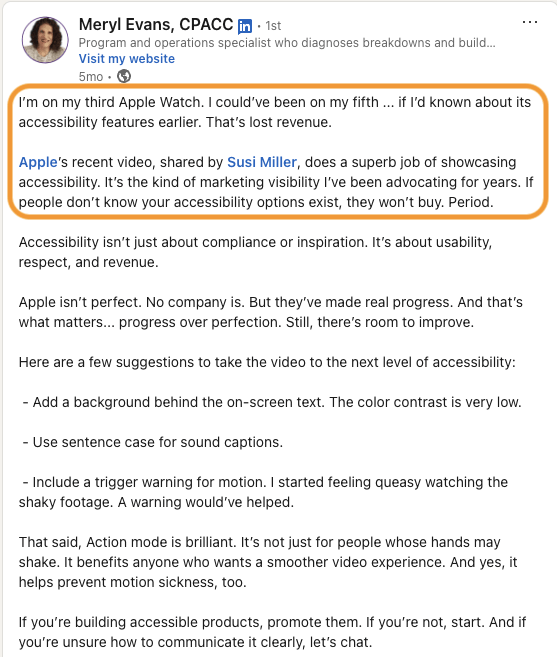
The brand understood that identity mattered in product design.
But that understanding never made it into product communication.
The result: delayed sales by several years.
At a family reunion a couple of years ago, our group decided not to go to a restaurant that was highly rated and widely recommended.
Why? They didn’t have any gluten-free options on the menu.
Two people in our group — including me — needed that option. So we chose a place that worked for everyone.
The result: lost sales from a large group — including people squarely in the so-called “general market.”
Another woman shared with me that she chose the company she uses to invest her retirement savings specifically because it was designed with women — their needs, considerations, and realities — in mind.
The result: a long-term customer relationship rooted in recognition.
These decisions aren’t rare.
They’re happening every day.
Because whether they say it out loud or not, consumers are always trying to answer a fundamental question:
Is this for someone like me?
Will this actually work for someone like me?
Have people like me found success with this product?
And they’re looking for signals — quickly and clearly — that give them the answer.
When that answer feels unclear, people don’t always explain why.
They don’t always complain.
They choose differently.
The data reflects this shift.
In the 2025 State of Representation in Marketing study,
37% of consumers said they do not engage with or buy from a brand if they don’t see themselves represented. And 81% said they buy from a brand when they do see themselves represented.
That’s the cost of the glitch.
Lost sales when consumers don’t feel recognized.
Increased sales when they do.
Not because identity is a trend. But because recognition is now a baseline expectation in a market defined by choice.
The Problem With “General Market” Marketing
The limitation of “general market” marketing isn’t that it’s wrong. It’s that it’s incomplete.
It operates under the assumption that large groups of people experience the world — and make decisions — based on largely similar factors.
But the world doesn’t work that way.
People move through the same environments differently.
They face different constraints.
They assess risk differently.
They look for different signals before they decide.
When marketing ignores those differences, it creates friction — not because people are difficult, but because the experience wasn’t designed with them in mind.
One woman shared with me that her Muslim faith shaped which events she could attend when she went to conferences for her business.
Because she didn’t attend events centered around alcohol — or held in bar settings — she missed out on opportunities to build relationships and close deals.
The issue wasn’t lack of ambition.
Or lack of interest.
Or lack of capability.
It was that the default experience assumed a version of participation that didn’t work for her.
I saw the same pattern show up in research in a different way.
One respondent described himself as a single, older man — never married, no kids, loves his pets, with disposable income.
And yet, he shared that he’s rarely marketed to in a way that reflects his life or priorities.
Not because he’s hard to reach.
Not because he lacks buying power.
But because he doesn’t fit the default assumptions baked into “general market” thinking.
That’s what general market marketing does by design.
It doesn’t answer the someone like me question.
Instead, it quietly defines “someone like me” as average.
Typical.
Normal.
But what is normal, really?
Consider this: data shows that Black women experience significantly higher maternal mortality rates than women of other races.
Pregnancy and childbirth are often described as universal experiences.
But the risks — and the outcomes — are not the same.
So when a Black woman is choosing a doctor, birthing team, or deciding where to give birth, she may be evaluating entirely different criteria.
Not because she’s an exception — but because her lived reality requires it.
A general market approach doesn’t account for that difference.
And when those differences matter — as they often do — the experience fails quietly.
Not with backlash.
But with disengagement.
This is the quiet flaw in general market marketing: when experiences are designed for an imagined average, anyone who doesn’t see themselves in that average is left to do the work — or opt out.
What Happens When Brands Ignore Identity
At this point, brands tend to fall into one of three places.
Some already understand that identity shapes how people experience products, services, and brands — and they’re actively building with that in mind.
Others sense that something isn’t working, but can’t quite name what’s broken.
They feel the friction, but haven’t yet connected it to identity.
And some haven’t engaged with this at all — because when systems work by default, it’s easy to mistake that experience for universality and miss the cost that assumption creates.
What matters isn’t where a brand starts.
What matters is what it does next.
Because in today’s market, choosing not to account for identity isn’t neutral.
It’s a decision — with consequences.
And that’s where the opportunity sits.
The Reframe: Why Identity Completes Personalization
Identity doesn’t replace personalization — it completes it by making differences visible where relevance, trust, and conversion are actually decided.
This is what identity-based marketing actually is: designing personalization systems that account for how real people and communitites experience risk, relevance, and decision-making based upon lived experiences.
Personalization alone stopped short of giving identity-driven consumers what they need.
Most brands already know how to tailor experiences — by behavior, lifecycle stage, preferences, and intent.
They’ve invested heavily in doing this well.
But when identity entered the picture, that same rigor often disappeared.
Not because identity isn’t relevant.
But because it was treated as something separate — something cultural, political, or optional — rather than foundational.
Identity isn’t the destination.
Treating identity as a standalone initiative — something to acknowledge, reference, or represent — creates another kind of fragmentation.
The work isn’t addition.
It’s integration.
Letting identity inform how personalization shows up across the system —
from who is centered in research, to how customers are defined, to what signals are prioritized, to how relevance is communicated.
This isn’t a departure from best practices.
It’s the completion of them.
Because the question consumers are answering hasn’t changed.
They’re still deciding whether or not a product, communication, or experience will work for someone like them.
Identity simply makes that easier to answer for brands.
And brands that learn to design with that visibility don’t just personalize better.
They grow with more precision, relevance, and resilience.
The Strategic Choice Brands Are Making Now
At this point, the choice is simple — even if the work isn’t.
Brands can continue designing for an imagined average.
Or they can acknowledge what’s already true: that identity shapes how people experience products, services, and brands — and how they decide whether something is for them.
Choosing the latter doesn’t mean launching a campaign.
It doesn’t mean saying everything perfectly.
And it doesn’t mean turning identity into a moment.
It means letting identity inform the places where strategy already lives.
Who you define as your customer.
What your buyer personas reflect — and what they leave out.
What you measure — and what you don’t.
How you conduct market research and build customer intimacy.
How your messaging lands.
Who shows up in your creative and representation.
And how decisions get made across the marketing mix.
In other words, it means treating identity not as an overlay — but as a design input.
This isn’t about adding complexity.
It’s about removing assumptions that no longer hold.
Because the market has already shifted.
Consumers are deciding through identity — whether brands account for it or not.
They’re looking for signals that answer these fundamental questions quickly and clearly:
Is this for someone like me?
Will this work for someone like me?
Brands that choose to see this clearly will build relevance that compounds.
Brands that don’t won’t fail loudly.
They’ll just keep wondering why growth feels harder than it should.
Frequently Asked Questions About Identity and Modern Marketing
What is the glitch in modern marketing?
The glitch is that brands understand personalization but stop applying it when identity enters the picture, creating friction that reduces relevance, trust, and sales.
Why does identity affect buying decisions?
Identity shapes how people assess risk, relevance, and whether a product or experience will work for them.
Why doesn’t general market marketing work as well anymore?
Because it assumes people experience the world similarly, ignoring differences that materially affect decision-making and outcomes.
Is identity-based marketing the same as representation?
No. Representation focuses on visibility. Identity-based marketing integrates lived experience into strategy, research, and experience design.
How does identity connect to personalization?
Identity completes personalization by making differences visible at the moments where relevance and conversion are decided.
Bottom Line
The future of growth belongs to brands that don’t just acknowledge how people are different — but design for those differences, without asking customers to adapt or explain themselves.
If you’re wondering where this shows up in your own business, I’ve built a short quiz to help you pinpoint the friction slowing growth — and where to focus first.
Take the Quiz: What’s Slowing Your Growth?
Found this post useful?
There’s more where that came from—get insights on the new rules of growth delivered to your inbox.