Nobody wants their brand growth strategy to underperform.
That’s because nobody wants to underperform. Period.
Heck, I still remember a trigonometry test I underperformed on in 11th grade that cost me the #2 spot in my graduating class.
But more important than a high school senior’s ego — are the consequences of a brand underperforming.
There’s the consumers who don’t get their problem solved.
There’s also your business. Perhaps that means jobs lost. Bonuses not paid. Opportunities squandered.
Not to mention the stress that comes with it — and we know stress isn’t good for anyone.
Underperformance benefits no one. Well — except maybe your competitors.
Recently, I was traveling with friends and family. One night, fifteen of us were deciding where to eat. Two people needed gluten-free options — including me. So the search was “gluten-free near me.”
The restaurant we ended up at showed up because they had applied a growth strategy designed to reach today’s customer. They got fifteen people through their door — thirteen of whom were their exact customer profile — because they had made themselves findable and relevant to us.
The restaurants that didn’t show up in that search never knew we existed. They didn’t know about the lost opportunity. They lost revenue — and had no idea it happened.
That’s the thing about growth strategy gaps: they’re almost always invisible from the inside.
And here’s what makes it more complex: the gap that kept those restaurants from showing up for us wasn’t really about food. It was about identity — understanding who their customers are, what they need, and how to show up in a way that says clearly: this is for someone like you.
That’s the gap at the heart of most brand growth strategy challenges today. Not product quality. Not budget. Not creative. A gap between how brands show up and how today’s consumer actually experiences them.
The 7C Frictionless Growth Marketing Framework was built to close that gap.
It’s a complete, sequenced operating system for brand growth — one that accounts for how today’s consumers actually make decisions, and gives marketing leaders a clear system for attracting, converting, and retaining the customers they most want to serve.
In this guide, I’ll walk you through all seven components — what they are, why they’re sequenced the way they are, and what becomes possible for your brand when the whole system is working together.
Liston on Apple Podcasts | Spotify
Why Brand Growth Strategies Leave Opportunity on the Table
Before we get into the framework, let’s name the root cause of most brand growth strategy gaps.
It comes down to one thing: identity.
And I know what some of you might be thinking. “Our product isn’t really an identity product.”
Maybe that’s true at the product level. But the marketing almost always is.
Take bedroom sheets. Whether someone chooses 400 thread count over 600, bamboo over polyester, cotton over microfiber — the choice itself may have nothing to do with identity.
But the visual imagery in your campaign? The testimonials on your website? The people featured in your ads? The media channels you use to distribute them? Those absolutely influence whether a consumer feels like your product is for someone like them — or not.
And here’s what matters even more: just because you don’t immediately see how identity plays a role doesn’t mean it isn’t playing one for the consumers you’re trying to reach.
A consumer who is hearing impaired may have chosen your product years ago — if they’d known about the accessibility features built into it. But because your marketing never surfaced that information in a way that reached them, they didn’t buy. That’s lost revenue from a customer who was ready and willing, just waiting to feel seen.
When consumers receive the signal that a brand isn’t designed for someone like them, they don’t complain. They don’t leave a review. They just go elsewhere — and they take their networks with them. Their friends. Their families. The people they make purchasing decisions for.
Brands lose all of them. And never know why.
That’s exactly what the 7C Frictionless Growth Marketing Framework is designed to fix.
FAQ: Why do growth marketing strategies underperform?
The most common and least visible cause of growth strategy underperformance is the absence of identity as a strategic input. When brands design campaigns, products, and customer experiences without deeply understanding how identity shapes their customers’ decisions and perceptions, they create friction at every stage of the funnel — friction that drives customers away silently, without complaint or explanation.
The 7C Frictionless Growth Marketing Framework: An Overview
The framework is built around seven components:
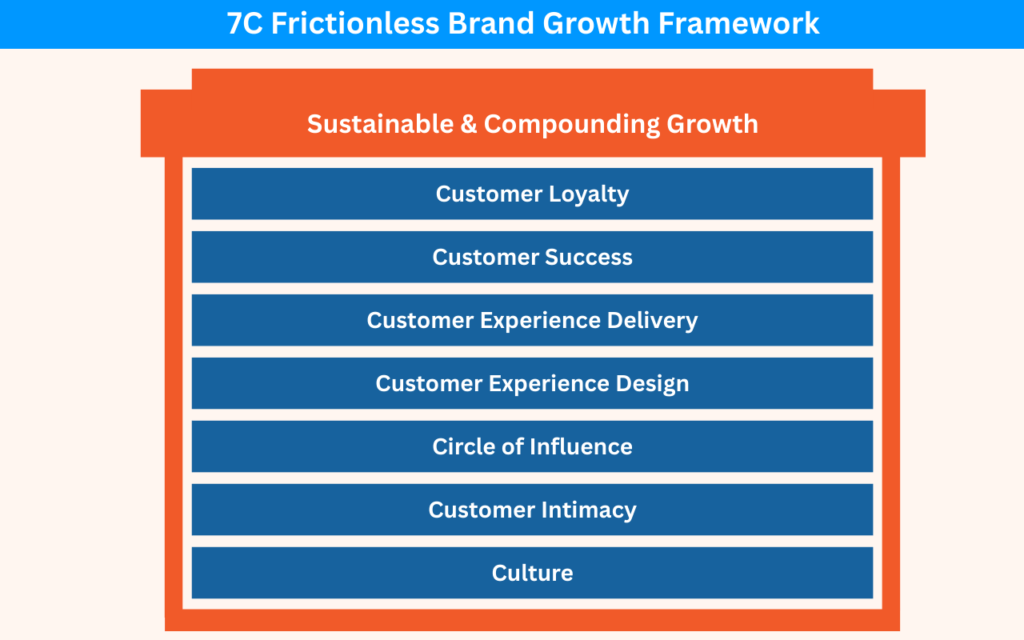
- Culture — Your company or brand values
- Customer Intimacy — Deep knowledge of your customers’ identities and lived experiences
- Circle of Influence — The diversity of perspectives shaping your decisions
- Customer Experience Design — How you architect the customer journey with identity in mind
- Customer Experience Delivery — Your campaigns, content, messaging, and channels
- Customer Success — Whether all customers achieve outcomes regardless of identity
- Customer Loyalty — The compounding relationship you’ve earned over time
Before we go deeper, one critical framing note: these aren’t a menu. You don’t get to pick the C’s that feel comfortable and skip the rest. They’re a deliberate system, and they’re sequenced for a reason. Each one builds on the ones before it.
If you don’t have the Customer Intimacy to understand the communities you’re trying to reach, your Customer Experience Design will have gaps you can’t see. If your Circle of Influence doesn’t include people with the lived experiences of your ideal customers, your Customer Experience Delivery will feel inauthentic no matter how much budget you put behind it.
The brands that do one or two C’s well and skip the others end up with beautiful campaigns that don’t convert, research that keeps coming back incomplete, and loyalty programs that don’t actually build loyalty.
The power of this framework is in the whole system working together.
FAQ: What is the 7C Frictionless Growth Marketing Framework?
The 7C Frictionless Growth Marketing Framework is a complete operating system for growth marketing strategy, developed by brand growth strategist Sonia Thompson. It consists of seven sequenced components — Culture, Customer Intimacy, Circle of Influence, Customer Experience Design, Customer Experience Delivery, Customer Success, and Customer Loyalty — each building on the ones before it. The framework is designed to help brands eliminate the identity-related friction that quietly drives customers away and suppresses growth.
C1: Culture — The Foundation Everything Else Is Built On
Most brands skip this step entirely. They go straight to campaigns, content, and customer experience — and then wonder why the work feels inconsistent, or why it falls apart the moment there’s internal resistance or external pushback.
Culture is the foundation. Without it, everything else you build is unstable.
Michael Graves Design is known as one of the most accessible design brands in the world — and that’s not an accident. Accessibility isn’t a campaign for them. It isn’t a product line. It’s in the brand’s DNA. It’s who they are and how they show up at every level. As a result, they attract and serve customers for whom disability — whether permanent or temporary — is part of their identity.
Pinterest takes a different approach, but the principle is the same. Their brand values specifically include “Putting Pinners First” — and they describe it as being relentlessly focused on Pinners’ diverse needs, so that all product, business, and policy decisions are centered on their well-being. They actively invite Pinners into the conversation, creating with them, not just for them.
Two completely different brands. Two completely different industries. Both saying the same thing: our path to success is inseparable from the identities of the customers we serve.
That’s what Culture means in this framework.
Why does this matter so much?
First, embedding identity into your brand values makes it everyone’s job — not something delegated to a multicultural team, an agency, or one internal champion. When that person leaves, the institutional knowledge leaves with them. When it’s in the values, it becomes an organizational expectation. That’s the difference between a program and a culture.
Second, it gives consumers something to connect with. Consumers today make purchasing decisions based on values alignment more than ever. They don’t just want to know what your brand does — they want to know what it stands for, and whether that reflects something they recognize and trust.
Third — and this is the one most brands don’t think about until they need it — your values become your north star when pushback comes. And in today’s environment, pushback comes. The brands that have values to stand on, stand. The brands that don’t, retreat. And the communities they were trying to reach notice both.
The diagnostic question: Does your brand have a clear, genuine commitment to the identities of the customers you want to serve embedded somewhere in your mission, vision, or values? If not, that’s where the work starts.
FAQ: Why does company culture matter for brand growth?
Because without a genuine, embedded commitment to the identities of your customers, inclusive marketing becomes a tactic — one that’s adopted when convenient and abandoned under pressure. When identity is embedded in brand values, it becomes an organizational capability rather than a fragile program dependent on individual champions. It also signals authenticity to consumers, who are increasingly skilled at detecting the difference between brands that mean it and brands that don’t.
C2: Customer Intimacy — The Root of Almost Every Culturally Inappropriate Campaign
Any time you see a brand release content that misses the mark, or a cringeworthy campaign — that is almost always a customer intimacy problem. Not a creative problem. Not a budget problem. A knowledge problem.
Think about it this way: imagine your product as a gift. The best gifts — the ones that make someone’s eyes light up — come from people who truly see you. Who know what matters to you and why.
Now translate that to your customers.
If you don’t have a deep degree of intimacy with the people you’re trying to serve — especially when it comes to their identities and how those shape their experiences with you — it becomes very hard to design products, communications, and experiences that make them feel seen, supported, and like they belong.
The data confirms what most brand leaders already sense but can’t always name. In the 2025 Representation in Marketing research study, the overwhelming majority of consumers said that when brands attempt representation, it lacks authenticity. They feel like brands are checking a box. Leaning on stereotypes. Presenting versions of their community that don’t reflect who they actually are.
Those aren’t creative failures. They’re customer intimacy failures.
When a brand takes the time to understand deeply who their customers are — their identities, their lived experiences, how those shape their journey — everything changes. Products feel more relevant. Communications feel more real. Experiences feel designed for them, not like an afterthought.
And here’s the connection back to Culture: if your brand values don’t include a genuine commitment to understanding the identities of your customers, Customer Intimacy becomes someone’s side project instead of an organizational priority. Which is exactly why C1 (Culture) comes before C2 (Customer Intimacy).
The diagnostic question: How deep is your actual knowledge of the identities of your ideal customers — and how those identities shape their experience with your brand? Not demographic data. Lived experience.
FAQ: What is customer intimacy in marketing?
In the context of growth marketing strategy, customer intimacy refers to the depth of understanding a brand has about its customers’ identities, lived experiences, and how those shape their perception of and behavior toward the brand. It goes beyond demographic data to include cultural context, community-specific norms, and the ways identity influences the “is this for someone like me?” question at every stage of the customer journey.
C3: Circle of Influence — The Echo Chamber Problem
Here’s a principle from gut health that applies directly to your marketing organization: diversity of diet correlates with a healthier gut microbiome. When you eat the same five foods every week, your microbiome becomes less resilient. When you rotate and introduce variety, it becomes stronger and more adaptive.
Your organization works the same way.
When the people influencing your marketing decisions all come from similar backgrounds and experiences, your strategic thinking becomes fragile. You develop gaps you can’t see. You make decisions that feel right from the inside but miss entirely from the outside.
There’s actually a scientific name for why this happens naturally. It’s called homophily — the tendency for people to build networks that reflect themselves. Marketing teams are no exception. In many organizations, the teams making decisions about how to reach diverse consumer communities don’t actually reflect those communities. And that mismatch shows up in the work.
The final season of Stranger Things generated significant criticism from LGBTQ+ audiences over a coming-out scene intended to be a moment of representation.
One viewer who identitifies as queer wrote: “This really felt like it was written by a straight person who didn’t bother to talk to a queer person about what coming out actually feels like.”
Another who identifies as lesbian said, “watching season 5 episode 7 last night was the biggest let down of this show for me. It was clumsy in every way, there’s no way he wouldn’t told the entire group like that and there are sooo many ways they couldn’t written a more intimate scene of this event from the radio station. It honestly felt like it was written by straight ppl who have never actually listened to a queer person and tried to understand the intimacy of sharing something like that about themselves…it just missed every mark.:
No malicious intent. Significant budget. Beloved franchise. And still — a broken moment of connection with the exact community the scene was trying to reach.
That’s what a narrow circle of influence costs. Not just criticism — but a missed opportunity to genuinely connect with the audience you were trying to serve.
Diversifying your circle of influence means deliberately ensuring the people shaping your products, communications, and experiences include people with the lived experience of the communities you’re trying to reach. That might mean co-creation — the gold standard. It might mean bringing in agency partners or consultants with deep cultural expertise. It might mean expanding who you listen to, learn from, and collaborate with regularly.
The goal is to get out of the echo chamber before it shows up in your work.
The diagnostic question: When decisions get made about how to reach the diverse communities you serve, who is actually in the room — and whose lived experience is represented?
FAQ: How does circle of influence affect marketing strategy?
A narrow circle of influence — teams and advisors who all share similar backgrounds and perspectives — creates strategic blind spots that consistently produce inauthentic, or ineffective marketing. Diversifying your circle of influence means proactively including people with the lived experiences of your target communities in the decision-making process, not just as reviewers at the end, but as co-creators from the start.
C4: Customer Experience Design — Where Intention Meets Reality
Here’s the principle I come back to constantly in client work: customer experience is the throughline that enables you to attract, convert, and retain the customers you want to reach. You can have the best product in your category and the most compelling campaign your agency has ever produced — but if the experience you’ve designed pushes people away, none of that matters.
The problem is that most brands don’t design customer experiences with identity in mind. And as a result, consumers from underrepresented communities encounter experiences filled with friction — experiences that don’t quickly and clearly answer the question they’re always asking: is this for someone like me?
Real examples of what this looks like in practice:
In an audit I conducted, I did a consumer testing interview with a Spanish-speaking consumer navigating the brand’s website. He was frustrated — he couldn’t find what he needed. When I finally pointed him to the language translation option, it was buried in the footer. When he found it, he said out loud: “Why would they put it there? It’s like they’re saying — you’re not important.” The brand had done something right — they had a translation option. But the experience wasn’t designed thoughtfully, and the consumer still felt like an afterthought.
Shonda Rhimes, in her book Year of Yes, described a time when she needed a seatbelt extender on an airplane. She said she would rather take the risk of not wearing a seatbelt than raise her hand and let someone know she needed it. The airline had the extender. The accommodation existed. But the experience of publicly requesting it — of announcing to the people around you that you need something others don’t — was too high a cost. So she didn’t ask. She didn’t get what she needed. And she told millions of people about it in a bestselling book.
I also worked with a brand that had invested significantly in reaching the African-American community — real resources, real research, real commitment. And then I conducted in-depth customer experience interviews with consumers from that community as part of an audit. The feedback was consistent: they appreciated the effort, but the execution wasn’t landing the way the brand intended. Some of it was off-putting in ways the brand had never anticipated — because they hadn’t had the right people in the room when the experience was being designed. Which is exactly why Circle of Influence comes before Customer Experience Design.
The dinner party framework: Imagine planning a dinner party for guests who are lactose intolerant, don’t eat pork, and are vegan. Do you make what you originally planned and figure they’ll find something? Or do you plan carefully — making sure there are sufficient options for every person at the table, that no one leaves hungry, and no one spends the evening feeling like a burden?
Now flip it. You’re the guest with the dietary restriction. You’ve been invited to two parties. One host always has food for you — they plan ahead, you leave full and feeling genuinely welcome. The other host? You’ve learned to pre-eat before you go, because there’s never anything there for you.
Which invitation do you accept?
Your customers are making that calculation about your brand every single time.
The diagnostic question: Walk through your customer experience as someone whose identity is underrepresented in your typical customer profile. Where does it break down? Where do they receive the signal — intended or not — that this wasn’t designed for them?
FAQ: How do you design a customer experience with identity in mind?
Start by walking your customer experience as someone whose identity differs from your assumed default. Map every touchpoint and ask: does this experience answer “is this for someone like me?” clearly and quickly, or does it create friction? Involve people from the communities you’re trying to serve in the design process — not as reviewers at the end, but as co-designers from the beginning. Intention matters, but what the customer actually experiences is what drives behavior.
C5: Customer Experience Delivery — Where Most Brands Live (and Where Most Budgets Go)
This is the C where most brands spend the vast majority of their time, money, and attention. It’s your products and services. Your content and campaigns. Your messaging, visual imagery, SEO, social media, paid media. Everything your customers actually see, hear, touch, and experience when they interact with your brand.
This is where growth strategies come to life. And this is also where they die — when brands skip straight here without doing the work of the first four C’s.
Imagine a chef preparing a meal for a guest with a serious dietary restriction — and having never cooked for someone with that restriction before, having done no research, consulted nobody with expertise, and not thought through what being that guest actually feels like. They just start cooking. Substituting ingredients at the last minute. Hoping it works out.
Sometimes it does. Usually it doesn’t. And when it doesn’t — it’s not a cooking problem. It’s a preparation problem. The failure happened long before the food hit the plate.
That’s exactly what happens when brands invest heavily in Customer Experience Delivery without having built the foundation of the first four C’s.
The campaign launches. The content goes live. The product hits the market. Something feels off. The messaging doesn’t land. The community you were trying to reach doesn’t respond the way you hoped. The ROI doesn’t reflect the investment.
The instinct is to fix the delivery — optimize the campaign, refresh the creative, try a different channel. But the problem isn’t the delivery. The problem is everything that should have happened before the delivery.
This is the most expensive mistake in inclusive growth marketing — and it’s the most common. Brands diagnose a delivery problem when they actually have a foundation problem. And no amount of optimization fixes a foundation problem.
When the first four C’s are in place — when your Culture is clear, your Customer Intimacy is deep, your Circle of Influence is diverse, and your Customer Experience Design is intentional — Customer Experience Delivery becomes the moment everything compounds. Campaigns resonate. Content connects. Messaging answers the “is this for someone like me?” question before the customer has to ask it.
That’s when delivery becomes growth.
The diagnostic question: When your campaigns underperform with specific communities, is the instinct to optimize the delivery — or to examine the foundation? If it’s always the former, the gap is likely deeper.
FAQ: Why do inclusive marketing campaigns fail to perform?
Most inclusive marketing campaign failures are not creative or channel problems — they’re foundation problems. When brands skip Culture, Customer Intimacy, Circle of Influence, or Customer Experience Design and go straight to campaign delivery, the work lacks the authenticity and specificity needed to genuinely resonate. Consumers from underrepresented communities are highly attuned to the difference between brands that understand them and brands that are performing inclusion without doing the work.
C6: Customer Success — The Growth Lever Most Brands Ignore
Customer Success may or may not fall directly under marketing’s purview in your organization — but regardless of where it sits on the org chart, it plays an integral role in your brand’s growth. Here’s why it matters directly.
Think about the classic AAARRR growth funnel: Awareness, Acquisition, Activation, Retention, Referral, Revenue. Referral is one of the most powerful and cost-efficient growth drivers in that model. But customers don’t refer brands they haven’t had success with. Customer success is what makes referral possible. And referral is what makes acquisition compound.
Here’s the part most brands haven’t fully reckoned with: not all customers achieve success at the same rates. And identity plays a role in that.
Women hold only 11% of C-suite positions at publicly traded companies in the U.S., despite making up nearly half the workforce. Women-led startups receive roughly 2% of total venture capital funding, despite representing 35% of U.S. founders. These gaps don’t exist because of differences in capability. They exist because identity shapes the systems, experiences, and decisions that determine outcomes.
If identity shapes success rates in careers and funding, it shapes success rates with your brand too.
I worked with a client whose business model included both service providers and the consumers those providers served. Research revealed that the race and ethnicity of service providers was influencing how some consumers selected and rated them — not because of anything related to the quality of their work, but because of bias in the selection process. Each service provider was left to navigate that reality on their own.
My recommendation was a certification program — a visible, brand-endorsed credential designating certain providers as certified by the brand. For the consumer, it reduced perceived risk. For the provider, it gave them a brand-backed credential that helped level a playing field tilted against them for reasons that had nothing to do with their ability.
Win for the consumer. Win for the provider. Win for the brand — because they took responsibility for a gap in their customer’s success instead of leaving it for individuals to absorb alone.
The diagnostic question: Do all of your customers achieve success with your brand at the same rates, regardless of their identity? If the answer isn’t a confident yes backed by data, that gap is a brand responsibility — not a customer one.
FAQ: How does customer success connect to inclusive marketing strategy?
Customer success is the bridge between a good customer experience and the referral and loyalty that fuel sustainable growth. When identity-related barriers prevent certain customers from achieving success with your brand at the same rates as others, it suppresses referral, retention, and advocacy from communities you’ve invested in reaching. Brands that take responsibility for equitable customer success outcomes — rather than leaving it to individuals to solve — turn this into a growth advantage.
C7: Customer Loyalty — The Proof That the System Is Working
Loyalty is the holy grail for any brand. But here’s what most loyalty strategies get wrong: they try to manufacture it through programs, points, and buying tiers — before they’ve done the work that actually earns it.
Real loyalty isn’t transactional. It’s relational. It’s built across the entire arc of the customer experience — and it has to be maintained and nurtured over time.
When you’ve done the work of the first six C’s — when your Culture signals genuine commitment, your Customer Intimacy runs deep, your Circle of Influence is diverse, your Customer Experience Design is intentional, your Customer Experience Delivery resonates authentically, and your customers are achieving success regardless of their identity — loyalty becomes a natural byproduct. Not a program you engineer. A relationship you’ve earned.
And here’s what that loyalty is worth: research consistently shows that consumers from underrepresented and underserved communities — when they find a brand that genuinely sees them and serves them well — become some of the most loyal customers that brand has. They don’t just come back. They bring their communities with them. They become advocates in spaces the brand could never reach through paid media alone. They defend the brand when others criticize it. And they forgive mistakes — when those mistakes are handled with genuine accountability — because the relationship has enough equity to absorb them.
Investing in customer loyalty is a growth strategy.
Loyal customers buy more. They pay more. They refer others. And they give you the benefit of the doubt when you fall short while they wait for you to get it right.
Loyalty programs can and do work as tools. But the brands that earn the deepest loyalty — the kind that compounds over years and weathers market shifts and competitive pressure — earn it by doing the things that make people feel seen, served, and valued.
The diagnostic question: Is your loyalty driven primarily by programs and incentives — or by the depth of the relationship you’ve built through the first six C’s?
FAQ: What builds real customer loyalty for underrepresented communities?
Genuine, durable loyalty from underrepresented consumers is built through the cumulative experience of being seen, served well, and valued across every touchpoint — not through points, programs, or discounts. When a brand demonstrates through its Culture, its intimacy with customers, its Circle of Influence, its experience design, its delivery, and its commitment to equitable success that it truly sees its customers as individuals with real identities and real needs, loyalty becomes a natural outcome — and it compounds through community advocacy in ways no paid media can replicate.
The Complete System: How All 7 C’s Work Together
Let’s bring it all together — because this is where the framework becomes more than a checklist.
The reason the 7C Frictionless Growth Marketing Framework is sequenced the way it is:
Culture gives you the commitment and the north star. Without it, everything is a tactic.
Customer Intimacy gives you the knowledge. Without it, your design and delivery are built on assumptions.
Circle of Influence gives you the perspective to see what you can’t see from inside your own experience. Without it, gaps appear in your work that you can’t diagnose.
Customer Experience Design translates knowledge and perspective into intentional architecture. Without it, your delivery has no foundation.
Customer Experience Delivery is where everything compounds — campaigns, content, messaging that resonates because the first four C’s did their job.
Customer Success closes the loop on whether your customers are actually getting results — regardless of identity — and turns satisfied customers into your most powerful acquisition channel.
Customer Loyalty is the proof. The relationship you’ve earned. The community that shows up for you because you showed up for them first.
Skip any C and the system weakens. Do all seven and growth stops being something you force — it becomes something your customers do for you.
Two Tools to Help You Find Your Gaps
If this framework surfaced questions about where your growth strategy might have gaps — I’ve built two tools to help you find out.
The “What’s Slowing Your Growth” Assessment takes 2–3 minutes and points you toward where friction is quietly suppressing your growth. [Take it at frictionlessgrowthlab.com/quiz →]
The Friction Finder Growth Audit is a deeper engagement where we go into your business together — identifying exactly where identity is creating friction in your customer experience and building a clear picture of what to fix first.
Found this post useful?
There’s more where that came from—get insights on the new rules of growth delivered to your inbox.